
A young woman, her cap and gown laid across the foot of her bed on graduation morning, looks at one printed photo of her father from 2017 and the empty space next to her in the mirror where he would be standing in six hours. The photo she wants does not exist. It can exist by Saturday afternoon. The part that matters is not the prompt. It is the line the prompt holds: same age he was, same hairline, same sweater, same person.
The photo that never got taken
For the high-school class of 2026, the gap shows up earlier than the ceremony. A 2021 Pediatrics study led by the CDC’s Susan Hillis estimated that more than 140,000 US children had lost a primary or secondary caregiver to COVID-19 between April 2020 and June 2021. By 2022 the same research collaboration’s follow-up in JAMA Pediatrics put the number above 250,000. Most of those children are 17 or 18 right now. Their parent died when they were 11 or 12 or 14. The photo with that parent at the graduation never got taken because the graduation came years too late.
It is not only the 2020-2023 cohort. First-generation graduates often have a parent watching from a country they can’t fly to. Military-kid graduates have a parent on a base or a deployment that the ceremony date won’t bend around. Divorced families have a parent who hasn’t stood in the same frame as the other parent in fifteen years. A sibling can’t get the time off. A grandmother died last August.
The cap-and-gown photo exists. The photo with that specific person in it does not. The question is whether to make one in a way that lands, or in a way that doesn’t.
Why most “add a person to a photo” tools change both faces
The default move of an AI image tool, when you hand it two photos and ask it to put both people in one frame, is to average them. It averages skin texture, jawline, eye shape, hair, and lighting toward a single conventionally attractive center. The graduate comes back smoother. The missing person comes back younger. Both faces feel like cousins of the people in the source photos. Neither face feels exactly like them.
The name for the failure is identity drift, and on a graduation portrait with a missing parent it is the entire reason the result feels wrong. The same mechanism is what makes most AI photos look fake in the first place: the model leans on the boring center of its training data and quietly redraws each person into something more generic. On a single-subject portrait this is annoying. On a two-subject portrait of someone you loved, it is unkind.
The fix is at the prompt layer, not the tool layer. The same identity-lock muscle that keeps Grandma as Grandma in a photo restoration works for two people at once when you upload two separate reference photos and tell the model to hold each face to its own reference. The pattern is already proven in the founder-portrait prompt, where one face stays locked across many backdrops, and in the eight-campus Ivy League graduation prompt, where the same selfie reads at Harvard, Yale, Stanford, and five more. This article applies the same pattern to two faces in one backdrop.
Identity holds on both faces because each face is anchored to its own upload. The model is not allowed to average between them.
The two-upload prompt
Upload two photos. The graduate’s cap-and-gown photo, and a separate reference photo of the missing person. Color, black-and-white, or a phone snapshot of a faded print: any of them work. Then paste the block below into ChatGPT, Claude, Gemini, or any AI image tool that accepts a photo upload and returns an image. Swap two lines: the clothing the missing person actually wore, and the backdrop of the ceremony.
Show the full promptTap to expand
Paste this into your AI (ChatGPT, Claude, Gemini, and many other AI image tools).
REQUIRED upload before pasting: two separate photos.
- Photo 1: a clear front-facing photo of the GRADUATE in cap and gown (or a clear face-forward photo of the graduate; the AI will add the cap and gown).
- Photo 2: a clear reference photo of the MISSING PERSON. Color, black-and-white, or faded are all fine. A phone snapshot of an old print works.
Generate this image:
A 3:4 vertical editorial graduation portrait, three-quarter mid-shot of TWO people identity-locked to TWO separate uploaded reference photos. The GRADUATE is on the right, identity-locked to Photo 1 — same skin tone, same eye shape, same freckles or moles, same hair color and length, same micro-asymmetry around the mouth, recognizable as unmistakably one person — wearing a black bachelor’s cap-and-gown with a gold tassel hanging to the right side of the mortarboard, white blouse or shirt collar just visible at the gown’s V-neck, soft confident half-smile. The MISSING PERSON is on the left, slightly turned toward the graduate, identity-locked to Photo 2 — same exact face from that reference, same age they were at the time of that reference, same hairline, same age lines, same glasses if any, same facial hair if any, same any scars or moles, no younger, no smoother, no idealized — wearing {ERA_CLOTHING}. Both faces unmistakably the same two people from their respective uploaded references, no averaging between the two faces, no blending of features, no compositing seam. Background is {CEREMONY_BACKDROP}. Lighting: directional warm golden-hour key from upper-right at 45 degrees, BOTH subjects lit by the SAME light source, matched skin temperature across both faces, gentle cool fill on the shadow sides, no hint of two separate lighting setups. Shot with an 85mm lens look at f/2.0, shallow depth of field so the background reads clearly but stays soft behind the subjects. Editorial magazine-grade polish, restrained, photoreal. Final output is a 3:4 vertical portrait suitable for an 8x10 print or for hanging on a wall.
Rules the AI must follow:
- Aspect ratio: 3:4 vertical, strict, locked at start and end.
- Identity lock from BOTH uploaded reference photos is the highest-priority constraint. The rendered face of the graduate must be unmistakable as the graduate from Photo 1. The rendered face of the missing person must be unmistakable as the missing person from Photo 2. Preserve skin tone, eye shape, nose shape, lip shape, hair, age, age lines, glasses, facial hair, freckles, moles, and scars on BOTH faces.
- Do not “fix” the missing person. Same age they were at the time of their reference photo. Do not de-age. Do not smooth wrinkles. Do not modernize their hair. Do not remove their glasses. Do not idealize their face. They are already the right person. The job is to put them in the frame, not to improve them.
- Render the missing person in {ERA_CLOTHING} — clothing period-correct to who they were. Do not translate their wardrobe into a modern equivalent. A grandfather who wore cardigans wears the cardigan.
- Match the lighting on the missing person’s face to the warm golden-hour ceremony light on the graduate’s face. The composite must read as ONE photograph, not two photographs cut and pasted together. The temperature and direction of the light must match across both subjects.
- Render visible skin pores, fine micro-texture, natural micro-asymmetry, and any freckles, moles, or age lines from BOTH references. No porcelain smoothing on either face. No plastic flat digital look. No airbrushing.
- No school logos, no school crests, no school names, no university wordmarks, no Greek letters, no readable signage anywhere in the image. Background reads as a generic warm university or high-school quadrangle in late-afternoon light.
- For dress-uniform variants: generic dress uniform only. No service-branch insignia, no readable name tape, no readable medal arrangements, no flag close enough to render readable. The uniform should read as dignified but generic.
- Single image output, one composed portrait, no moodboard, no contact sheet, no variant grid, no before/after split.
- Output the image directly without explaining the prompt back.
- All text in English Latin script, but render NO text in the image itself.
Replace these placeholders with your details:
-
{ERA_CLOTHING} = a period-correct 1990s-style cream knit sweater over a soft-collared button-down shirt (or pick yours, matched to who they were — e.g., “a late-1980s charcoal cardigan over a pale checked button-down for a grandfather”, “a clean generic dark dress uniform jacket with simple shoulder boards, no readable insignia, no name tape”, “a modest current-decade navy blazer over a cream blouse for a parent who is alive but couldn’t travel”, “a mid-1990s soft pink knit cardigan over a simple cream blouse for a grandmother”)
-
{CEREMONY_BACKDROP} = a softly out-of-focus warm-stone university quadrangle in late-afternoon light, mature trees with leaves catching the warm sun, no recognizable school logos or readable signage (or pick yours — e.g., “a softly out-of-focus high-school auditorium exterior”, “a softly out-of-focus campus lawn with the ceremony stage behind”, “a softly out-of-focus brick chapel facade in late-afternoon light”)
A few things to know about that block before pasting.
The identity-lock instruction sits at the very top of the prompt and is repeated in the rules at the bottom. That repetition is deliberate. A 2023 Stanford paper by Nelson Liu and colleagues titled “Lost in the Middle: How Language Models Use Long Contexts” found that large language models pay the most attention to the first and last tokens of a prompt and degrade in the middle. Saying “lock both faces” twice, at the start and at the end, is the cheapest way to keep the model attentive across a long instruction.
The upload is two photos, not one. Without both, the AI has no reference to anchor the missing person to, and it will invent a face. The point of the recipe is the opposite of inventing.
{ERA_CLOTHING} is what locks the wardrobe to who they were. The line says “a 1990s-style cream knit sweater over a soft-collared button-down” because a father who died in the 1990s wore those exact clothes. For a deployed mother, the line is “a clean generic dark dress uniform jacket with simple shoulder boards, no readable insignia, no name tape.” For a grandmother who died last August, the line names the cardigan she actually owned. The placeholder is in the prompt so you can fill it in honestly, one specific garment at a time.
{CEREMONY_BACKDROP} is the soft-focused setting behind the two of you. Generic warm-stone quadrangle works for most college ceremonies; a softly out-of-focus high-school auditorium exterior works for high-school grads. The backdrop is intentionally low-detail so the photo reads as ceremony day, not as a specific school crest the AI is forbidden to render anyway.
One paste-ready AI move a week. The kind you can use on a Tuesday or a Sunday. Subscribe to the newsletter.
Five families, one recipe
Same prompt. Five family situations. What changes between them is one reference photo and one clothing line. The shape of the prompt is the shape of the answer.
A deceased grandfather, alongside a high-school grad
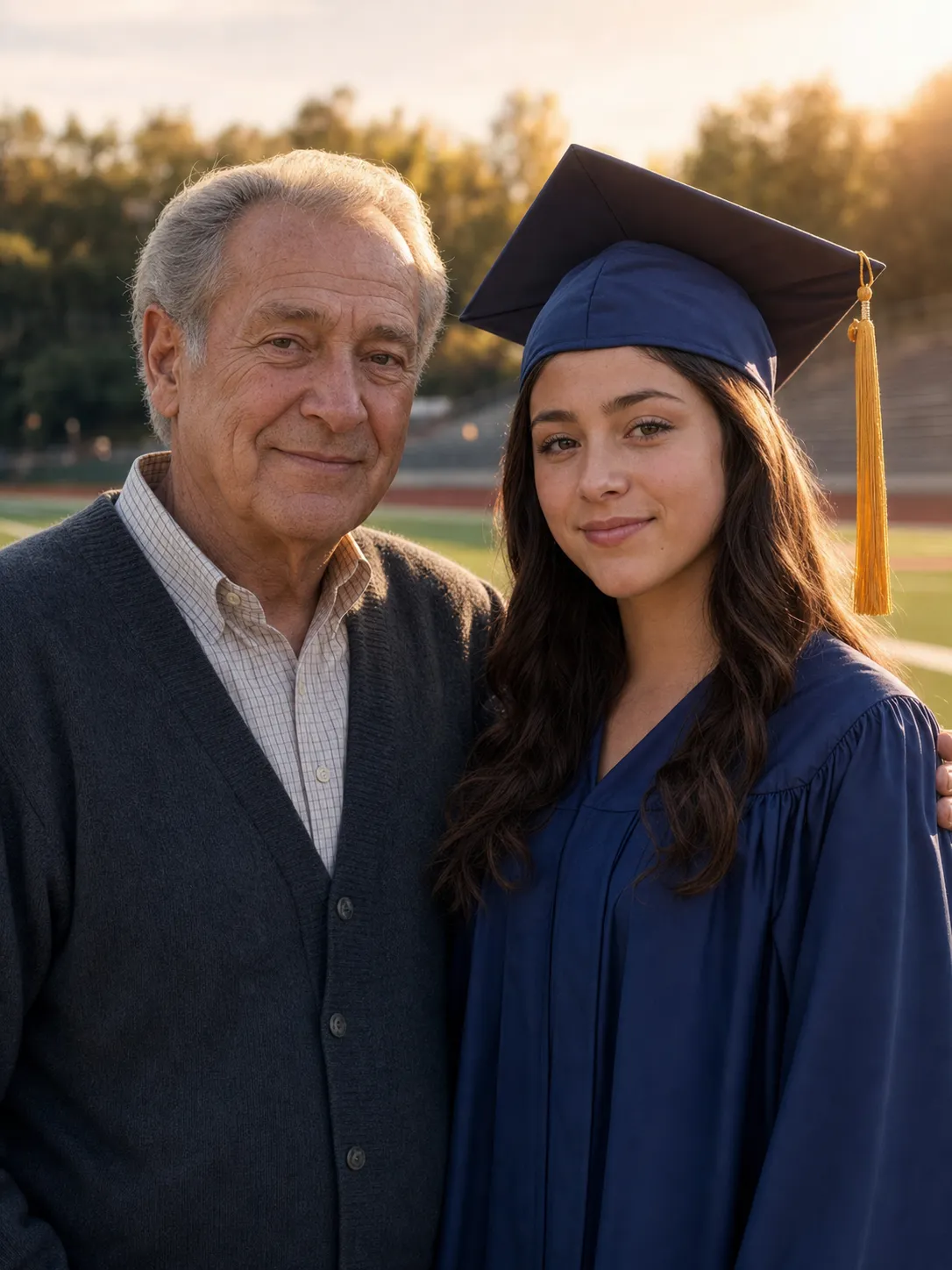
The reference photo of her grandfather was an old color print from 1989, slightly faded. The prompt holds him at the age he was in that print: late 60s, the gray at his temples, the small lines around his mouth. {ERA_CLOTHING} is the charcoal cardigan he wore in the print, over a pale checked button-down. The same identity-lock muscle from the photo-restoration prompt handles the upgrade from a faded print into a present-day light. He looks like himself.
A deployed parent in dress uniform, next to a college grad
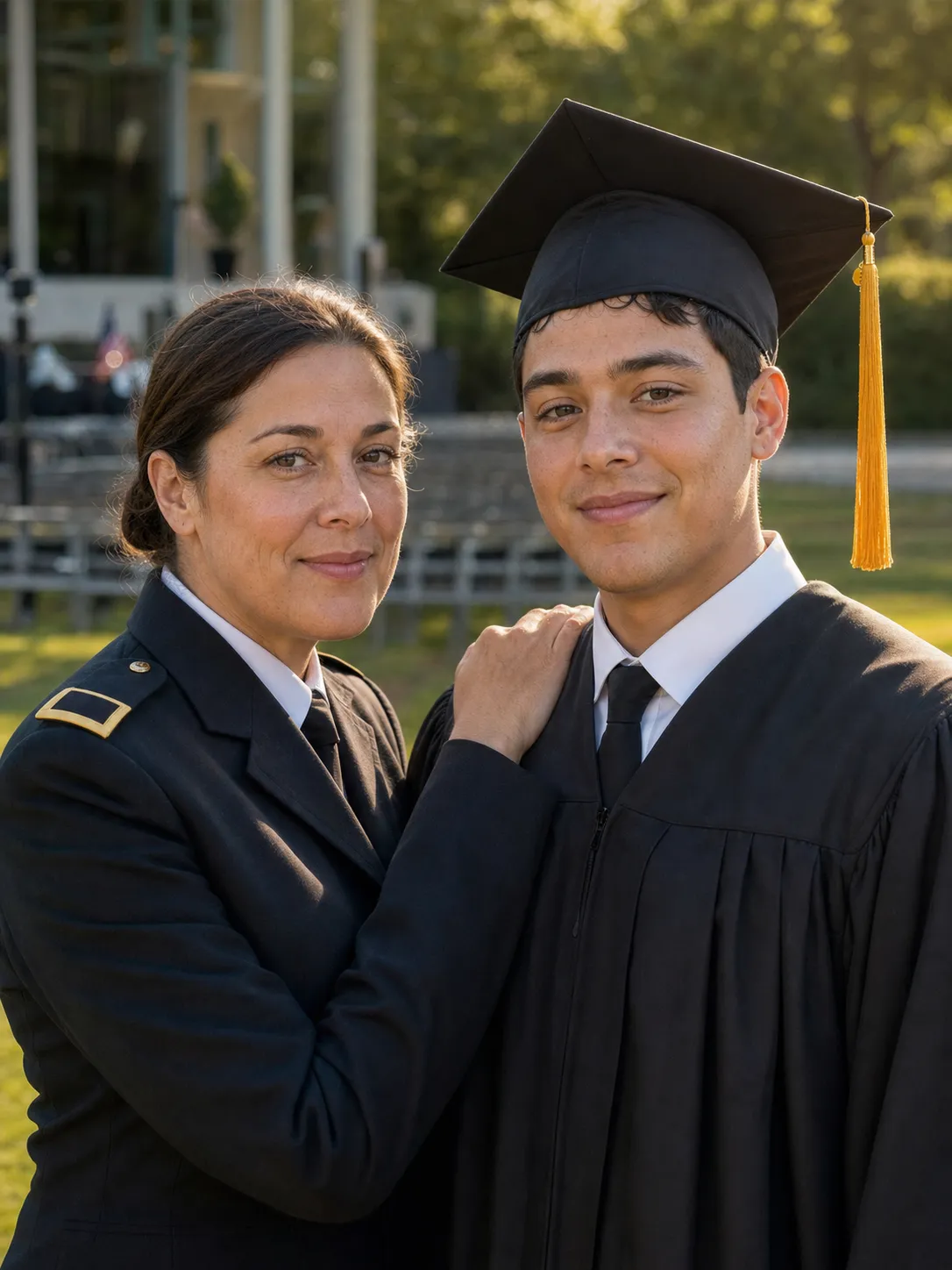
The clothing line names a clean generic dark dress uniform jacket with simple shoulder boards, no readable name tape, no medal arrangement, no service-branch wordmark. According to OpenAI’s usage policies, AI image generators refuse to render trademarked content, and that refusal extends to service-branch insignia for the same reason it extends to school crests. The workaround is not to try. A generic dress uniform reads as dignified and present without asking the AI to do something it will not do.
Divorced parents, both in one frame for the first time in fifteen years

Three uploads, not two: the graduate, the mother, the father. Both parents are alive, in modest current-decade outfits, and identity-locked to their own separate references so neither face drifts toward the other. The body-language line in the prompt keeps a small restrained spacing between each parent and the graduate, the kind of composition that doesn’t fake a closeness that isn’t there. The graduate is the anchor between them. The portrait says they were both present at her graduation, which is true. It does not say anything about what they are to each other.
A sibling who couldn’t fly in
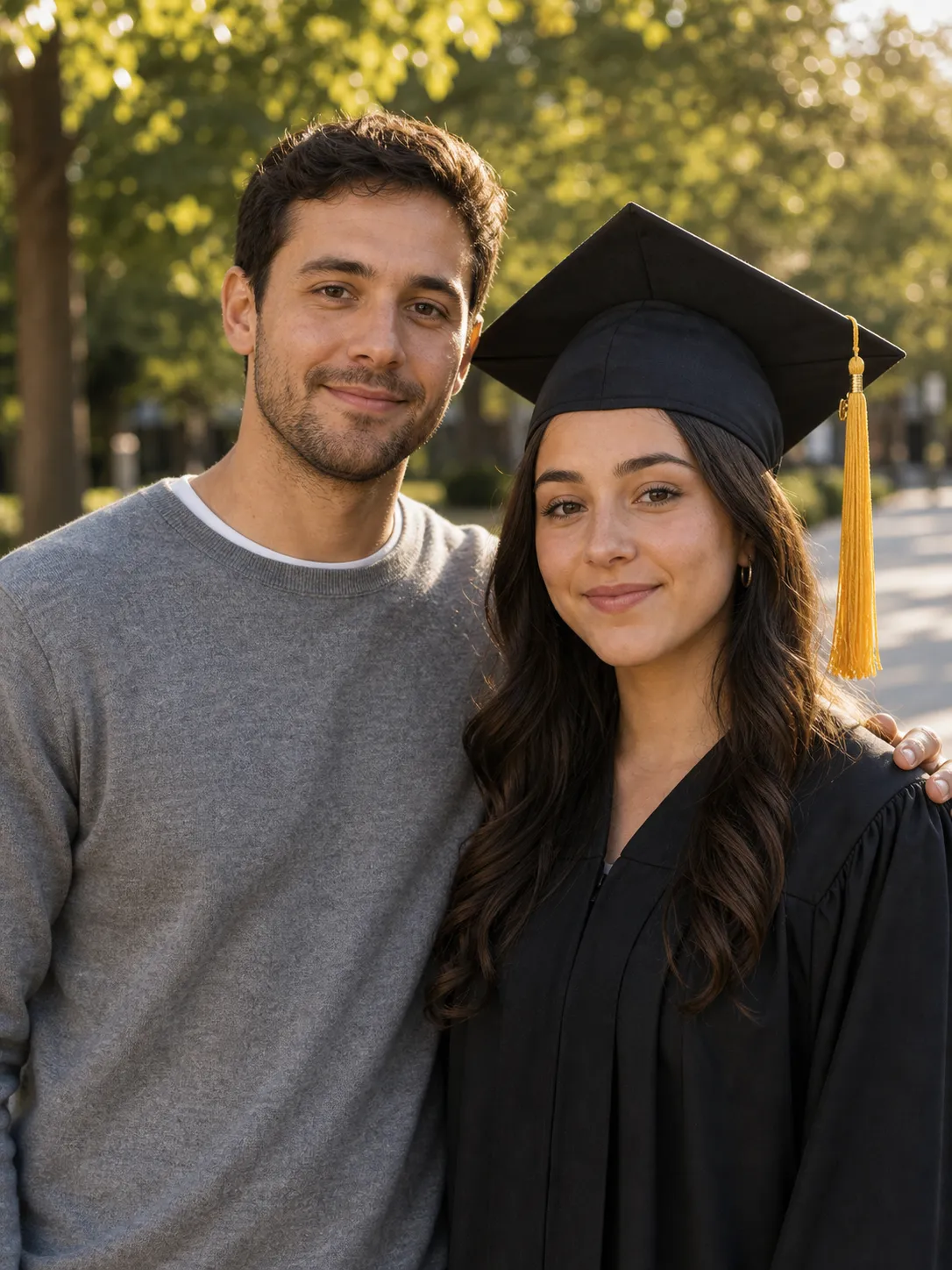
The sibling is alive. He is teaching a six-month posting on a different continent and the airfare was not the obstacle. The ceremony date was. The clothing line is current-decade casual because that is what he wears now, in his life now. The point of identity-lock here is the inverse of the deceased-grandfather case: the AI must not age him forward or polish him into a stranger. He looks like the way she will see him on a video call later that night, not a glossier version.
A grandmother who didn’t live to see this day
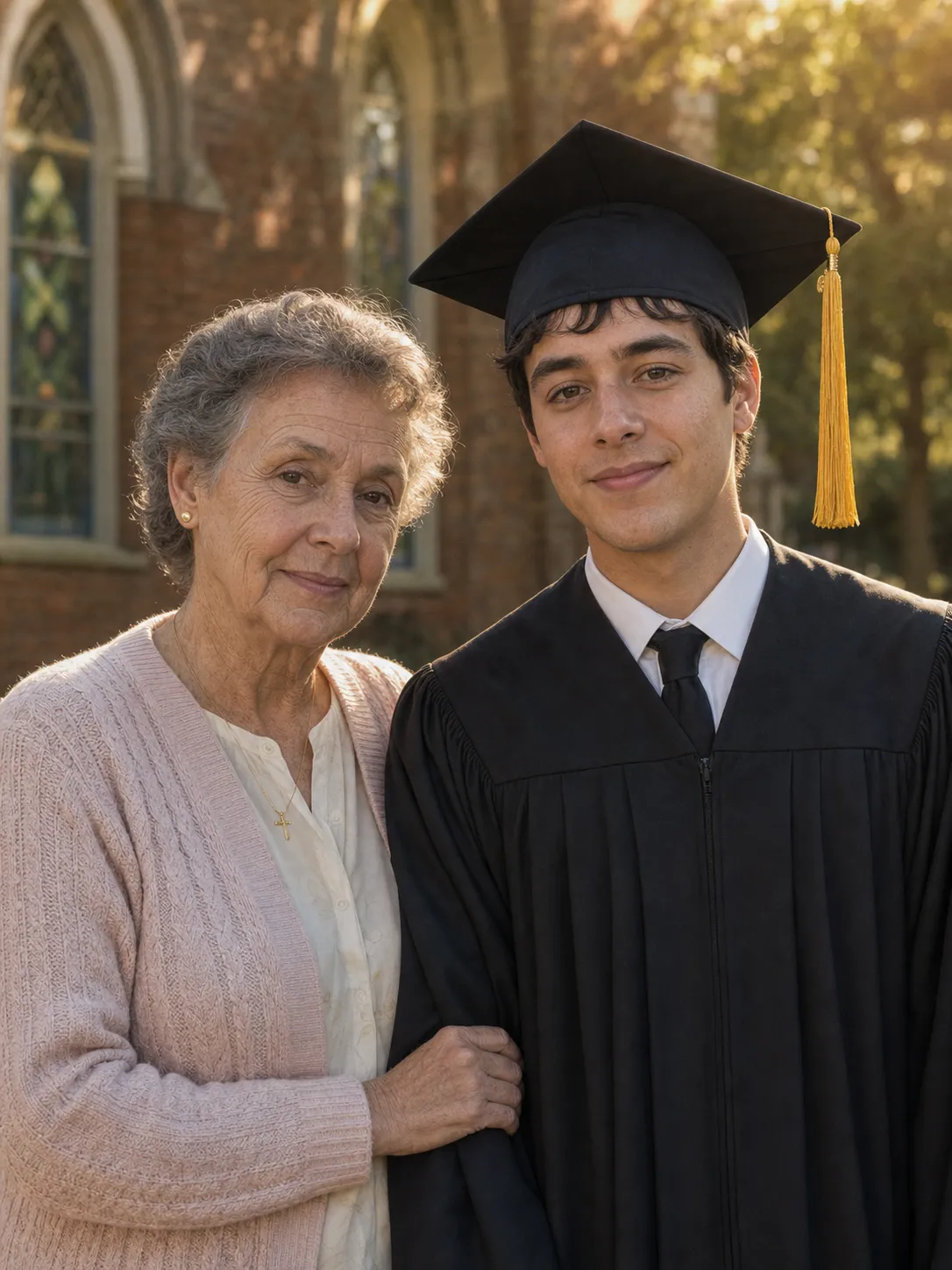
This one leans hardest on the respect rules. The reference photo is a small 4x6 print from 1994. The clothing line names the soft pink knit cardigan she actually owned. The prompt is explicit: do not de-age her, do not smooth her age lines, do not modernize her hair, do not idealize. She is already the right person. The job is to put her in the frame, not to improve her. The photograph that lands on the kitchen counter is the one that the family says her name in front of.
The respect rules
Three rules carry the whole article. Each one names a specific way the AI will, by default, try to make the photograph worse by trying to make it more.
Clothing era
Render the missing person in the clothes they actually wore. Not a modern translation. A grandfather who lived in cardigans wears the cardigan he owned. A deployed mother wears the dress uniform she actually wears, with no readable insignia rendered (per platform usage policies on trademarked content). A grandmother who died in 1998 wears the cardigan she died in, not a 2026 update of the same garment. The clothing locks the photograph to the era of the person, and the era of the person is what makes the face read as them.
Lighting match
Match the light on the missing person’s face to the warm afternoon light on the graduate’s face. The temperature and direction must match across both subjects. Otherwise the composite reads as two photographs cut and pasted together, and the reader’s eye catches the seam in less than a second. The way to test for it: when you cover one face with your thumb and look at the other, the skin temperature should match. If the missing person looks studio-lit and the graduate looks sun-lit, the photograph has not landed yet.
Do not “fix” the missing person
Same age as their reference. Same glasses if they wore glasses. Same hairline. Same age lines. Same any scars, any moles, any beard. The AI is allowed to put them in the frame. It is not allowed to improve them. The instinct to make a deceased parent look younger or healthier is the instinct that makes the photo feel like a stranger. The portrait lands because the missing person is unmistakably the person who is missing. The restraint is the whole point.
Print, frame, hand it over
Download the portrait at the largest size the tool offers, as PNG. Order a same-day 5x7 or 8x10 from Target same-day photo, Walgreens, or any same-day service nearby. The print is a few dollars. The frame is $12 to $18 at Target or Michaels. Total spend is under twenty dollars. Total wall-clock is under an hour, if you take your time choosing the frame.
Sit at the kitchen table with the framed print in your hands. Or take it to the ceremony in a tote bag and put it on the front-row seat next to you. Or set it on the kitchen counter on Sunday morning when the family comes over for brunch. The thing that lands is not “AI graduation gift.” It is a photograph on a kitchen counter that the family says the missing person’s name in front of.
The full prompt above is one of 125 in the Independent Brand Visual Kit and the broader pack, all built with the same identity-lock and respect-rule discipline.
FAQ
Q: How clear does the reference photo of the missing person have to be?
A: Clear enough to read the face. A phone snapshot of an old print works. A scan works. An old color photo from the 1980s works. A black-and-white studio portrait from the 1950s works. The prompt’s identity-lock instruction tells the model to anchor the rendered face to the reference, so the only requirement is that the face is visible and front-facing-enough. If the reference is faded or has a crease across the face, run the photo-restoration prompt first and use the restored image as the reference.
Q: What if the only photo of my dad is black-and-white?
A: Black-and-white is fine. The prompt instructs the model to render the final portrait in the same warm afternoon color as the graduate, but it locks identity to the face in the reference, not to its color. A 1962 black-and-white studio portrait gives the AI everything it needs to render him in color at the ceremony, in the clothes he wore. The face holds. The color of the final portrait is set by the lighting line, not by the source reference.
Q: My missing parent is alive but we’re estranged. Is this still respectful?
A: That is your call, not the prompt’s. The recipe handles the rendering. The question of whether to make this particular gift is a question to ask the graduate first. The prompt is most often used as a gift from the graduate to themselves, or from a sibling to a graduate, or from a parent or grandparent to a graduate. The case where someone outside the immediate family makes a portrait of an estranged living parent for the graduate is the case that needs the graduate’s consent first. The prompt does not solve that conversation.
Q: What about military dress uniforms with specific insignia or medals?
A: AI image generators refuse to render trademarked content, per OpenAI’s usage policies and the equivalent policies at Anthropic and Google. That refusal extends to service-branch wordmarks, readable name tapes, and specific medal arrangements. The prompt is written to ask for a clean generic dark dress uniform jacket with simple shoulder boards, no readable insignia. The result reads as dignified and military-appropriate without crossing a policy line. If you want a specific patch or medal that the model won’t render, that’s a hand-finishing job for a print shop or a small print sticker added after framing.
Q: How big can I print the portrait without it looking pixelated?
A: 5x7 and 8x10 print cleanly from most AI image tools. If you want 11x14, add a line to the prompt asking for print-ready resolution at 11x14 with authentic skin texture preserved. Most tools handle the upgrade without losing identity. For anything wall-poster size, the safer move is to send the rendered file to a print shop that can upscale with a dedicated tool. The face on the wall is what matters, not the megapixel count.
Key Takeaways
- The cohort is wider than you’d think. The 2026 high-school class includes more than 250,000 US children who lost a primary or secondary caregiver to COVID-19, per the CDC-led Pediatrics and JAMA Pediatrics research collaboration. Plus first-generation grads, military-kid grads, grads of divorce, grads whose grandparent didn’t live to see this day.
- Identity-lock works for two faces, not just one. Each face gets its own uploaded reference. The AI is told to hold each face to its own reference, separately, with no averaging between them.
- The respect rules are the article. Clothing period-correct to who they were. Lighting matched between both subjects. Do not “fix” the missing person. Skip any of those and the photograph reads as a stranger from the right era.
- The 2026 high-school grad cohort spans these wounds at unusual density. The article is written so the recipe stays usable for any graduation, any year, any family situation.
- Total cost lands near $19, including the prompt, a same-day print, and a frame from Target or Michaels. The thing on the kitchen counter is the point. The prompt is just the way you get there.
- Once everyone’s together for the real thing, family photo ideas and poses covers posing the whole group without the lineup look.
Pick the photo. Find the person.
The photo of him you keep meaning to do something with. The cardigan she actually wore. The dress uniform with no insignia. The brother on a different continent.
Hold the line on who they actually were. The portrait holds because you did.