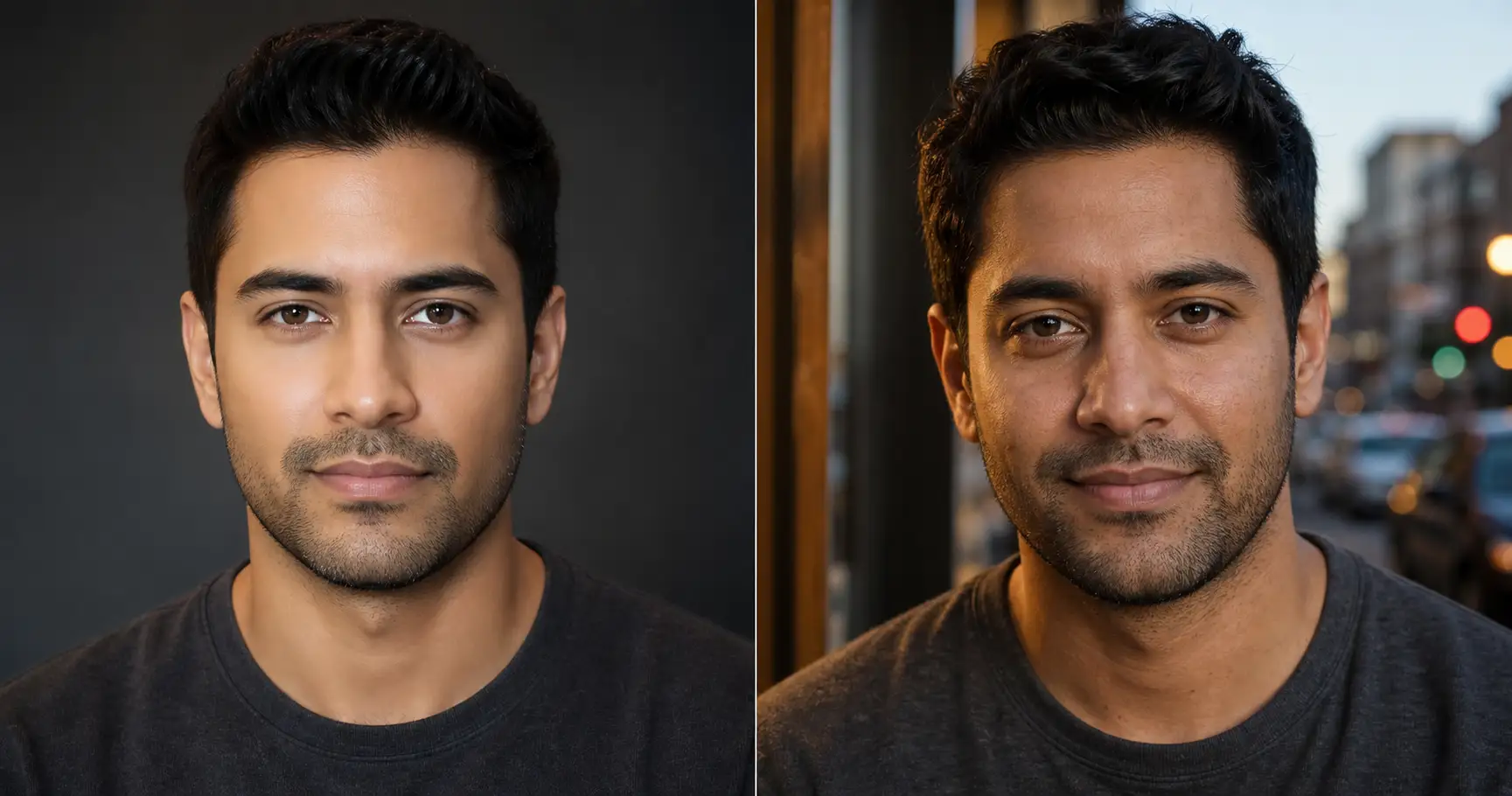
You can make a dating photo from one selfie now. The only thing stopping most people is a single fear: that it will look obviously fake, and that a match will feel catfished in person. The honest answer is that AI dating photos look fake in three specific ways, and all three are avoidable. Keep your real face and a believable setting, and the photo reads as you on a good day — which is exactly what the best dating profile photo examples have in common.
What changed in 2026
For years, the only way to get good photos of yourself was to point a camera at yourself. That stopped being true this year.
The shift is identity preservation. The newest image tools can take one clear selfie, hold onto your actual face, and rebuild everything else around it: the outfit, the room, the light, the angle. You are no longer generating a stranger who looks a bit like you. You are keeping you and changing the day.
This is also why the photos got convincing enough to worry about. In 2022, a study in the Proceedings of the National Academy of Sciences by Sophie Nightingale and Hany Farid found that people could not reliably tell AI-generated faces from real ones, and rated the synthetic faces as slightly more trustworthy than the real ones. That was three years and several model generations ago.
So the realism is real. The problem is that it has three predictable failure points, and “fake” is what we call a photo that fell into one of them.
The three ways an AI dating photo looks fake
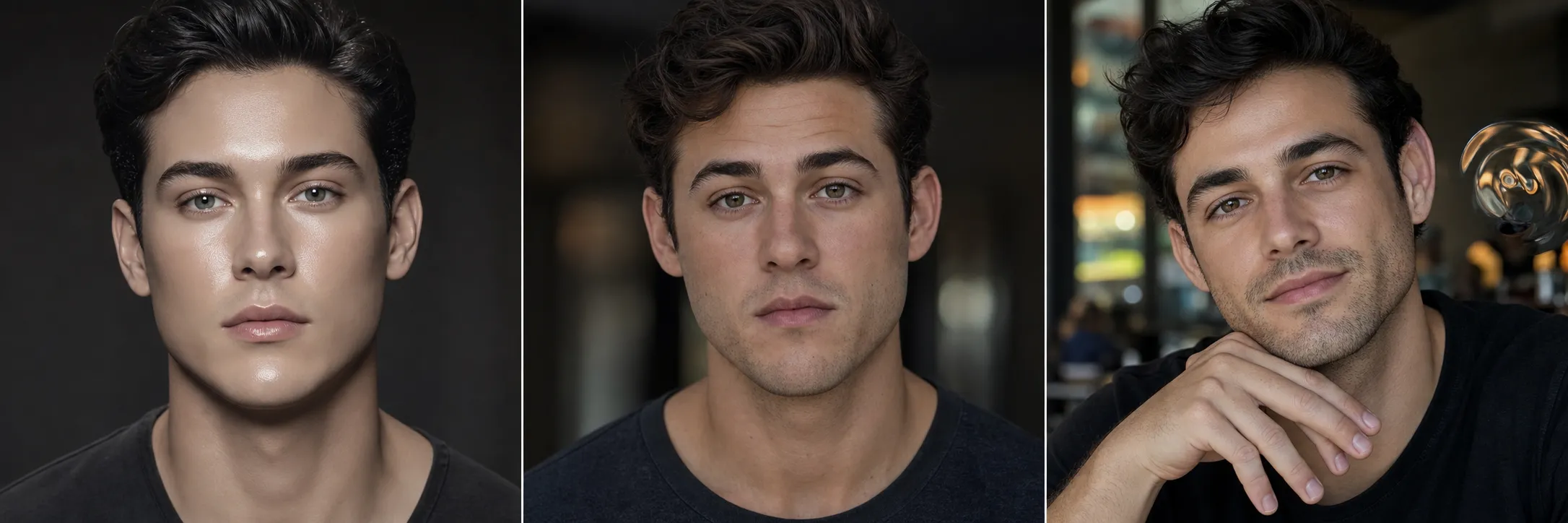
Almost every AI dating photo that gets caught is caught for one of three reasons. Learn them once and you can spot them in your own output before anyone else does.
Tell #1: plastic skin and dead eyes
The most common giveaway is skin that looks poured rather than grown. Pores vanish. The forehead turns to wax. Highlights sit in even, glassy patches, and the eyes go flat, like a mannequin that was told to smile. Real skin has texture, uneven light, and a little mess. When an image sands all of that away, the brain reads “doll” before it reads “fake,” but it reads it. This is the failure covered step by step in why AI images look fake, and the specific fix lives in how to get rid of the AI plastic-skin look.
Tell #2: identity drift
The second tell is the dangerous one, because you stop noticing it. The model keeps a face that is almost yours: the jaw widens a little, the nose narrows, the eyes move a millimeter apart. Each change is small. Together they make a sibling, not you. A stranger swiping will not care. The person you meet for a drink will, because they are holding your photo up against your actual face. Drift is the difference between a flattering photo and a bait-and-switch, and avoiding it is the whole point of an identity-lock prompt.
Tell #3: the impossible detail
The third tell is physics. A sixth finger. An ear that melts into the hair. A watch with no dial. A background sign that spells nothing. These are the artifacts people screenshot and laugh at, and they almost always hide at the edges of the frame, away from the face you were checking. One impossible detail sinks an otherwise good photo.
All three are avoidable, which means the real question was never “do they look fake.” It is “did you let one of the three through.”
The two-second test for your own photo
Before a photo goes on your profile, run it through a check that takes about as long as a swipe.
The two-second test
Zoom all the way in and check four things. Any miss = don't post it.
- 1 Skin. Real pores and a little texture, or smooth waxy plastic?
- 2 Teeth & eyes. Believable teeth and real catchlights, or a dead glassy stare?
- 3 Hands & ears. Right number of fingers and normal ear shape, or anything melted or extra?
- 4 Background text. Any signs or labels read as real words, or AI gibberish?
The recognition test
Would your closest friend recognize you instantly? If they'd pause, it has drifted too far.
The one-person gut check
Show it to one person who knows you and watch their first reaction, before strangers do.
The mechanical half is a zoom. Pull the image up to full size and look at four places the tells hide: the skin (pores or plastic?), the eyes and teeth (real catchlights, or dead glass?), the hands and ears (right count, right shape?), and any text in the background (real words, or melted nonsense?). Most fakes survive a thumbnail and fail a zoom. The whole game is to do the zoom yourself first.
The human half is recognition. Show the photo to one person who actually knows your face, and watch their first reaction, not their words. If they pause, the photo drifted. Then run the question you cannot fake your way past: would your closest friend pick this out of a lineup as obviously you, in under a second? If yes, it is a good photo of you. If they hesitate, it is a good photo of someone.
If your current photo fails the zoom, the fix is not more editing — it is rendering one that passes from the start. AI dating photos lock to your real face and ship real skin texture and live catchlights by default, the two tells the zoom checks first.
This is also where it helps to know the apps are watching too. In 2024 Tinder rolled out an AI Photo Selector that digs through your camera roll to pick your strongest real photos, a quiet signal that the platforms still want the person in the picture to be you.
One paste-ready AI move a week, the kind you can use on a Tuesday or a Sunday, plus our free Independent Brand Visual Kit the moment you join. Subscribe to the newsletter.
Is using an AI dating photo basically catfishing?
This is the fear under the fear, so it deserves a straight answer. Using AI on a dating photo is not catfishing. Using it to change who you are is.
- +Better lighting than your kitchen ceiling bulb
- +A nicer setting: a café, a street at dusk, the outdoors
- +A sharp, clean outfit you'd actually wear
- +A flattering but real angle: you on a good day
- ×Reshaping your jawline, weight, or age
- ×A face that isn't yours, drifted into a stranger
- ×A body that isn't yours
- ×Anything your date wouldn't recognize across the bar
The dividing principle: keep your real identity. Change the lighting, not the person.
Here is the line. Better light, a nicer room, a sharp outfit, a flattering angle: that is the same thing a good photographer charges two hundred dollars for, and nobody calls a studio headshot a lie. A new jaw, a thinner body, a younger face, a different person’s bone structure: that is the lie. The first set changes the day. The second set changes the you. One earns a second date. The other guarantees the first one ends early.
The platforms draw the line in the same place. Bumble shipped a Deception Detector in 2024 to flag fake and scam profiles, and both Bumble’s and Tinder’s guidelines treat impersonation and identity deception as violations while leaving ordinary photo enhancement alone. Industry standards like the C2PA content-credentials spec and the platforms’ own “AI-generated” labels exist for the same reason: the worry was never editing, it was deception.
Call it the recognition test. If the door opens and your date sees you and the photo at the same time, both should feel true. Pass that, and you did not catfish anyone. You just took a better photo.
FAQ
Q: Do AI dating photos look fake?
A: They can, but only in three predictable ways: plastic, over-smooth skin with dead eyes; a face that has drifted so it is almost-but-not-quite yours; and an impossible detail like a wrong-count finger or a garbled background. Avoid those three and an AI dating photo reads as you on a good day, not as a fake.
Q: Can people on Hinge or Tinder tell a photo is AI?
A: Most people cannot tell at thumbnail size. A 2022 study in the Proceedings of the National Academy of Sciences found people could not reliably separate AI-generated faces from real ones. The tells only show up when someone zooms in on the skin, hands, teeth, and background, which is exactly the self-check you should run before you post.
Q: Is using an AI dating photo catfishing?
A: It depends on one thing: identity. Better lighting, a nicer setting, and a flattering angle are the same thing a good photographer sells, and that is not deception. Changing your jawline, your weight, your age, or your actual face is. If your date would recognize you across the bar and feel the photo was honest, you are fine.
Q: Do dating apps allow AI-generated photos?
A: The apps allow photo enhancement but draw the line at misrepresenting who you are. Tinder and Bumble have both built AI features of their own (Tinder to help select your real photos, Bumble to flag fake and scam profiles), and their guidelines treat impersonation and identity deception as violations. Keep your real face and you stay on the right side of the line.
Key Takeaways
- AI dating photos look fake in three predictable ways: plastic skin, identity drift, and an impossible detail. All three are avoidable.
- The realism is genuine. Research has found people cannot reliably tell AI faces from real ones at a glance, so the tells only matter on a zoom.
- Run the two-second test before posting: zoom the skin, eyes, hands, and background, then confirm a friend would recognize you instantly.
- The line between enhancement and catfishing is identity. Change the day, never the face.
- Pass the recognition test (your date sees you and the photo and both feel true) and an AI dating photo is honest, not a fake.
So, post it or not?
Go back to the photo you actually liked, the one your finger was hovering over. Zoom it. Check the skin, the eyes, the hands, the edges. Then ask whether your closest friend would call it obviously you. If it clears the zoom and clears the recognition test, the fear was never the AI. It was identity drift, and you just caught it before a stranger did.
A dating photo that still looks like you is the entire point: if you want the easiest way to get there from a single selfie, Dream Photo Studio makes dating photos from one photo while keeping your real face, and the same identity-locked prompts ship inside our $19 Image Prompt Pack if you would rather paste them yourself.