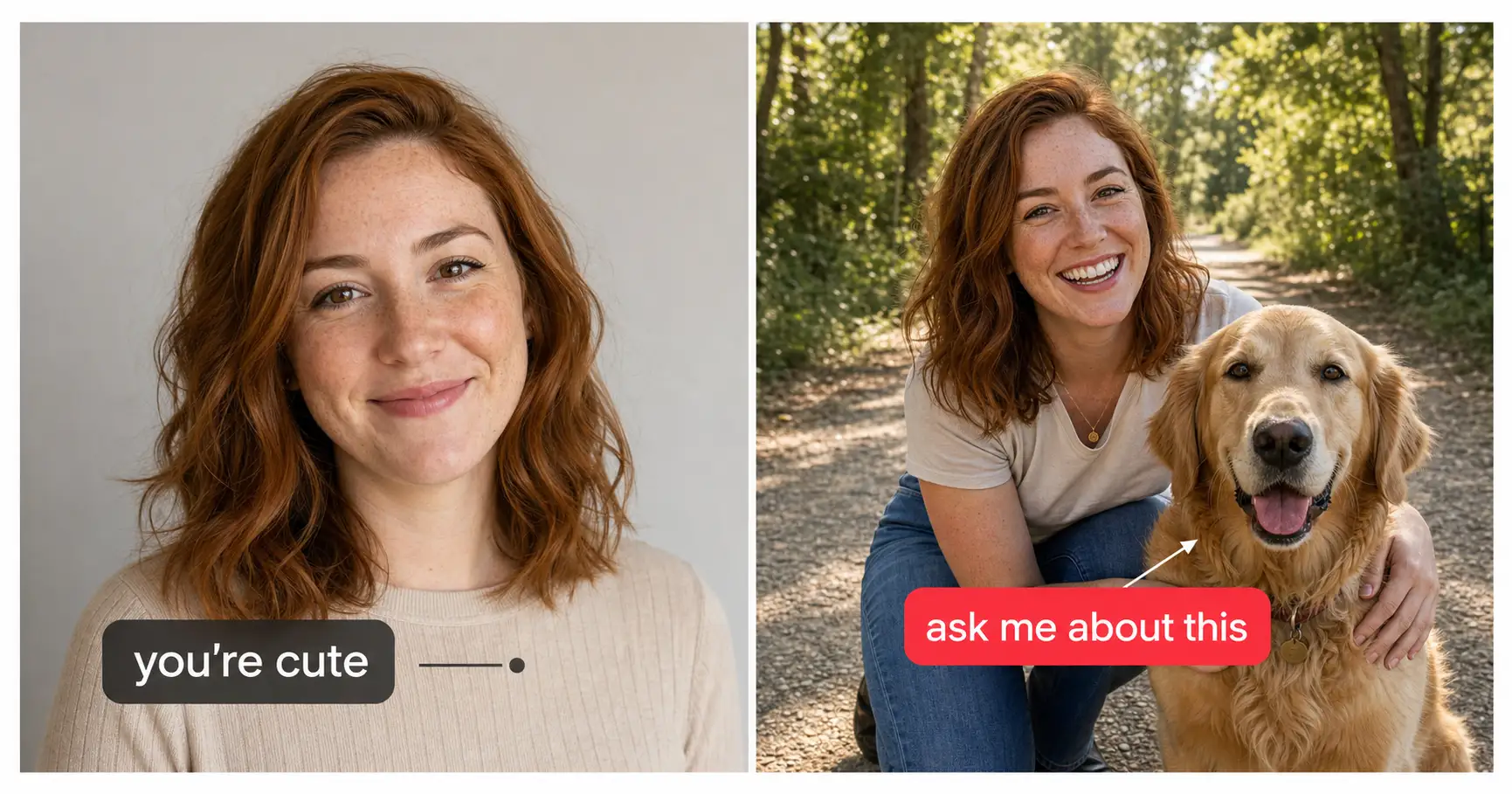
A match lands on Bumble on a Tuesday. Both people swiped right. Then the little timer runs, twenty-four hours, and the match expires with nothing said. Not because the photos were unattractive. Because the lead photo gave neither person a single thing to open with. A face can be the most attractive one in the deck and still leave the other person staring at an empty message box.
What should the first photo on Bumble be? The best first photo on Bumble is a clear, recent, solo portrait where you are smiling, your eyes and full face are visible, no sunglasses or hats, and there is one concrete thing in the frame a match could message you about: a dog, an instrument, a place, a visible hobby. The face wins the match. The hook wins the message. On Bumble you need both in the same photo, and most leads carry only the first.
Why your matches go quiet on Bumble
For ten years Bumble ran on one rule: in a straight match, the woman messages first. In 2024 that changed. Bumble launched Opening Moves, where a member sets a prompt the other person can answer, or still sends the first message if they want to. As NPR reported at the launch, the change was meant to lift the pressure of always having to think of the opener.
It did not remove the opener. It just moved the burden onto the profile. The conversation now gets seeded by a prompt plus whatever your photos hand the other person to react to. If your lead is a clean, attractive headshot against a blank wall, you have given a prompt and a pretty face and nothing to point at. The match sits there. The timer runs.
Bumble even built a feature around the lead carrying the weight: its Best Photo tool quietly tests your first three photos against incoming swipes and promotes the winner to the front. The catch is it can only pick the best of what you give it. It surfaces a stronger lead. It cannot add a reason to message you.
So the lead’s first job on Bumble is not to be your most flattering photo. It is to be your most referenceable one.
The Opener Test
The rule that turns a match into a message has one job, and you can run it on any photo in under a second.
The Opener Test. Look at the photo and ask the only question the other person is about to ask: what would I message this person about? If the honest answer is nothing beyond “you’re cute,” the photo is a dead end. If the answer is a real line, “is that your dog,” “where is that trail,” “wait, do you make pottery,” the photo is doing its job. A like is the match. A line is the conversation. The lead photo exists to hand someone the line.
Bumble says it almost this plainly. Its guide to the best first photo tells you to show your eyes, your smile, and your whole face with no sunglasses or filters, and then to give a match something to reference: a photo tied to an interest, a pet, or a place is an easy in. The litmus test it points at is the one above. If all someone can say is that you look nice, the photo has not earned a reply.
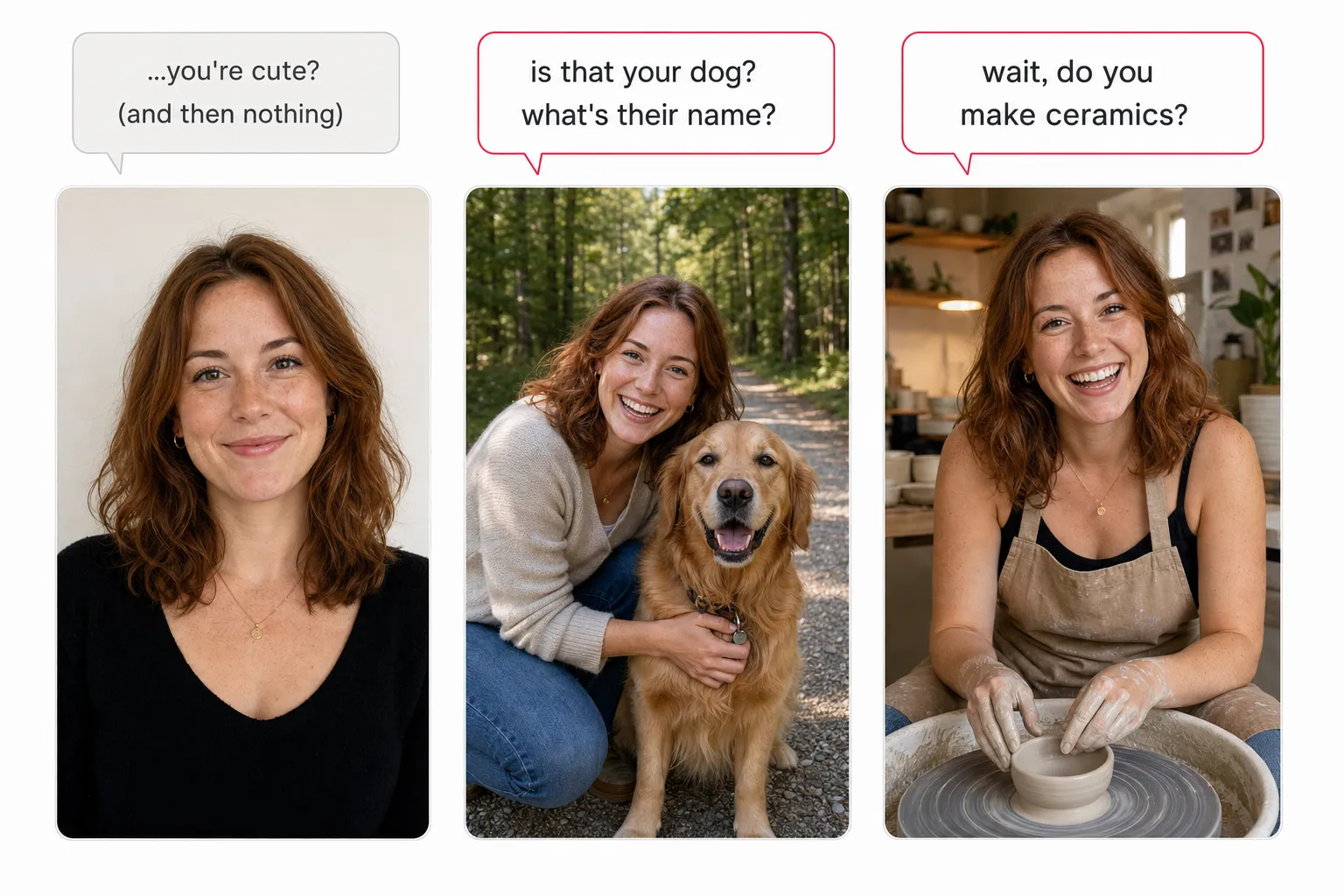
The Opener Test is the whole game on Bumble. Pass it in the lead and a match has a reason to type.
Shoot portrait, and put the hook in the frame
Knowing the test is one thing. Building a lead that passes it is the other, and Bumble gives you more room to do it than the other apps.
Bumble is a portrait app. Dating-profile photographer Eddie Hernandez, who publishes the platform photo specs for a living, notes that Bumble uploads are portrait-oriented, taller than wide — more elongated than Hinge’s lead frame, and unlike Tinder’s tight square crop. That vertical frame is an asset: it has room for a clear face and a piece of context in the same shot, which is exactly what the Opener Test wants.
Get the face right first, because the swipe still comes before the message. Princeton psychologists Janine Willis and Alexander Todorov found, in a 2006 study published in Psychological Science, that a 100-millisecond glimpse of a face, a tenth of a second, is enough to form a lasting impression, and that trustworthiness is read the fastest of all. Photofeeler’s peer-rated testing found the lead with eye contact and a real smile beats the same person in sunglasses or a group — and that eye contact with no smile is the one lead that actively backfires. OkCupid’s 2010 “4 Big Myths of Profile Pictures” argued the contrarian opposite, but a larger dataset did not hold it up. So: solo, smiling, eyes visible, no sunglasses, real light.
Then add the one thing the other apps’ lead-photo advice forgets. Put a single concrete hook in the frame. Not a busy collage, one clean detail: the dog at your side, the guitar in your lap, the trailhead sign behind you, the bike you actually ride. The face earns the swipe. The hook earns the sentence that lands in your inbox.
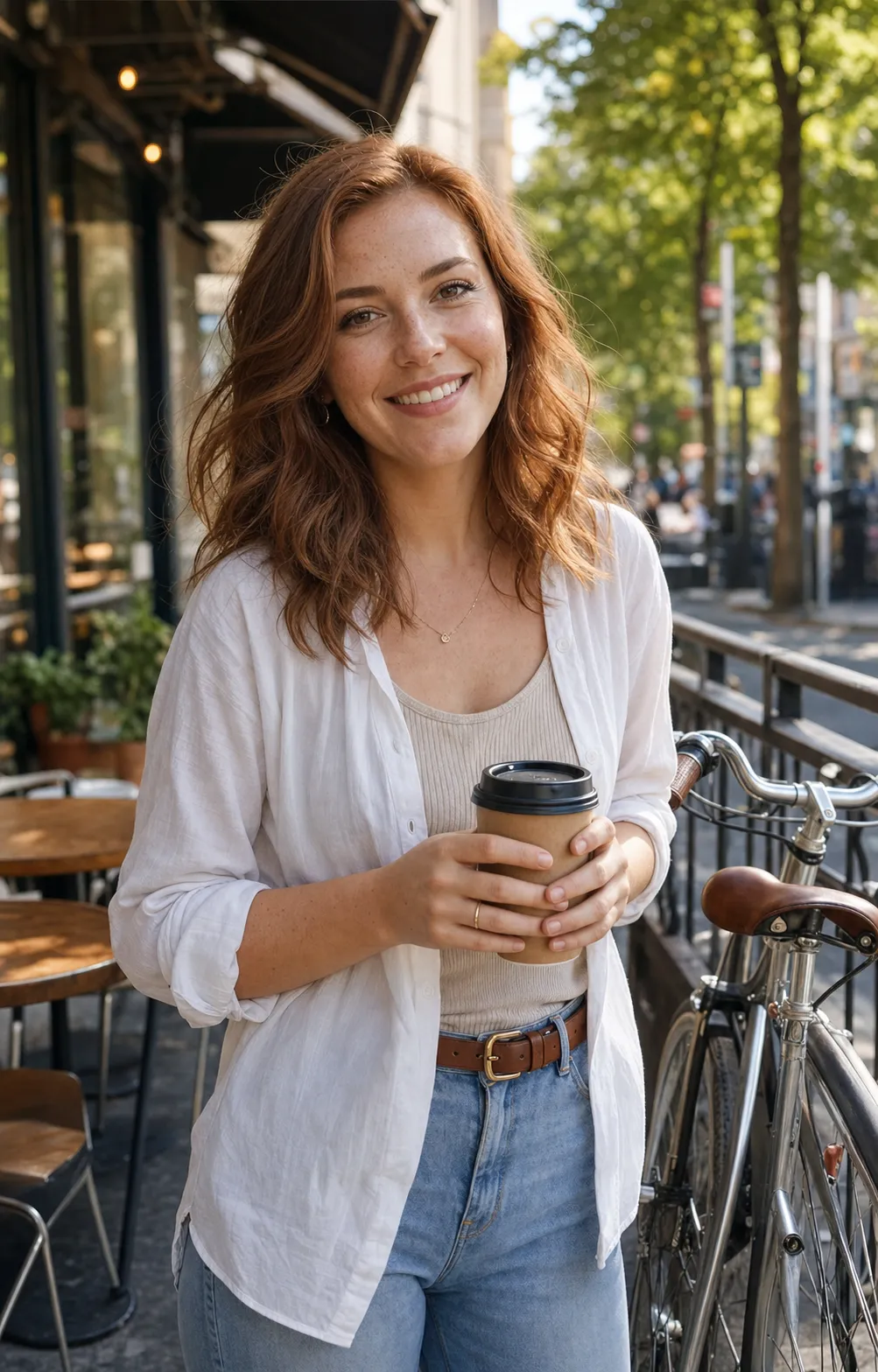
Warmth wins the match. The hook wins the message. On Bumble the lead has to do both.
Same face, dead end or hook
The fail and the fix are the same person and the same week. Only the frame around the face changes.
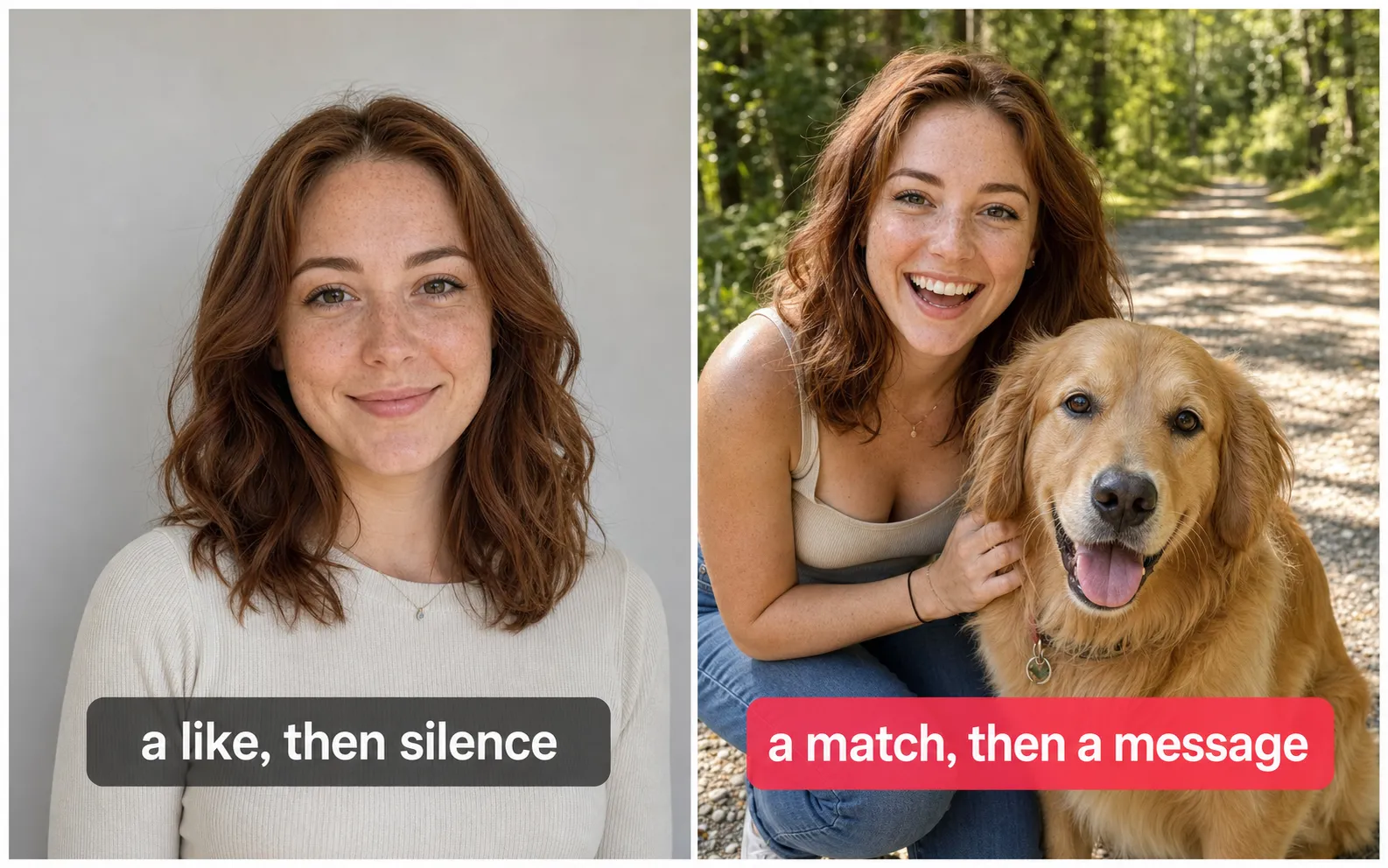
The left photo is what most quiet Bumble profiles lead with: a nice, clean, hookless headshot. It wins the swipe and then strands the match, because neither person has anything to point at. The right photo gives them the dog.
Two paths get you the photo on the right tonight. Path one is the one you already have. Open your camera roll and find the shot where your face is clear and warm and there is one real thing in the frame: the pet, the hobby, the place you actually go. Crop it to portrait. That is your lead. Path two is the one most quiet profiles do not have a camera roll for yet: render it. If pasting a prompt is not your thing, Dream Photo Studio builds a portrait lead from one selfie, with the face kept and the scene handled, nothing to paste. The version below is the same job as a prompt, with the Opener Test built into the rules.
Show the full promptTap to expand
Paste this into your AI (ChatGPT, Gemini, or any AI image tool).
REQUIRED upload before pasting: one clear, well-lit, front-facing photo of your face.
The realism rules in the prompt are what keep the result from looking obviously AI.
Generate this image:
A single photoreal portrait-orientation dating-profile lead photo of the person in the uploaded reference image, built to pass the Opener Test: a clear warm face plus one concrete, referenceable hook in the frame. Match their bone structure, eyes, nose, lips, proportions, and skin tone exactly so the subject is unmistakably the same person. The face is clearly visible with a real warm smile and direct eye contact, no sunglasses, no hat, in soft natural daylight. Beside or behind the subject is one clean hook that gives a viewer something to ask about, such as a friendly dog, an acoustic guitar, a bicycle at an outdoor cafe, or a recognizable trail or coastline. The hook is present but does not crowd the face. Solo subject, real candid feel, not a studio headshot.
Rules the AI must follow:
- Aspect ratio 4:5 vertical portrait, locked, because Bumble is a portrait app.
- The face is clearly readable and warm: real smile, eye contact, no sunglasses, no hat, no heavy filter.
- Exactly one referenceable hook in the frame, clearly visible but secondary to the face. Never a cluttered or busy background.
- Identity preservation is the highest-priority constraint: match the uploaded reference photo’s bone structure, eyes, nose, lips, proportions, and skin tone exactly.
- Realistic skin texture: visible pores, fine micro-asymmetry, natural unevenness, faint flyaways. No porcelain smoothing, no waxy AI-plastic surface, no beauty filter.
- Solo subject only: no second person, no group.
- No text, captions, watermarks, logos, or app UI anywhere in the frame.
- Output one portrait image only. No grid, no variant sheet, no before/after split.
Replace these placeholders with your details:
{HOOK}= a friendly dog at your side, OR an acoustic guitar, OR a bicycle at an outdoor cafe, OR a recognizable trail or coastline behind you{LIGHT_AND_PLACE}= soft window light at home, OR open shade outdoors, OR golden-hour daylight on a quiet street
One paste-ready AI move a week, plus the Independent Brand Visual Kit the moment you join: twelve copy-ready prompts for the photo jobs most readers paste next, from this dating lead to a LinkedIn headshot. Subscribe to the newsletter.
One more Bumble-specific move: once your lead carries a hook, set an Opening Move prompt that points at it. The photo gives the line, the prompt invites it, and the match has two doors into the same conversation instead of none. The same hook logic runs across the rest of your pack, the way the five-photo dating pack lays it out slot by slot.
FAQ
Q: What is the best first photo for Bumble?
A: A clear, recent, solo portrait where you are smiling, your eyes and full face are visible, and there are no sunglasses, hats, or heavy filters, with one concrete thing in the frame someone could message you about: a dog, a visible hobby, a place. Bumble’s own guidance is that your first photo is your first impression, and that a photo someone can only call “you’re cute” is not doing enough. Lead with a face that reads warm and a detail that hands a match an opener.
Q: Do you still have to message first on Bumble?
A: No. In 2024 Bumble replaced its long-standing “women message first” rule with Opening Moves. A member can set a prompt that the other person replies to, or still send the first message themselves. Either way, the conversation gets seeded by a prompt plus what your photos give the other person to react to, which is exactly why a referenceable lead photo matters more on Bumble than the rule change made it look.
Q: What makes a good Bumble photo?
A: Two things at once. It reads warm and trustworthy in the half-second glance that decides the swipe, and it gives the viewer something concrete to say. Bumble recommends a clear solo shot, real smile, eyes and face visible, good natural light, no sunglasses or busy background. Then add the hook: a photo tied to an interest, a pet, or a place gives a match an easy first line, which is what turns the match into a message.
Q: Should your first Bumble photo be a full body or a headshot?
A: Lead with a photo where your face is clearly identifiable and that also shows a hint of context. Bumble is a portrait-orientation app, so the lead has room for a face plus a setting in one shot. A pure tight headshot reads as attractive but gives nothing to reference. A full-body-only shot can lose the face. The middle ground wins: a portrait where the face is clear and one referenceable detail is visible.
Q: Are AI photos allowed on Bumble?
A: An AI photo of your own face is fine. Bumble’s guidelines forbid misrepresentation, the catfishing line being photos of someone who is not you or edited to change how you look. An identity-locked render of your real face, in clothes you wear, in a scene that matches your life, does not cross that line. Keep the face yours and the hook real, and the render is just a better-lit version of a true photo.
Key Takeaways
- Bumble dropped “women message first” for Opening Moves in 2024, so the conversation is seeded by a prompt plus what your photos give someone to react to. The lead photo carries more of the open than it used to, not less.
- The Opener Test is the fix: every photo, the lead most of all, has to answer “what would someone message me about this?” A photo that only earns “you’re cute” is a dead end.
- Get the face right first, because the swipe is decided in about a tenth of a second, the window Princeton’s Willis and Todorov measured. Solo, smiling, eyes visible, no sunglasses.
- Then add one concrete hook in the portrait frame: a dog, a trail, an instrument, a visible hobby. The face wins the match. The hook wins the message.
The lead photo on your profile right now
Open Bumble and look at your lead the way a stranger will. Past “they look nice,” what could anyone actually say about it? If the honest answer is nothing, that is why the matches go quiet. A like is the match. A line is the conversation. The lead photo’s only job on Bumble is to hand someone the line.
The Bumble hook-lead prompt, and the rest of the five-photo dating pack it sits inside, lives in the $19 Image Prompt Pack, one of 125 prompts for the photo jobs that come up across a normal year. Or skip the prompt entirely: Dream Photo Studio renders a portrait lead with the face kept and the hook in frame, from a single selfie, nothing to paste.