A swiper opens Hinge on a Wednesday lunch break. The thumb is already moving. The lead photo of the next profile loads, the eye-line lands or it doesn’t, and the verdict is in under a second. Six other photos sit underneath that lead. A meaningful fraction of swipers never see any of them. One photo decides. The rule that decides it has three parts, and most profiles break all three at once.
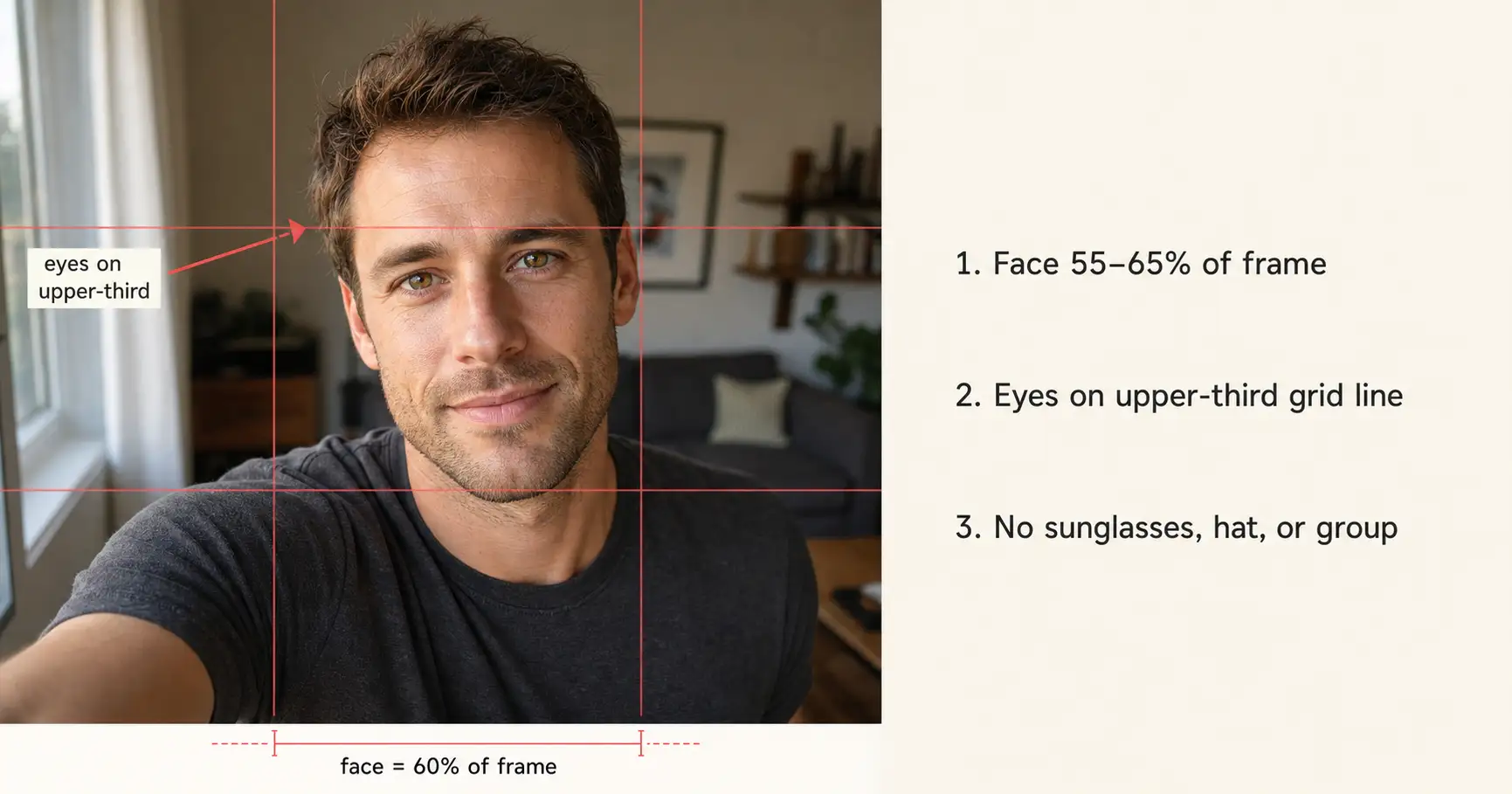
What should the first photo on Hinge be? The best first photo on Hinge — your first picture, the lead — is a solo, eye-level selfie in soft natural light where your face fills 55 to 65 percent of the vertical frame, your eyes land on the upper-third grid line, and there is no sunglasses, no hat, and no group. That is the whole rule. Everything below is why each part matters and how to shoot it tonight.
The lead photo is the only photo a swiper actually sees
The lead photo is the photo a fast-scrolling swiper sees before they decide to flip or skip. On Hinge it is also the photo a meaningful fraction of swipers see at all. Hinge’s published guidance on profile photos names a confident smile in the lead photo, eye contact, and a true full-body shot somewhere in the pack as three of the strongest signals it weights. The lead photo is where the eye contact and warm smile have to live. Slot 2 is where they get to support.
Photofeeler, the photo-testing platform whose research blog at blog.photofeeler.com has run more than ten million peer-rated photo tests, has reported the same pattern across years of data. Photo variety and technical photo quality consistently out-perform raw facial attractiveness in blind A/B tests of which profile gets more right-swipes. Variety is what the rest of the pack delivers. Technical quality is what the lead photo has to deliver alone.
OkCupid’s 2010 data post, “The 4 Big Myths of Profile Pictures”, set the original benchmark from a catalog of 7,140 photos — and famously argued the contrarian case that men drew more contacts looking away from the camera and not smiling. Photofeeler later re-ran that analysis on a far larger dataset and found the claim did not hold: whether you smile makes no statistically significant difference on its own, and the one genuinely harmful lead is eye contact with no smile. The two studies disagree on almost everything except the part that matters here — the lead photo carries the decision, and the swiper still makes it in under a second.
One photo decides. Everything else in the profile is downstream of that decision.
The lead-photo 3-rule stack
The rule that decides the lead-photo verdict has three parts. They are written below as one passage because that is how they apply: all three at once, in the same photo, in the same composition decision.
The lead-photo 3-rule stack. Your face occupies 55 to 65 percent of the vertical frame, framed mid-chest up. Your eyes land on the upper-third grid line of the photo, not the dead center, so a swiper’s gaze lands where yours already is. The lead slot carries no sunglasses, no hat, and no group: sunglasses kill the eye contact a strong lead is built on, hats break the face read at the silhouette, and group photos turn a single-subject test into ambiguity the swiper resolves by skipping. All three rules apply together. The lead photo that passes all three at once is the lead photo that lands.
That is the named primitive. The rest of the section unpacks one rule at a time.
Rule 1: face occupies 55 to 65 percent of the vertical frame
Closer than 65 percent and the photo reads as a confrontational close-up; the swiper’s gut response is “too much.” Wider than 55 percent and the face stops being the subject of the photo; the swiper’s eye drifts to the wall behind you, the cabinet edge, the kitchen counter. The 55-to-65 band is where the face IS the photo without crowding.


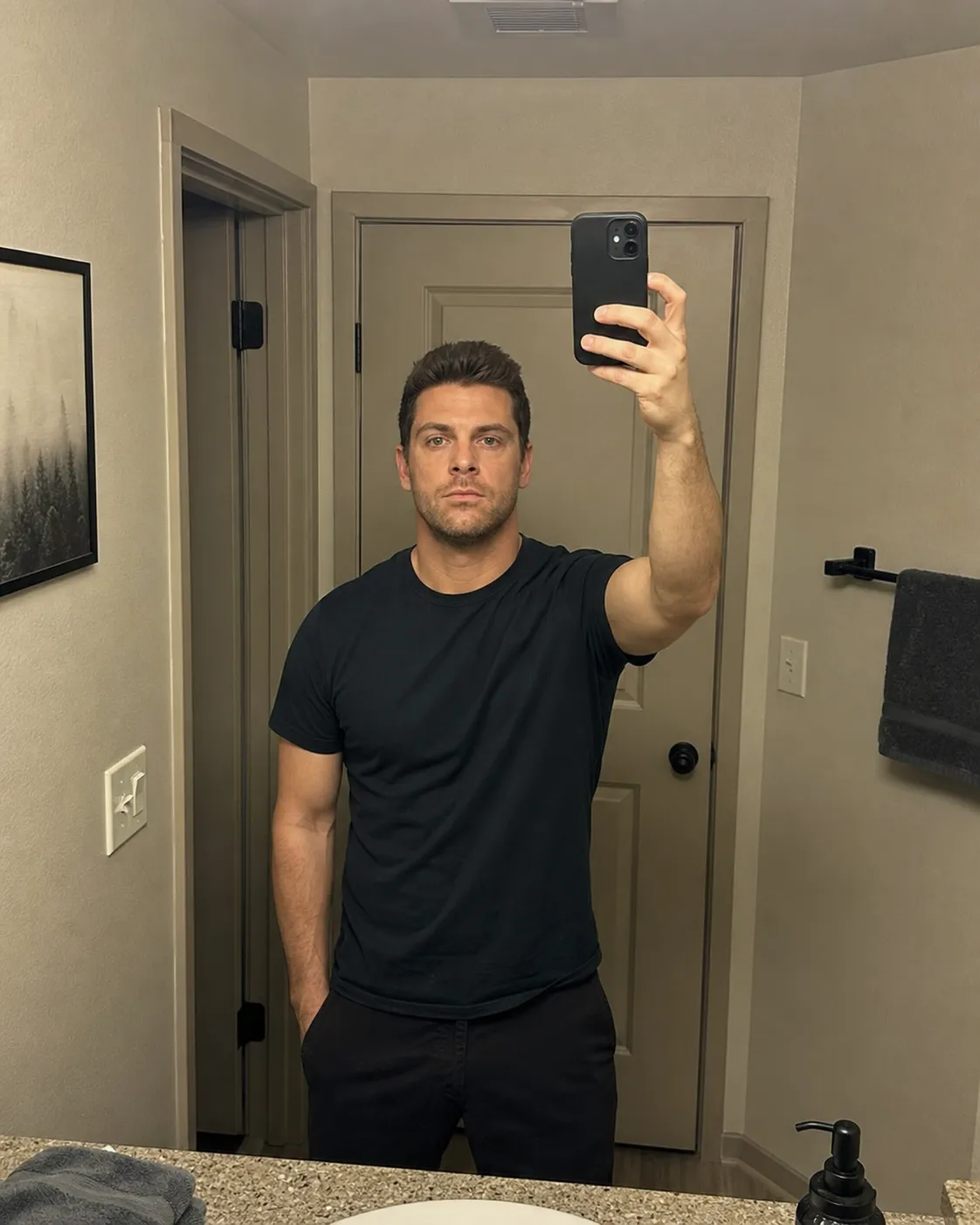
The bathroom-mirror selfie at arm’s length puts the face below 40 percent of frame every time. The cabinet, the toilet edge, the soap dispenser are now competing for the swiper’s attention with your face. They win. The swipe is gone.
Rule 2: eyes hit the upper-third grid line
The rule of thirds is the oldest piece of composition advice in portrait photography. Divide the frame into nine rectangles with two horizontal and two vertical lines. The subject’s eyes go on the upper horizontal third, not at the dead center.
The reason is not aesthetic. A viewer’s gaze on a small phone screen tracks to the upper portion of the frame first, then settles. If the eyes are already there, the swiper makes contact in the first pass. If the eyes are at the center, the swiper finds them on the second pass, and on Hinge a meaningful fraction of swipers do not make a second pass before deciding. The dead-eye AI tell that gets renders clocked as fake is the same mechanism in reverse: the methodology piece on why AI images look fake walks through the catch-light asymmetry the swiper’s brain reads for. The 3-rule stack puts your eyes where the swiper’s eyes are already going. The dead-eye tell asks whether anyone is home once they get there.
Rule 3: no sunglasses, no hat, no group
No single study has A/B-tested sunglasses, hats, and groups side by side — but every credible source converges on the same lead. Hinge’s own guidance names a clear, unobstructed face with a confident smile and eye contact. Photofeeler’s millions of peer ratings flag eye contact with no smile as the single harmful combination, and sunglasses remove the eye contact altogether. Tinder’s own roundup of its top 100 male profiles found every one of them smiling in the lead, none hiding behind shades. The verdict has not moved in fifteen years.
Sunglasses kill rule 2 outright: no eye-line means no eye contact. A hat narrows the read at the silhouette, and at the speed of a Hinge scroll, “harder to lock onto” means skip. A group photo turns a single-subject test into a puzzle: which one are you? The swiper’s resolution mechanism is the thumb. The thumb resolves by moving on.
Why most lead photos fail all three at once
The bathroom-mirror selfie under harsh overhead bathroom light is not three separate rule-breaks. It is one composition decision that breaks all three rules at the same time.


The arm’s-length crop puts the face below 40 percent of frame. The phone held at chest level puts the eye-line at center, not upper-third. The bathroom backdrop adds the secondary tell of generic mirror-light and a visible toilet edge. The same person, same face, same Wednesday lunch break. The swiper flips. The rules look like three things to remember. In practice they are three reads of the same composition decision.
How to ship a lead photo that passes all three tonight
Two paths. Path one is the one you already have. Open your camera roll, find the photo where your face is closest to mid-chest up, framed by someone holding a phone at eye-level in real light, no sunglasses, no hat, no friend in the frame. Crop it to 4:5 vertical. Check that your eyes sit roughly one-third of the way down from the top edge after the crop. That photo is your lead.
Path two is the one most readers do not yet have a camera roll for: render it. The five-photo dating pack at the anchor article ships an anti-AI candid selfie prompt that locks the composition to a real iPhone selfie at soft natural window light, framed mid-chest up, with a real warm half-smile and direct eye contact. Add one sentence to the rules block: “face occupies 60 percent of the vertical frame, eyes on the upper-third grid line, solo subject.” Paste, render, swap. The anti-AI candid selfie prompt is the lead-photo prompt by default.
If copying a prompt is not your thing, Dream Photo Studio does the same job from one selfie — upload a single clear photo of your face, and it renders a lead-worthy shot with the composition handled, nothing to paste. Either path gets you a lead photo that passes the 3-rule stack tonight.
The version below is that prompt with the 3-rule stack already baked into the rules block. Paste it as is.
Show the full promptTap to expand
Paste this into your AI (ChatGPT, Claude, Gemini, or any AI image tool).
REQUIRED upload before pasting: one clear, well-lit front-facing photo of your face.
Generate this image:
A single photoreal 4:5 vertical dating-profile lead photo of the person in the uploaded reference image, deliberately styled as a real iPhone selfie rather than a polished studio portrait, and built to pass all three lead-photo rules at once. Match their bone structure, eyes, nose, lips, proportions, and skin tone exactly so the subject is unmistakably the same person. The subject holds their phone with one hand at slightly-above-eye-level, head tilted barely off-axis, looking into the camera with a real warm half-smile, eyes lit, hair slightly windblown with one hair flyaway visible at the temple. Soft natural late-afternoon window light comes from front-and-slightly-left, producing even fill across the face with mild fall-off into the cheek shadow on the opposite side. They wear {CASUAL_TOP}. The backdrop is {REAL_HOME_BACKDROP}, busy enough to look real, never noisy enough to compete with the face. The face occupies {FRAME_TIGHTNESS} of the vertical frame, framed mid-chest up, with the eyes landing precisely on the upper-third grid line of the photo (not the dead center). Solo subject — no sunglasses, no hat, no second person anywhere in the frame. Skin shows visible pores, fine micro-texture, natural micro-asymmetry, one or two faint freckles, a slight under-eye shadow from a normal weekday. The image carries the faintest grain of an iPhone front camera at f/2.2 with a hint of chromatic aberration at the highest contrast edges. Phone-held casual selfie composition, NOT studio headshot. Single 4:5 vertical dating-profile lead photo, identity-locked to the uploaded reference.
Rules the AI must follow:
- Aspect ratio 4:5 vertical: strict, locked at the start and the end of the prompt
- The lead-photo 3-rule stack must be visibly satisfied: face occupies 55 to 65 percent of the vertical frame, eyes land on the upper-third grid line (not the dead center), and the photo is solo with no sunglasses, no hat, and no group. All three rules at once.
- Identity preservation is the highest-priority constraint: match the uploaded reference photo’s bone structure, eyes, nose, lips, proportions, and skin tone exactly; the subject must be unmistakably the same person
- The image must read as a real iPhone selfie, not a studio headshot: phone-held angle, soft natural window light, no directional cinematic key, no harsh overhead fluorescent
- Realistic skin texture required: visible pores, fine micro-asymmetry, natural unevenness, faint freckles, slight hair flyaways; no porcelain smoothing, no over-retouched beauty filter, no waxy AI-plastic surface
- Age and natural micro-imperfection preserved: under-eye softness, asymmetric smile, real hair texture; do not airbrush
- One human figure only: solo subject; no advisors, no crowd, no background people, no sunglasses, no hat
- No text, captions, watermarks, logos, brand marks, badge text, dating-app UI chrome, or readable signage anywhere in the frame
- Single image output: one 4:5 file; no contact sheet, no variant grid, no before/after split
- All text in English Latin script if any incidental signage appears
- Output the image directly without explaining the prompt back
Replace these placeholders with your details:
- REQUIRED upload before pasting: one clear, well-lit front-facing photo of your face
{CASUAL_TOP}= a plain charcoal cotton t-shirt with no logo, OR an unbuttoned soft chambray shirt over a plain white tee, OR a soft oatmeal crew sweatshirt{REAL_HOME_BACKDROP}= a softly-blurred living-room wall with the edge of a kitchen counter and a half-visible houseplant, OR a quiet home-office corner with a single warm-amber framed print behind, OR a sunlit bedroom corner with the edge of a linen-headboard visible{FRAME_TIGHTNESS}= 60 percent (the safe mid-range default), OR 55 percent if you want the wider crop, OR 65 percent if you want the close crop. Stay inside 55 to 65 percent: closer reads as confrontational, wider stops being a face-led photo.
One paste-ready AI move a week. The kind you can use on a Tuesday or a Sunday, on the lead photo or on the rest of the pack. Subscribe to the newsletter for the weekly hack and the Independent Brand Visual Kit: twelve copy-ready AI image prompts that cover the photo jobs most readers paste next.
The 3-rule stack changes by app. Tinder’s swipe-deck zooms into your photo and rewards a centered, room-to-spare lead, and Bumble’s lead has to hand a match something to message about; the Hinge vs Bumble vs Tinder comparison walks the delta. On Hinge specifically, the lead photo carries the most weight, and the 3-rule stack is the named law that decides whether the weight lands.
FAQ
Q: What makes a good first photo on Hinge?
A: Three rules. Your face occupies between 55 and 65 percent of the vertical frame. Your eyes hit the upper-third grid line of the photo, not the dead center. No sunglasses, no hat, no group photo in the lead slot. All three at once. Hinge’s published guidance and Photofeeler’s photo-testing data both point to eye contact and a real smile as the lead’s strongest signal, and the composition rules above are how a real iPhone selfie actually delivers that signal.
Q: Does Hinge show your most popular photo first?
A: No. Hinge does not automatically reorder your photos or promote your strongest, most-liked, or most popular one to the lead slot. The photo in position one is the photo you dragged there, and it stays the lead until you move a different one up. The lead-photo decision is entirely yours: Hinge will not rescue a weak lead by surfacing a better slot-3 shot to swipers. Open your profile, decide which single photo passes the 3-rule stack — face at 55 to 65 percent of the frame, eyes on the upper-third grid line, solo with no sunglasses or hat — and drag that one to position one yourself.
Q: Is it okay for the first photo on Hinge to be a selfie?
A: Yes. A selfie is one of the best first photos on Hinge, as long as it passes the 3-rule stack. The lead slot rewards a real, eye-level iPhone selfie in soft natural light: face at 55 to 65 percent of the frame, eyes on the upper-third grid line, solo with no sunglasses or hat. What loses is the bathroom-mirror selfie at arm’s length — face too small, eyes at the dead center, harsh overhead light. The selfie is not the problem; the arm’s-length mirror crop is. Shoot it at eye level in window light and a selfie outperforms most posed photos in the lead slot.
Q: Does the lead photo actually matter more on Hinge than on Tinder?
A: The lead photo matters everywhere. It matters more on Hinge. Hinge’s profile format surfaces the lead photo as the dominant visual, with the rest of the pack accessed by scrolling down, and a meaningful fraction of swipers never reach slot 2. On Tinder the swipe-card stack invites quicker flip-through to the rest. The 3-rule stack still applies on every app; the stakes are highest where the lead is the only photo most swipers see.
Q: Can I use a group photo as my first photo if my face is the clearest?
A: No. A group photo in the lead is the classic mistake, and the reason is not that group photos are bad. The reason is that the lead slot is a single-subject test, and a swiper deciding in under a second reads ambiguity as a skip signal. Put the group photo in slot 4 or slot 5 where the social-proof signal helps. Keep the lead a solo close-up of your face.
Q: What if I do not have a single photo that passes all three rules right now?
A: Render one. The anti-AI candid selfie prompt from the five-photo dating pack locks the composition to a real iPhone selfie at soft natural window light, framed mid-chest up, with a real warm half-smile and direct eye contact. Add one sentence to the rules block: “face must occupy 60 percent of the vertical frame, eyes on the upper-third grid line.” Paste, render, swap.
Q: What order should your Hinge photos be in?
A: Lead with the close-up that passes the 3-rule stack: face at 55 to 65 percent of the frame, eyes on the upper-third grid line, solo with no sunglasses or hat. After the lead, vary the scene every slot — an at-home shot, a true full-body shot, a hobby photo, a second outdoor — and put any group photo last, never in the lead, where it turns a single-subject test into a puzzle the swiper resolves by skipping. Hinge does not reorder your photos for you; the lead is whichever one you dragged to position one, so the order is entirely your call.
Q: What are Hinge photo rules?
A: Hinge has two kinds of photo rules, and only one decides your match rate. The platform rules are mechanical: a minimum of three photos, a maximum of six, shown in the order you place them — Hinge does not reorder or auto-promote your strongest shot. The rule that actually decides whether your lead lands is the lead-photo 3-rule stack: your face occupies 55 to 65 percent of the vertical frame, your eyes hit the upper-third grid line of the photo (not the dead center), and the lead is solo with no sunglasses, no hat, and no group. Hinge lets you post six photos; the 3-rule stack is what makes the first one work.
Q: What size should a Hinge photo be?
A: Upload the highest-resolution version you have, straight from your camera roll — at least 800 pixels on the short side. Hinge re-compresses every upload, so a screenshot or a photo forwarded through a messaging app lands soft and washed-out. Hinge crops your photo to fit its profile card and zooms toward the center, so keep your face centered and framed mid-chest up: that way it survives the crop whether you upload a square or a taller vertical shot. Crop it yourself before uploading rather than letting the in-app cropper guess, and fill all three to six photo slots.
Key Takeaways
- The lead photo is the only photo a meaningful fraction of Hinge swipers actually see. Every other photo in your pack is downstream of whether the lead photo lands.
- The lead-photo 3-rule stack is the named law: face occupies 55 to 65 percent of the vertical frame, eyes land on the upper-third grid line, no sunglasses, no hat, no group. All three at once.
- The bathroom-mirror selfie at arm’s length breaks all three rules in one composition decision. The fix is not three fixes; it is one photo taken at eye level in soft natural light, framed mid-chest up.
- If your camera roll does not have a lead photo that passes the rules, the anti-AI candid selfie prompt renders one tonight on the same identity-locked face you walk around as today.
The lead photo on your profile right now
Open your profile. Look at the lead. What fraction of the vertical frame is your face? Where do your eyes land relative to the upper third? Is there a hat, sunglasses, or a friend in the slot meant for you alone? The 3-rule stack is the only check that matters in that slot. And if the face is framed right but the smile still reads tight, that is a separate fix — how to smile in photos so it looks real.
The lead-photo prompt, and the rest of the five-photo dating pack, lives in the $19 Image Prompt Pack. Or skip the prompt altogether: Dream Photo Studio renders a lead-worthy photo from a single selfie, nothing to paste.