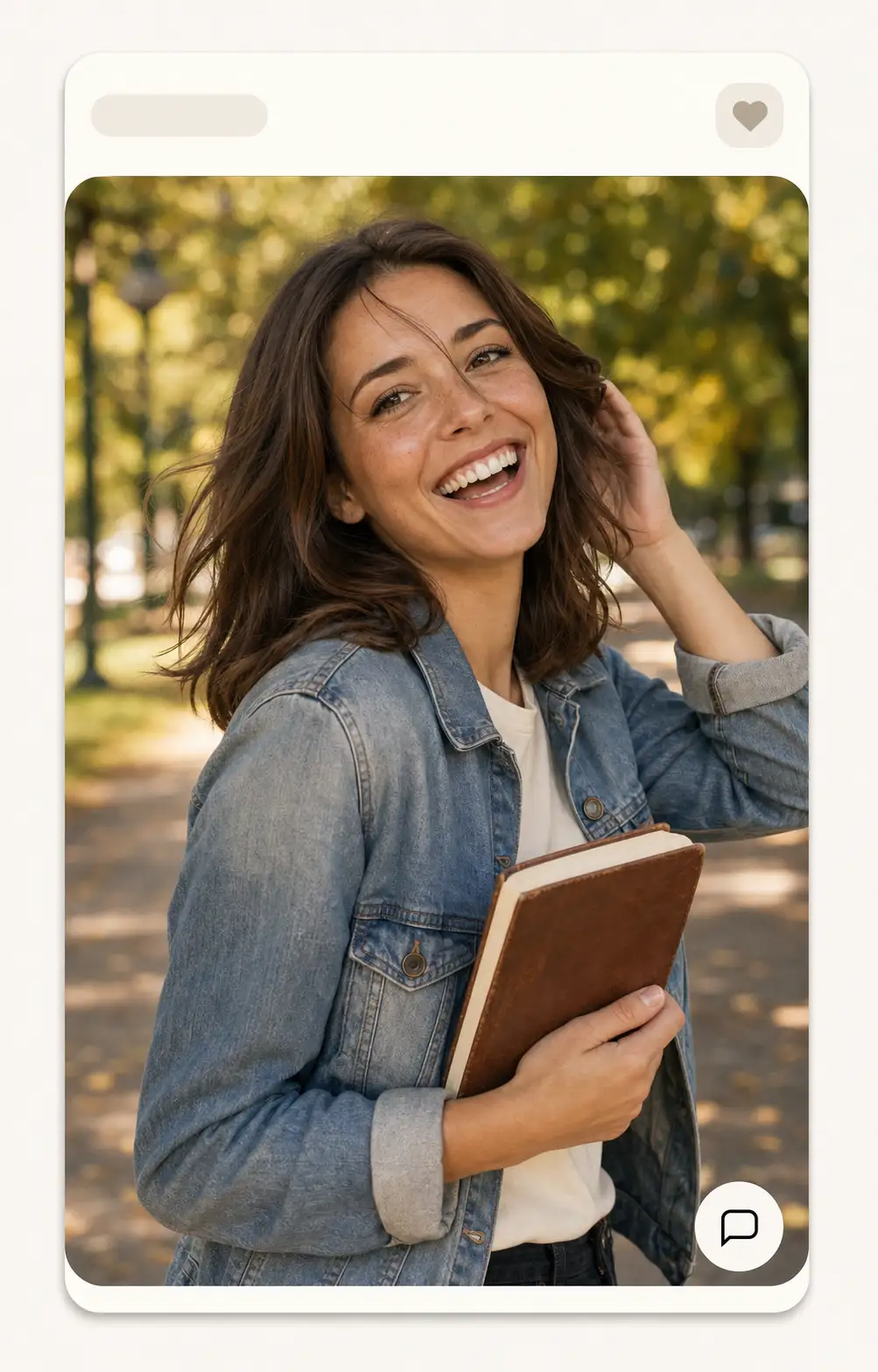
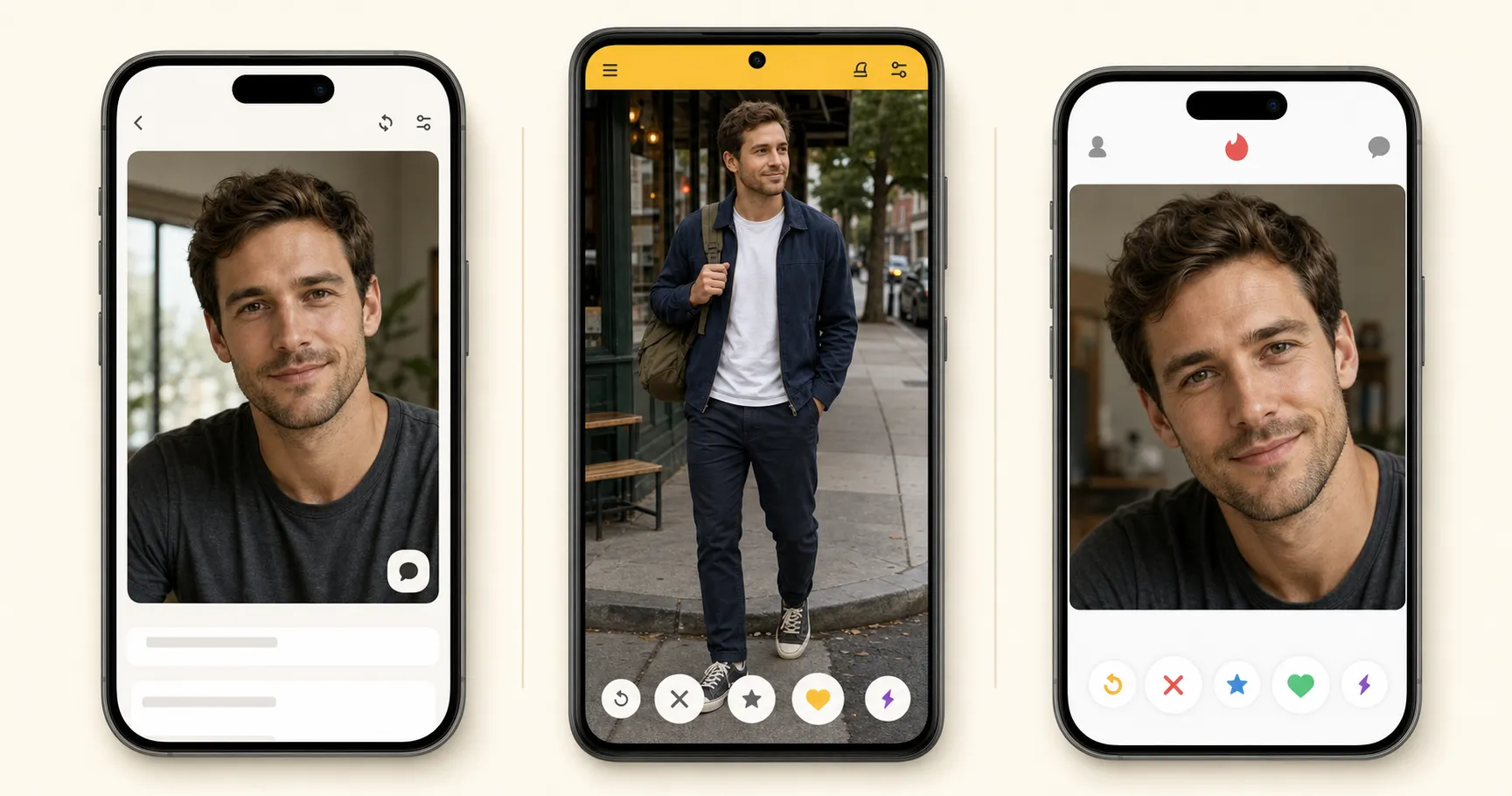
The reader has three apps open on a Sunday night. Hinge on the left of the screen, Bumble in the middle, Tinder on the right. Same face uploaded to all three. Same six photos in all three packs. Three different match rates by Wednesday. The reader’s first instinct is the wrong one — render new photos for the app that is underperforming. The right instinct is to look at the slot order. The pack does not need to change. The lead photo does.
What each dating app is actually weighting in 2026
The dating-app teams have been publicly clear about how they treat the photo grid, and the three apps do not agree. The mechanism they all trace back to is the lead-photo read Photofeeler’s testing has confirmed across millions of peer ratings: a real smile with eye contact beats the same person in sunglasses or in a group, and eye contact with no smile is the one lead that backfires. (OkCupid’s 2010 post argued the contrarian opposite, but a larger dataset did not hold it up.) The mechanism has not changed; the apps have. Three different products read the same lead-photo signal three different ways in 2026.
Hinge’s published profile-photo guidance names a true full-body shot, a confident smile in the lead photo, and a spread of photo types across the six slots as the strongest signals it surfaces. Bumble makes the lead photo a conversation-opener: since its 2024 Opening Moves change retired the old women-message-first rule, the open is now seeded by a prompt plus whatever your photos give the other person to react to — so a lead with nothing to say about it stalls before a word is sent. Tinder’s Smart Photos feature names a sub-second swipe-decision as the read it optimizes for, and offers an algorithmic lead-photo picker that A-B tests your uploaded photos to find the best performer in that one slot.
Three different weightings. Three different lead-photo moves. One photo pack underneath, if the pack is built right.
| App | What it weights most | Lead-photo move | Where most profiles fail |
|---|---|---|---|
| Hinge | Lead-photo eye contact + smile, full-body shot, photo variety across six slots | Close-up smile with eye contact, 55-65% of frame, no sunglasses or hat | Lead photo is a group shot or a sunglasses shot; full-body slot missing |
| Bumble | Lead photo as a conversation-opener (post-2024 Opening Moves — a prompt, or either person can message first) | Mid-action hobby photo or full-body shot that gives the swiper something concrete to write about | Lead photo is a bare close-up with no context — nothing to message about |
| Tinder | Sub-second swipe-decision on the lead photo; Smart Photos picker A-B tests the slot | A warm, centered close-up at about two-thirds of the square with headroom — the swipe deck zooms into the center, so leaving room is what survives it | Lead photo is a far-off vacation shot, or a tight fill whose head the deck-zoom crops |
Which means the answer to “what is my best photo for this app” is not a render-new-photos question. It is a slot-order question.
Hinge: the slow-flip app
Hinge’s profile is browsed slowly. The swiper scrolls past one photo, taps to like a specific photo, taps again to leave a comment, then either sends or moves on. The lead-photo eye contact is the gate; if the swiper does not get past the first photo, the rest of the pack does not exist.
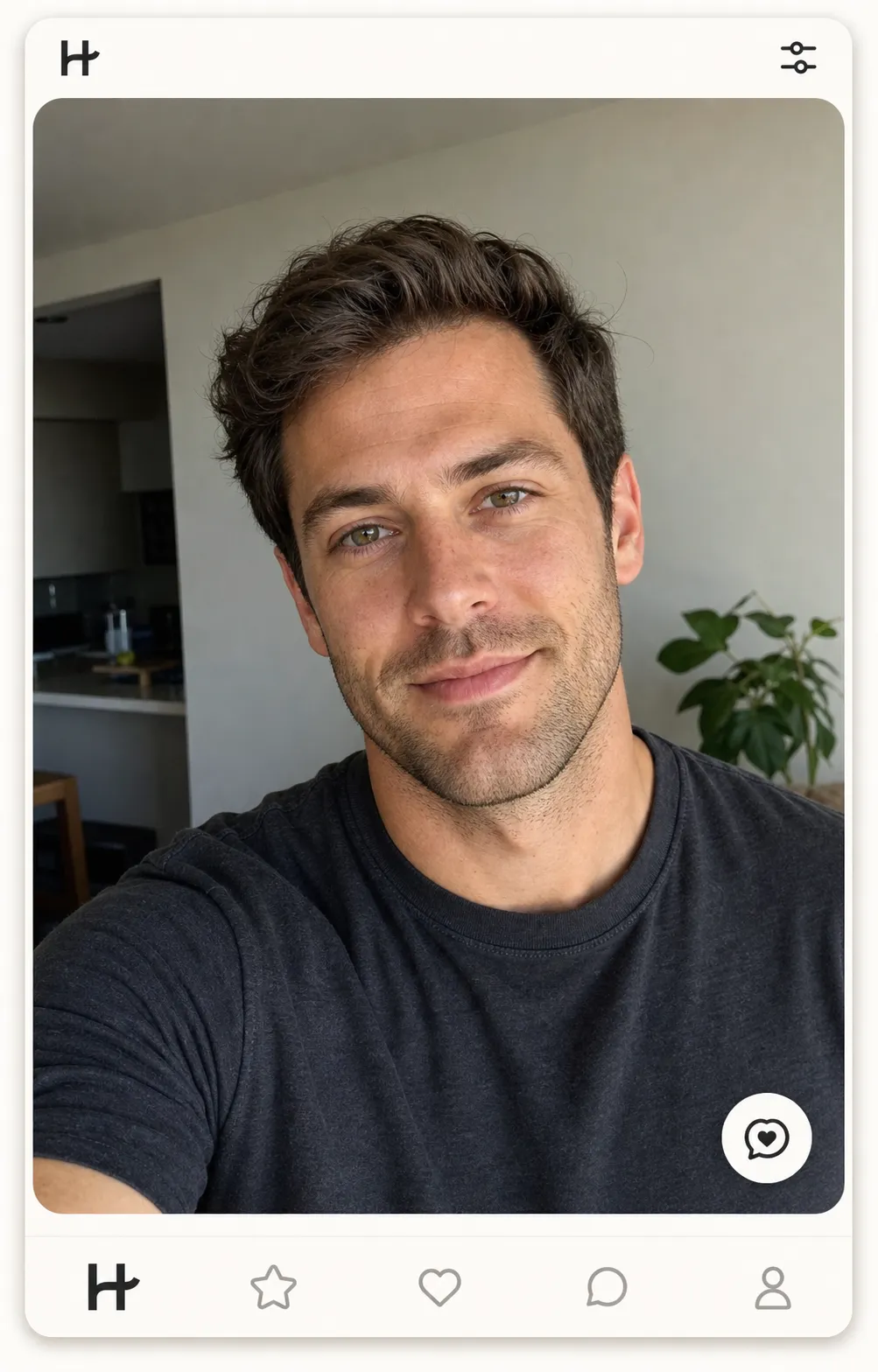
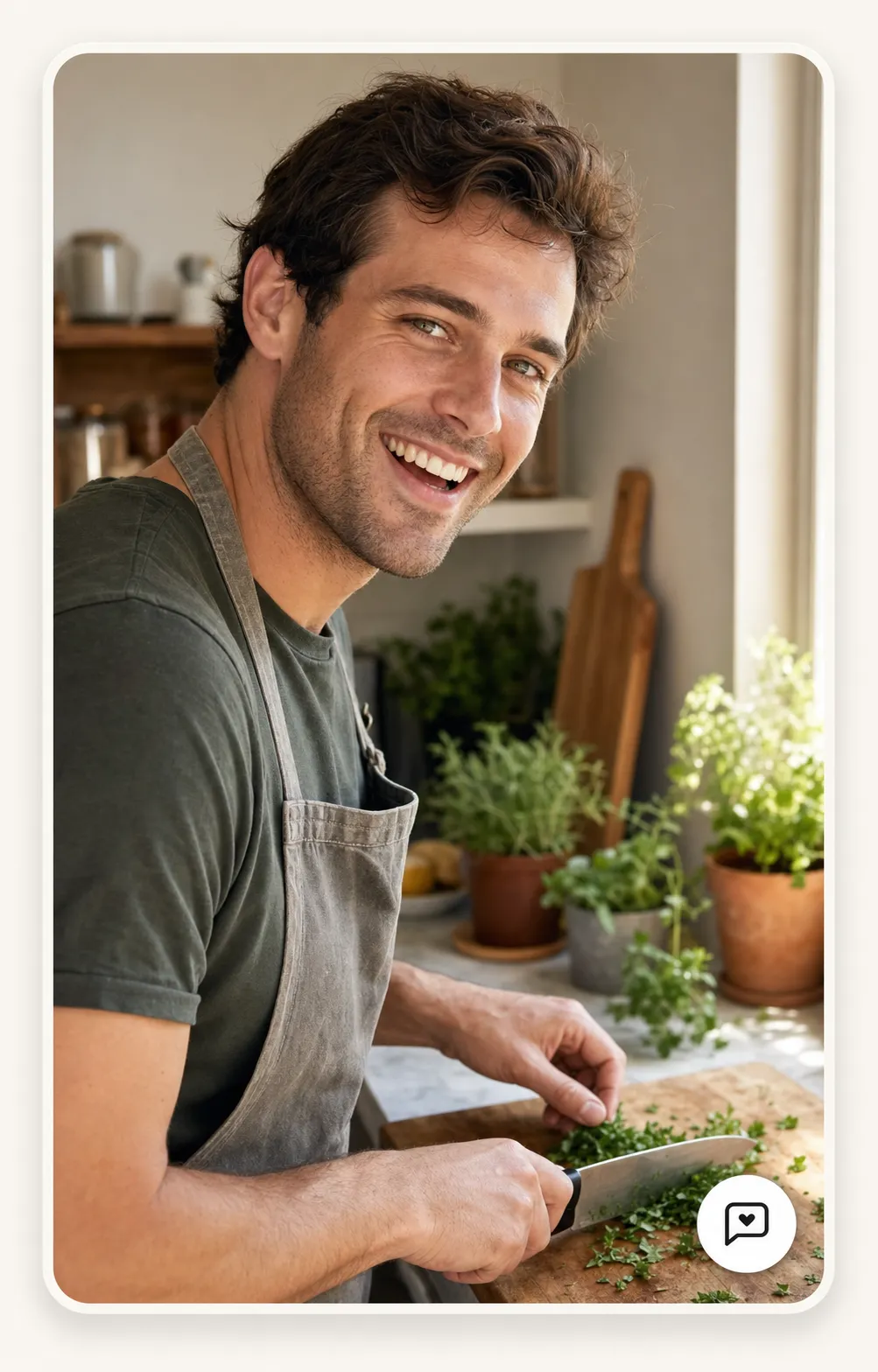
Hinge’s lead-photo move:
- Close-up smile with eye contact, framed mid-chest up
- Face occupies 55-65% of the frame
- No sunglasses, no hat, no group
Paste this when you need a Hinge lead-photo render — the 4:5 slow-flip close-up with eye contact and a warm half-smile.
Show the full Hinge lead-photo promptTap to expand
Paste this into your AI (ChatGPT, Claude, Gemini, or any AI image tool).
REQUIRED upload before pasting: one clear, well-lit front-facing photo of your face.
Generate this image:
A single photoreal 4:5 vertical Hinge lead-photo of the person in the uploaded reference image, deliberately styled as a real iPhone selfie rather than a polished studio portrait. Match their bone structure, eyes, nose, lips, proportions, and skin tone exactly so the subject is unmistakably the same person. The subject holds their phone with one hand at slightly-above-eye-level, head tilted barely off-axis, looking into the camera with a real warm half-smile, eyes lit, hair slightly windblown with one hair flyaway visible at the temple. Soft natural late-afternoon window light comes from front-and-slightly-left, producing even fill across the face with mild fall-off into the opposite cheek shadow. The subject reads as {GENDER_PRESENTATION}. They wear {CASUAL_TOP}. The backdrop is {REAL_HOME_INTERIOR}, busy enough to look real, never noisy enough to compete with the face. The subject occupies 55-65% of the vertical frame, framed mid-chest up. Skin shows visible pores, fine micro-texture, natural micro-asymmetry, one or two faint freckles, a slight under-eye shadow from a normal weekday. The image carries the faintest grain of an iPhone front camera at f/2.2 with a hint of chromatic aberration at the highest contrast edges. Phone-held casual selfie composition, NOT studio headshot. Single 4:5 vertical Hinge lead-photo, identity-locked to the uploaded reference.
Rules the AI must follow:
- Aspect ratio 4:5 vertical: strict, locked at the start and the end of the prompt (Hinge’s slot-one container)
- Identity preservation is the highest-priority constraint: match the uploaded reference photo’s bone structure, eyes, nose, lips, proportions, and skin tone exactly; the subject must be unmistakably the same person
- The image must read as a real iPhone selfie, not a studio headshot: phone-held angle, soft natural window light, no directional cinematic key
- Realistic skin texture required: visible pores, fine micro-asymmetry, natural unevenness, faint freckles, slight hair flyaways; no porcelain smoothing, no over-retouched beauty filter, no waxy AI-plastic surface
- Age and natural micro-imperfection preserved: under-eye softness, asymmetric smile, real hair texture; do not airbrush
- One human figure only: solo subject; no advisors, no crowd, no background people
- No sunglasses, no hat, no group — these are the three lead-photo failures Hinge’s published guidance explicitly names
- No text, captions, watermarks, logos, brand marks, badge text, or readable signage anywhere in the frame
- No dating-app UI chrome, no profile-card frame, no comment-bubble icons — output the photo only, not a mockup of the Hinge interface
- Single image output: one 4:5 file; no contact sheet, no variant grid, no before/after split
- All text in English Latin script if any incidental signage appears
- Output the image directly without explaining the prompt back
Replace these placeholders with your details:
- REQUIRED upload before pasting: one clear, well-lit front-facing photo of your face
{GENDER_PRESENTATION}= a man in his early thirties with short brown hair and light stubble, OR a woman around thirty with shoulder-length brown hair, OR any concrete sentence that describes how you actually present{CASUAL_TOP}= a plain charcoal cotton t-shirt with no logo, OR an unbuttoned soft chambray shirt over a plain white tee, OR a soft cream cable-knit sweater{REAL_HOME_INTERIOR}= a softly-blurred living-room wall with the edge of a kitchen counter and a half-visible houseplant in the background
The slow-flip pattern also means Hinge punishes the rest of the slots less than the other two apps. A weak slot two or slot three on Hinge costs less than a weak slot one. The slot-one decision is most of the decision. The lead-photo rule has three sub-rules nobody applies, and Hinge is the app where those sub-rules pay back hardest.
The Hinge lead is not the warmest, most flattering shot. It is the most legible one.
Bumble: the women-message-first app
Bumble’s mechanic changes the swiper’s job. The woman has to send the first message inside twenty-four hours or the match expires. The asymmetry shifts what the lead photo has to do. On Hinge, the lead photo has to make the swiper want to like a photo. On Bumble, the lead photo has to make the swiper want to write a sentence. Those are not the same job.
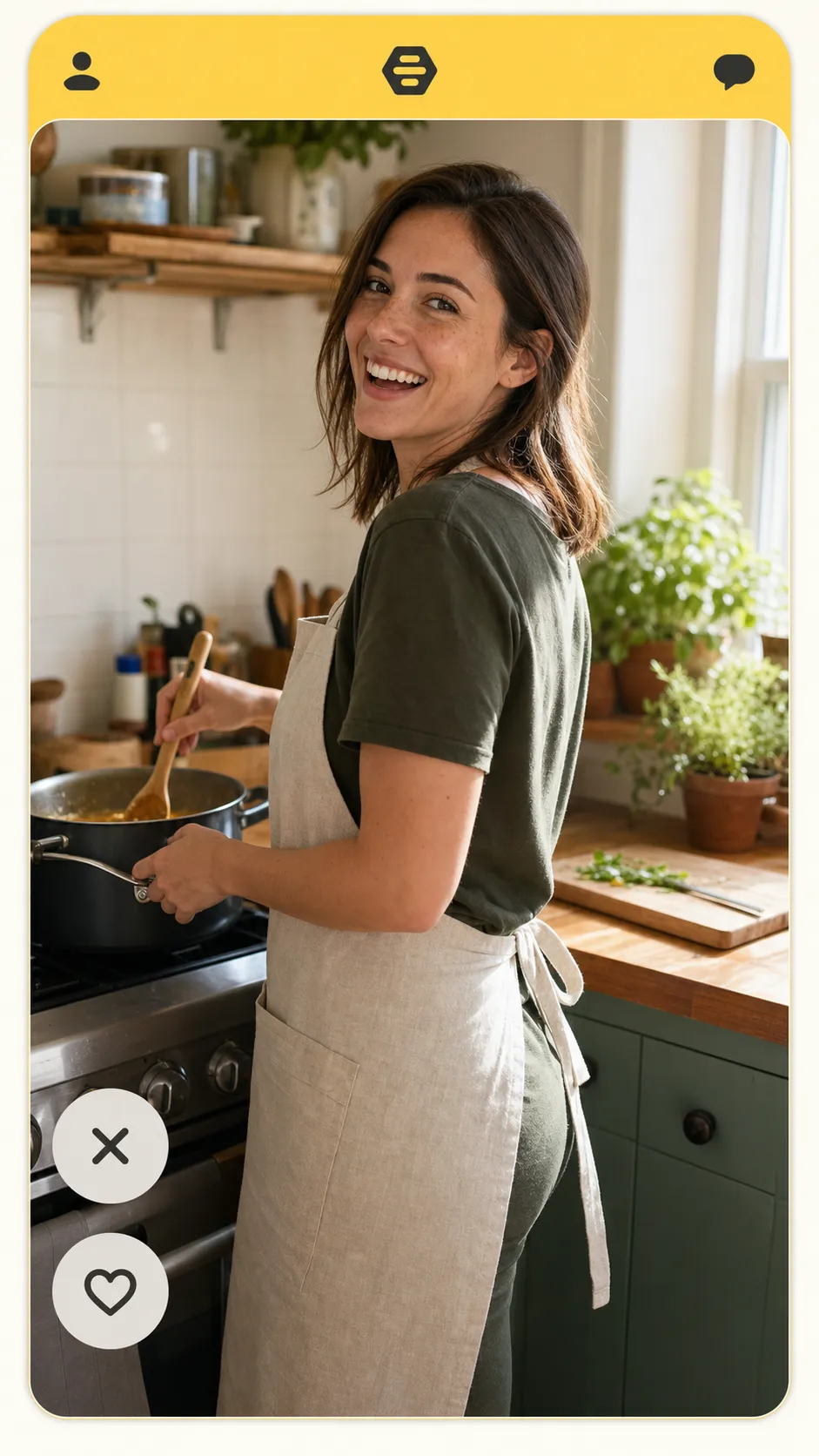
Bumble’s lead-photo move:
- Mid-action hobby photo, or a full-body context shot
- The frame contains a concrete conversation hook: a wooden spoon, a backpack, a climbing wall, a paintbrush
- The smile is real and warm, but the photo is not framed around the face the way the Hinge lead is
Paste this when you need a Bumble lead-photo render — the 9:16 full-body mid-action shot that gives the swiper a line to write.
Show the full Bumble lead-photo promptTap to expand
Paste this into your AI (ChatGPT, Claude, Gemini, or any AI image tool).
REQUIRED upload before pasting: the same clear front-facing photo of your face you used for the Hinge prompt (use the same reference upload across every prompt in this article so identity locks across all three app variants).
Generate this image:
A single photoreal 9:16 vertical Bumble lead-photo of the person in the uploaded reference image, caught mid-action while {HOBBY_ACTION}. Match their bone structure, eyes, nose, lips, proportions, and skin tone exactly so the subject is unmistakably the same person across every app’s lead-photo variant. The subject reads as {GENDER_PRESENTATION}. They are full-body visible from mid-thigh up at minimum, body slightly angled away from camera at about thirty degrees, head turned back toward camera with a real spontaneous mid-laugh, eyes lit, hair lifted lightly by a soft breeze. The frame contains a concrete conversation-hook prop placed naturally in their hands: {CONVERSATION_HOOK_PROP}. They wear {ACTIVITY_OUTFIT}. The backdrop is {ACTIVITY_SETTING}, slightly soft in bokeh, with real lived-in context cues readable. Soft warm setting-appropriate light, no harsh shadows, no editorial cinematic key. The subject occupies 60-70% of the vertical frame. Skin shows visible pores, fine micro-texture, micro-asymmetry, hair flyaways, a faint flush in the cheeks from exertion or concentration. Shot on a 35mm-equivalent lens at approximately f/4, modest shallow depth of field, the setting slightly soft beyond the subject but never out of recognition. Single 9:16 vertical Bumble lead-photo, identity-locked.
Rules the AI must follow:
- Aspect ratio 9:16 vertical (tall portrait): strict, locked at the start and the end of the prompt (Bumble’s slot-one container)
- Identity preservation is the highest-priority constraint: match the uploaded reference photo’s bone structure, eyes, nose, lips, proportions, and skin tone exactly; the subject must read as the same person as in the Hinge and Tinder lead-photo variants
- Full-body framing required: subject shown from mid-thigh up at minimum — this is the move Bumble’s women-message-first asymmetry rewards in slot one
- The image must read as caught mid-action, not posed: hands placed naturally on real props, body weight distributed as someone actually doing the activity would, expression mid-laugh rather than staged
- The conversation-hook prop must be visible and identifiable so the swiper has something concrete to open a message with
- Soft warm setting-appropriate light only: no editorial cinematic key, no Vogue stylization
- Realistic skin texture required: visible pores, fine micro-asymmetry, hair flyaways, exertion or concentration flush; no porcelain smoothing, no over-retouched beauty filter, no waxy AI-plastic surface
- One human figure only as the sharp subject; very soft-bokeh other people in the deep background are acceptable but must NOT be in focus
- No text, captions, watermarks, logos (including any brand logos on shoes / gear / instruments), brand marks, badge text, or readable signage anywhere in the frame
- No dating-app UI chrome, no profile-card frame, no yellow accent bars — output the photo only, not a mockup of the Bumble interface
- Single image output: one 9:16 file; no contact sheet, no variant grid
- All text in English Latin script if any incidental signage appears
- Output the image directly without explaining the prompt back
Replace these placeholders with your details:
- REQUIRED upload before pasting: the same clear front-facing photo of your face you used for the Hinge prompt
{GENDER_PRESENTATION}= a man in his early thirties with short brown hair and light stubble, OR a woman around thirty with shoulder-length brown hair, OR any concrete sentence that describes how you actually present{HOBBY_ACTION}= mid-stir at a sunlit kitchen counter cooking pasta, OR painting at an outdoor easel in a small garden, OR cycling on a tree-lined road, OR bouldering on an indoor climbing wall, OR strumming a chord on an acoustic guitar on a couch{CONVERSATION_HOOK_PROP}= a wooden spoon mid-stir (cooking), OR a paintbrush mid-stroke with a small wooden palette (painting), OR both hands on the handlebars of a vintage steel-frame road bike (cycling), OR one hand on a teal climbing hold above shoulder height (climbing), OR a chord shape on the fretboard with the other hand mid-strum (guitar){ACTIVITY_OUTFIT}= a soft linen apron over a plain dark olive tee with dark jeans (cooking); OR a paint-flecked light-blue chambray shirt over a plain cream tee (painting); OR a slate-blue lightweight cycling jersey-tee over dark cycling shorts (cycling); OR a heather-grey athletic tank with dark joggers (climbing){ACTIVITY_SETTING}= a window-lit home kitchen with herbs in small terracotta pots on the counter (cooking); OR a small sunlit garden with terracotta pots and soft greenery (painting); OR a soft-bokeh tree-lined road in dappled overcast light (cycling); OR a warm-amber-lit indoor climbing-gym wall covered in colored holds (climbing)
The conversation-opener move is also why a clean Hinge lead can underperform on Bumble. A close-up smile with nothing else in the frame gives the woman nothing to write — “hi” is what she has to type, and “hi” is what loses the match. The Bumble lead-photo move trades a small amount of facial legibility for a large amount of message-opening texture.
Render the pack once. On Bumble, the slot-one tile is the one with the most concrete prop in it.
Tinder: the sub-second swipe app
Tinder’s swipe pattern is the fastest of the three. The thumb flicks left or right inside a second, and most users never tap to see the second photo. The lead photo is the entire decision. Tinder’s Smart Photos picker A-B tests the photos you have already uploaded against live swipe data to find which one wins slot one — but the picker can only choose from photos you have given it. The photo that wins on Tinder has to be in the pack first.
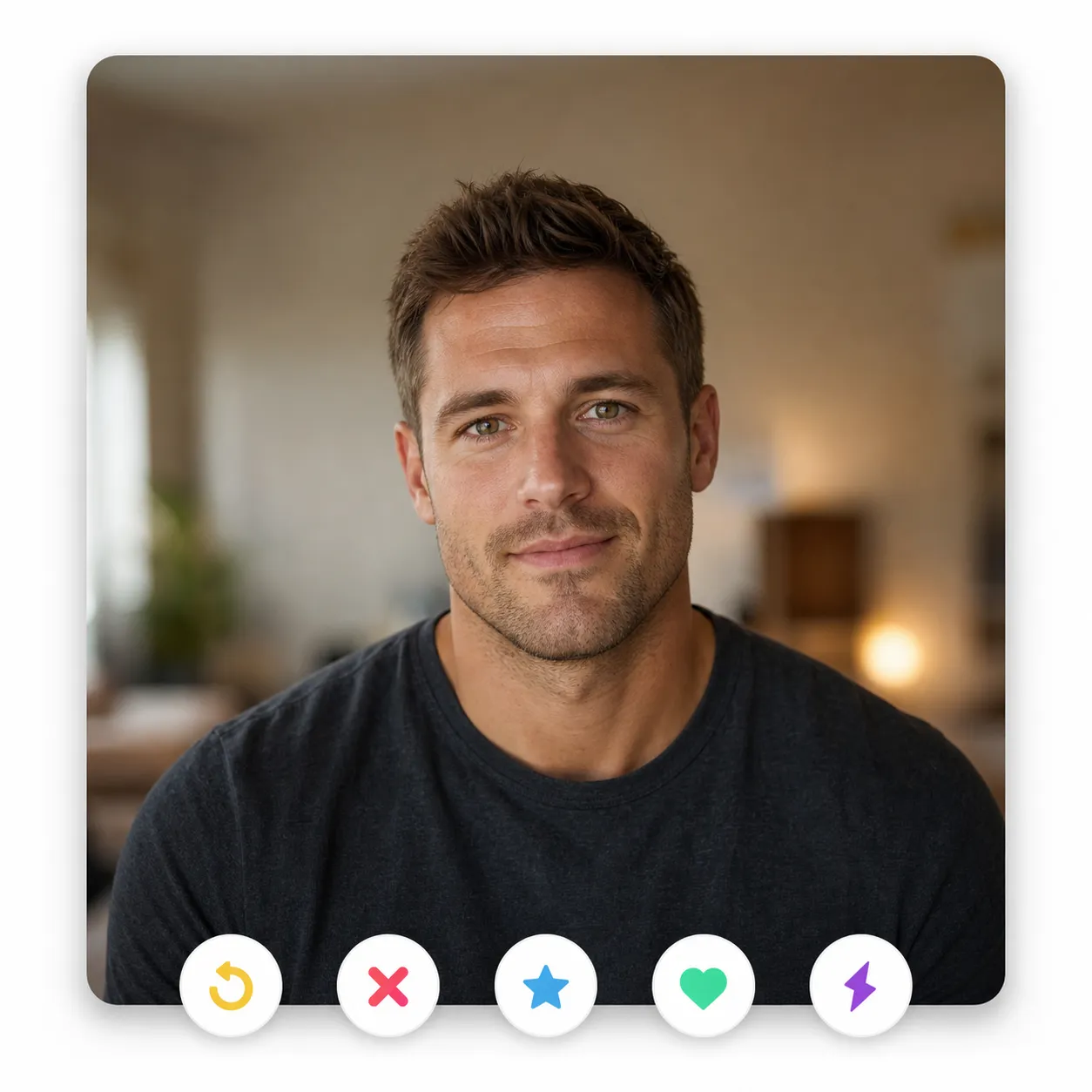
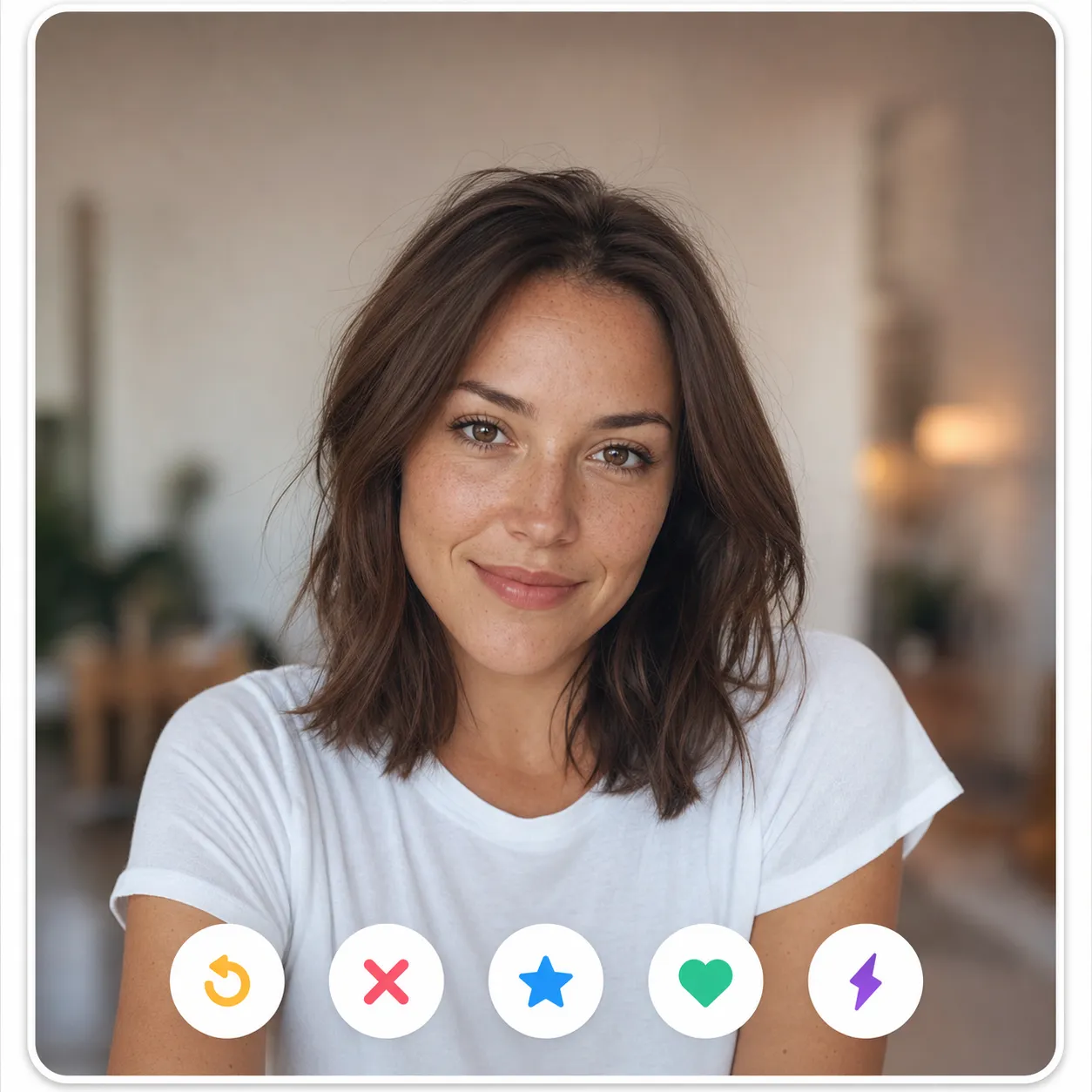
Tinder’s lead-photo move:
- Warm close-up smile, face centered in the square with headroom above the head and shoulders in
- Face at about two-thirds of the square (≤70%) — Tinder zooms into the center for the swipe deck, so leaving room is what keeps the zoom from cropping your face
- Soft natural light, warm tone, no sunglasses
Paste this when you need a Tinder lead-photo render — the 1:1 square built to still read warm after the deck-zoom tightens it.
Show the full Tinder lead-photo promptTap to expand
Paste this into your AI (ChatGPT, Claude, Gemini, or any AI image tool).
REQUIRED upload before pasting: the same clear front-facing photo of your face you used for the Hinge and Bumble prompts (the single upload locks identity across all three app variants).
Generate this image:
A single photoreal 1:1 square Tinder lead-photo of the person in the uploaded reference image, framed as a centered close-up with clear headroom above the head and the shoulders in. Match their bone structure, eyes, nose, lips, proportions, and skin tone exactly so the subject is unmistakably the same person as in the Hinge and Bumble lead-photo variants. The subject reads as {GENDER_PRESENTATION}. Head tilted barely off-axis toward camera, looking into the camera with a real warm half-smile, eyes lit, slight crease at the corner of each eye, hair slightly windblown with one hair flyaway visible at the temple. The light is {WARM_LIGHT_SOURCE}, casting a faint warm glow on the highlight side of the face. They wear {SIMPLE_TOP}. The backdrop is {SOFT_BOKEH_BACKDROP}, blurred enough that the face is the clear subject without competition. The subject’s face occupies about two-thirds of the square frame (no more than 70%), centered with clear headroom above the head and the shoulders in, because Tinder zooms into the center of the square for the swipe deck and that headroom is what stops the zoom from cropping the face. Skin shows visible pores, fine micro-texture, natural micro-asymmetry, hair flyaways at the temple, a faint warm cast on the highlight side. The image carries the faintest grain of a real camera at f/2.8 rather than the wax-figure smoothness of an AI default. Single 1:1 square Tinder lead-photo, identity-locked to the uploaded reference.
Rules the AI must follow:
- Aspect ratio 1:1 square: strict, locked at the start and the end of the prompt (Tinder’s slot-one container — the outlier from Hinge and Bumble’s vertical orientation)
- Identity preservation is the highest-priority constraint: match the uploaded reference photo’s bone structure, eyes, nose, lips, proportions, and skin tone exactly; the subject must read as the same person as in the Hinge and Bumble lead-photo variants
- Framing must leave room: face centered at about two-thirds of the square (no more than 70%), with clear headroom above the head and the shoulders in; do NOT fill the frame tight, because Tinder zooms into the center of the square for the swipe deck and a tight fill loses the top of the head and the chin to that zoom
- The image must read as a real candid portrait, warm and tight: soft natural light, no studio cinematic key, no ring-light dead-eyes
- Realistic skin texture required: visible pores, fine micro-asymmetry, hair flyaways, natural unevenness; no porcelain smoothing, no over-retouched beauty filter, no waxy AI-plastic surface
- One human figure only: solo subject; no advisors, no crowd, no background people
- No sunglasses anywhere on the face
- No text, captions, watermarks, logos, brand marks, badge text, or readable signage anywhere in the frame
- No dating-app UI chrome, no profile-card frame, no five-button action row — output the photo only, not a mockup of the Tinder interface
- Single image output: one 1:1 file; no contact sheet, no variant grid, no before/after split
- All text in English Latin script if any incidental signage appears
- Output the image directly without explaining the prompt back
Replace these placeholders with your details:
- REQUIRED upload before pasting: the same clear front-facing photo of your face you used for the Hinge and Bumble prompts
{GENDER_PRESENTATION}= a man in his early thirties with short brown hair and light stubble, OR a woman around thirty with shoulder-length brown hair, OR any concrete sentence that describes how you actually present{WARM_LIGHT_SOURCE}= soft warm golden-hour side-light from camera-right (outdoor variant), OR soft natural late-afternoon window light from front-and-slightly-left (indoor variant){SIMPLE_TOP}= a plain charcoal cotton tee with no logo, OR a navy crewneck knit sweater over a plain white tee collar showing at the neck, OR a soft cream cable-knit sweater{SOFT_BOKEH_BACKDROP}= a softly-bokeh maple-shaded park path at golden hour with warm amber tones (outdoor variant), OR a softly-blurred lived-in interior with the edge of a kitchen counter and a half-visible houseplant blurred to bokeh shapes (indoor variant)
Tinder changes how the face has to be framed, because it zooms into the center of your square for the swipe deck. A face framed tight enough to look right as a still loses its top of head and chin once the deck-zoom magnifies the center — so the Tinder lead has to sit smaller, about two-thirds of the square, centered, with headroom. The Tinder render is the only one of the three where the framing rule itself shifts; Hinge and Bumble display much closer to what you upload.
On Tinder, slot one is most of the match rate. On Tinder, slot one is also a square.
The Hinge-Bumble-Tinder photo-stack delta
The slot-order changes most in slot one. The rest of the pack shifts more gently. The full delta as a six-row stack:
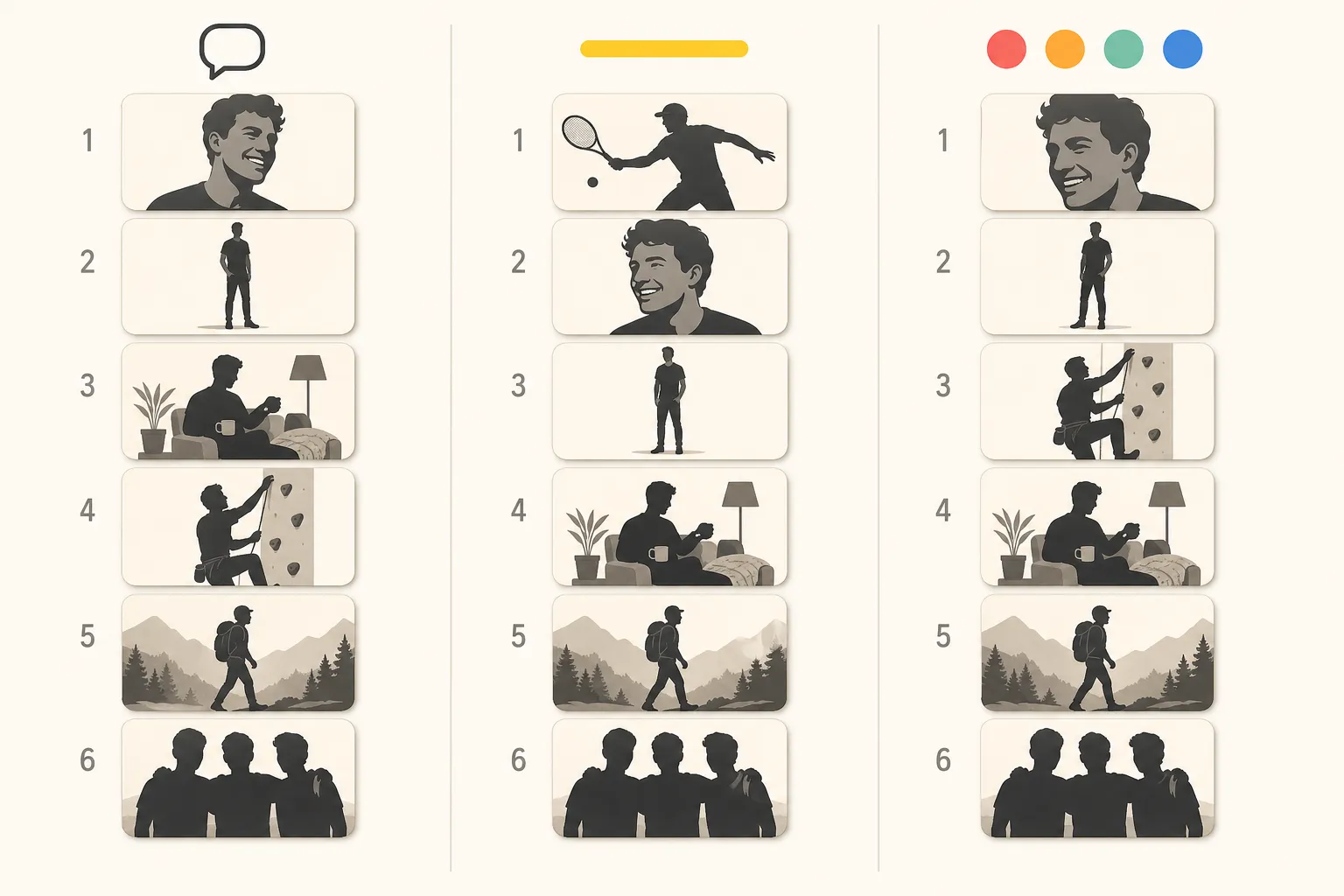
| Slot | Hinge | Bumble | Tinder |
|---|---|---|---|
| 1 (lead) | Close-up smile, eye contact, mid-chest up | Mid-action hobby (conversation-opener) | Centered close-up, ~two-thirds of square with headroom |
| 2 | True full-body shot | Close-up smile, eye contact | True full-body shot |
| 3 | At-home cozy lifestyle | True full-body shot | Mid-action hobby |
| 4 | Mid-action hobby | At-home cozy lifestyle | At-home cozy lifestyle |
| 5 | Outdoor candid | Outdoor candid | Outdoor candid |
| 6 | Real group photo | Real group photo | Real group photo |
The slot-one move is the one that changes. Slot two follows — whichever heavy-signal shot was not used in slot one moves up to slot two. The first two slots carry most of the swipe-decision weight on every app. Slots three through six anchor the rest of the variety. Slot six is the real group photo from the camera roll on every app, because the social-proof signal is the one signal the apps’ community guidelines explicitly police and AI cannot fake.
The gender-neutral five-photo dating pack the anchor article walks through is the underlying pack. The slot-order delta is what this article adds.
The five-photo pack does not change. The slot order does.
One reference selfie, three orderings
The reader who renders the pack once has every photo Hinge, Bumble, and Tinder reward. Identity-lock holds the same face across all five rendered tiles plus the one real group photo from the camera roll. The slot-order delta is then a copy-paste exercise — drag tile A into slot one on Hinge, drag tile D into slot one on Bumble, drag tile C into slot one on Tinder. Same six photos. Three apps. Three orderings.
One reference selfie from the camera roll. Five paste-ready prompts that share the same reference upload. The bone structure, the eye shape, the nose, the lips, and the proportions hold across every render because the identity-lock rule is the highest-priority constraint in every prompt’s rules block. The wardrobe, the light, and the scene are what swing the read. The Tinder lead photo is the same face as the Hinge lead photo — different crop, same person.
The identity-lock methodology — why one reference selfie can produce six photos that read as the same person across three different aspect ratios — is the deep dive in the methodology piece. A render that holds identity at 4:5 can lose it at 1:1 if the prompt does not explicitly carry the aspect-ratio rule through to the rendered output, which is why the three-app stack matters more here than in any other dating-photo article.
The dating pack is five of twenty-five visual prompts that come up repeatedly in a normal year — the LinkedIn headshot, the founder portrait, the Etsy listing photo, the personal-brand grid, and twenty-one others. The $19 Image Prompt Pack is the full library; the dating-app pack lives inside it. The free starter pack covers the most-pasted twelve and ships with one paste-ready AI move a week after that. Or skip the prompt entirely — AI dating photos generate from a single selfie inside Dream Photo Studio.
The doesn’t-look-AI quality bar still applies
The slot-order delta is downstream of the quality bar. A perfectly ordered Hinge lead photo that fails the doesn’t-look-AI sniff test is a wasted slot. The dating-app swiper has a sub-second tell-detector, and it runs before the slot-order matters. Photofeeler’s research blog has tracked the failure mode across years of blind testing: photos scoring higher on “trustworthy” and “authentic” out-perform photos scoring higher on “attractive” but lower on those two. The anchor article’s six AI tells — waxy skin, too-symmetric face, plastic hair edges, dead eyes, perfect teeth, no real-life context — are the floor every render has to clear. The slot-order delta is the ceiling.
Pass the sniff test. Then optimize the order. Shooting the lead on a real camera instead of rendering it? The same levers — angle, light, expression — are the ones how to be photogenic breaks down.
FAQ
Q: Do I need three different photo packs for Hinge, Bumble, and Tinder?
A: No. One six-photo pack covers all three apps. The Hinge-Bumble-Tinder photo-stack delta is a slot-order change, not a render-new-photos change. The same identity-reference selfie produces the same six tiles; what shifts by app is which tile lands in slot one and which slot most rewards the conversation-opener move. Render once. Reorder three times.
Q: Which photo should be my lead on each app in 2026?
A: Lead with a warm close-up on Tinder, a full-body or hobby photo on Bumble, and a clean lead-photo eye-contact close-up on Hinge. Tinder’s sub-second swipe-decision rewards the warmest, most identity-readable face. Bumble’s women-message-first asymmetry makes the lead photo a conversation-opener prompt — the swiper needs something concrete to write about. Hinge’s slow-flip browsing weights the lead-photo eye contact and smile most heavily.
Q: Does Tinder’s Smart Photos algorithm choose my lead photo for me?
A: Tinder offers an algorithmic lead-photo picker that A-B tests your uploaded photos against incoming swipes and surfaces the best performer as your lead. The picker is opt-in, and it can only choose from photos you have already uploaded. The Hinge-Bumble-Tinder photo-stack delta still applies: the algorithm picks from your pool, so the close-up smile photo has to be in the pool for it to win the slot. Render the full pack first; then let Tinder pick its favorite.
Q: Are AI-rendered dating photos allowed on Hinge, Bumble, and Tinder in 2026?
A: All three apps’ community guidelines forbid catfishing — photos of someone who is not you, or photos edited to misrepresent how you look. Identity-locked AI renders of your own face, in clothes you actually wear, in scenes that match the kind of life you actually live, do not cross that line. The rule the apps enforce is misrepresentation, not generation method. The photo that breaks the rule is the one where the person on the date does not recognize you when you walk in.
Key Takeaways
- One six-photo pack covers Hinge, Bumble, and Tinder. The slot order changes by app; the underlying pack does not.
- Hinge weights the lead-photo eye-contact close-up most heavily. Bumble’s women-message-first asymmetry rewards a mid-action conversation-opener in slot one. Tinder’s sub-second swipe-decision rewards the warmest, tightest, identity-readable close-up in the 1:1 square.
- Tinder is the outlier on framing — the 1:1 crop changes how the lead photo has to be shot; Hinge and Bumble share the vertical orientation.
- The doesn’t-look-AI six-tell quality bar applies on every app. The slot-order delta is the ceiling; the quality bar is the floor.
The next Sunday night
The reader from the opening scene opens the three apps again next Sunday. Same six photos. Three different orderings. The Hinge match rate is up. The Bumble messages are longer because the lead-photo hobby gave the swiper a sentence to write. The Tinder right-swipes come in faster because the lead photo is now the warm, centered close-up that survives the deck-zoom the algorithm has been waiting for.
Same face. Three orders. The pack did not change. The lead photo did.
Which app are you optimizing for tonight? Render the pack once. Re-order three times.