Most teams do not need another chatbot. They need fewer handoffs, fewer repeated decisions, and fewer half-automated workflows that still require a person to babysit every step.
That is where agentic AI becomes useful. The phrase sounds abstract, but the practical version is simple: agentic AI is software that can take a goal, decide the next step, use tools, check its own progress, and keep moving until the task reaches a useful stopping point.
A normal AI assistant answers a question. An agentic AI workflow tries to complete a job.
For a small team, that difference matters. The bottleneck is rarely idea generation. It is the pile of recurring work that sits between tools: collect the input, clean it, compare it against rules, draft the output, route it to the right person, and make sure nothing important was missed.
A simple definition
Agentic AI is an AI system that can act through a workflow instead of only responding in a chat box.
It usually has four parts:
- A goal: what the system is trying to accomplish.
- Context: documents, customer records, policies, examples, or prior decisions.
- Tools: the ability to search, retrieve, write, update, classify, route, or trigger another system.
- Checks: rules or review steps that stop the workflow from drifting.
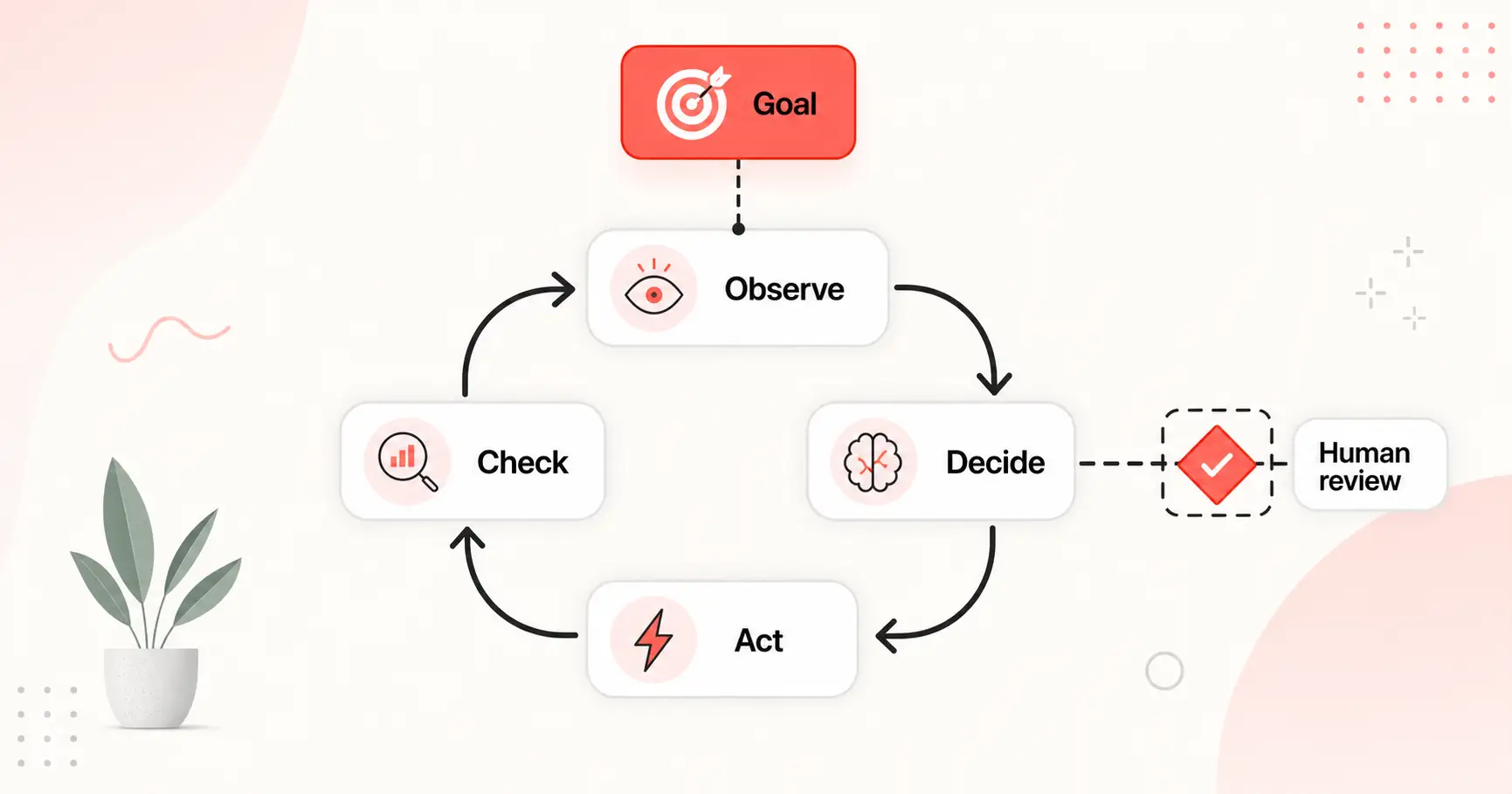
The important part is not that the system feels autonomous. The important part is that the work has a loop. It can observe the current state, choose a next action, perform that action, evaluate the result, and either continue or escalate.
That loop is what separates an AI answer from an AI workflow.
Where small teams should use it first
The best first use cases are not high-stakes decisions. They are repeatable operational workflows where the same kind of judgment happens again and again.
Good candidates include:
- Sorting inbound leads by fit, urgency, and missing information.
- Turning messy customer notes into structured CRM updates.
- Checking whether a marketing asset follows brand and compliance rules.
- Preparing first drafts of sales follow-ups from call notes.
- Comparing invoices, forms, or applications against a fixed checklist.
- Routing support tickets to the right queue with a short summary.
- Monitoring recurring reports and flagging only the unusual items.
These are not glamorous tasks, but they are exactly where small teams lose time. A person still owns the final judgment. The AI handles the repeated pass that happens before judgment.
What not to automate first
Agentic AI becomes risky when a team tries to automate work it cannot describe.
If the process lives only in someone’s head, start by writing down the decision rules. If the team disagrees on what a good outcome looks like, start with examples. If the output affects money, legal rights, health, safety, hiring, or sensitive personal information, keep a human review gate.
The best agentic workflows are not magical. They are documented. The AI is not replacing judgment so much as executing a known pattern more consistently.
That is why a good first question is not “Can AI do this?” It is “Can we tell whether AI did this correctly?”
If the answer is no, the workflow is not ready.
The review loop matters more than the model
Most failed AI automation projects have the same shape: the team connects a model to a workflow, celebrates the first impressive demo, then discovers that the last 10 percent of edge cases eats the time savings.
The fix is to design the review loop before scaling the workflow.
A useful review loop answers:
- What does the AI need to check before it acts?
- What should it do when confidence is low?
- Which outputs always require human approval?
- What evidence should it show the reviewer?
- How will the team measure whether the workflow saved time without lowering quality?
For example, an AI system that drafts customer replies should not simply produce a message. It should also show the source ticket, the policy it used, the unresolved question, and a reason why the reply is safe to send. That context turns the AI from a black box into a reviewable coworker.
Agentic AI versus simple automation
Traditional automation is best when the rule is fixed: if this happens, do that.
Agentic AI is useful when the workflow has variation: read this, decide which path fits, gather the missing context, draft the next step, and escalate if the task falls outside the pattern.
That does not mean every workflow needs an agent. Many do not. A calendar reminder, email routing rule, or Zapier-style trigger is often enough. The agentic layer becomes useful when the task requires language understanding, flexible classification, or repeated context gathering.
A simple rule of thumb:
- Use automation when the path is predictable.
- Use agentic AI when the path changes but the goal and review rules are clear.
- Keep a human in the loop when the cost of a wrong action is high.
A practical setup checklist
Before building an agentic workflow, small teams should define five things.
First, define the job. Do not say “use AI for sales.” Say “turn qualified demo notes into a CRM update, follow-up email draft, and next-step reminder.”
Second, define the input. What does the AI need before it can act? Notes, forms, transcripts, screenshots, spreadsheet rows, policy docs, prior examples, or customer history?
Third, define the output. What should the completed work look like? A draft, a score, a summary, a routed ticket, a proposed decision, or a checklist with pass/fail results?
Fourth, define the escalation rule. When should the workflow stop and ask a person? Missing data, low confidence, sensitive account, customer complaint, pricing exception, or anything outside the written policy?
Fifth, define the measurement. Count something concrete: minutes saved per task, error rate, revision rate, response time, or number of items processed without extra review.
Without that checklist, agentic AI becomes a demo. With it, it can become an operating system for repeated work.
Where Xew AI fits
Some teams will build these workflows internally. Others will use outside automation partners when the workflow touches multiple systems, needs custom routing, or requires a more durable operating layer than a prompt pasted into a chat window.
One example in this category is Agentic AI from Xew AI, which positions its work around AI automation for business operations. For a small team evaluating this kind of partner, the most important question is not whether the vendor can build an impressive AI demo. It is whether the workflow will be measurable, reviewable, and safe to hand off gradually.
That means asking for the process map, the review gates, the fallback behavior, and the before-after operational metric. If those are clear, an agentic workflow has a chance to reduce work instead of creating another system someone has to manage.
The bottom line
Agentic AI is useful when it turns a repeated operational pattern into a reviewable workflow. It is not useful when it is treated as a magic employee.
For small teams, the best path is narrow:
- Pick one workflow with repeated judgment.
- Write down the rules.
- Keep human review where mistakes matter.
- Measure the result in time saved and quality preserved.
The promise of agentic AI is not that the software thinks for the team. It is that the team can stop repeating the same first-pass work and spend more time on the decisions that actually need a person.