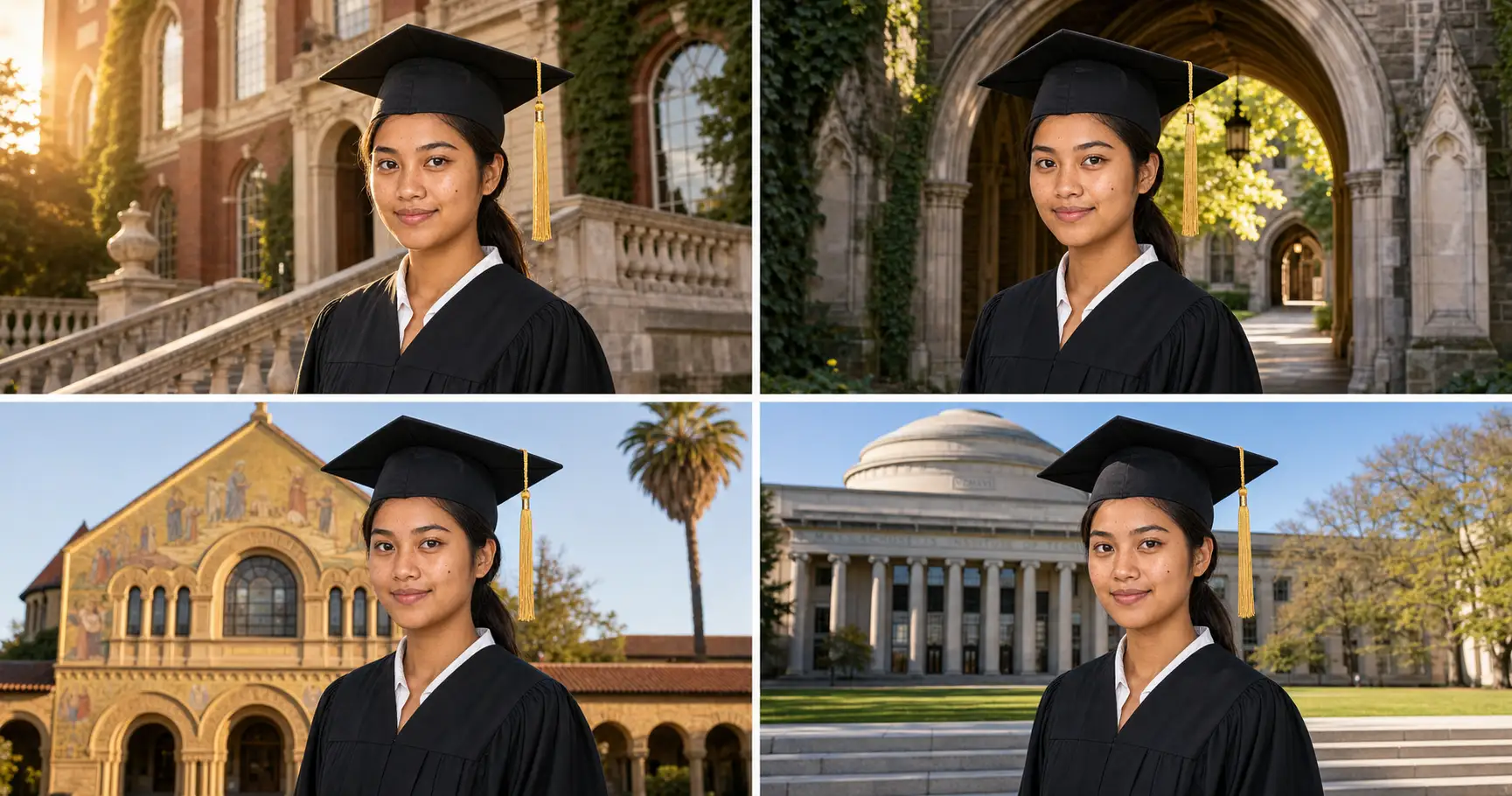
The graduation photo that gets shared on Pinterest is almost never the photo a parent paid a photographer to take. It is the one with the recognizable building behind it. The Widener Library steps. The Yale Old Campus arches. The Stanford Memorial Church facade. For ninety-five percent of graduates, those photos do not exist, because they did not go to those schools. They can exist anyway. One selfie, one prompt, eight portraits at eight iconic American campuses, by Saturday afternoon. Here is the prompt.
The eight-campus tour
One uploaded selfie, one paste, eight portraits. Same face, same cap, same gold tassel falling to the right side of the mortarboard. Eight different American campuses: the Ivy Seven plus one Big Ten anchor. Architectural styles vary. The subject does not. Identity stays locked while location does the work.
Harvard, on the Widener Library steps.
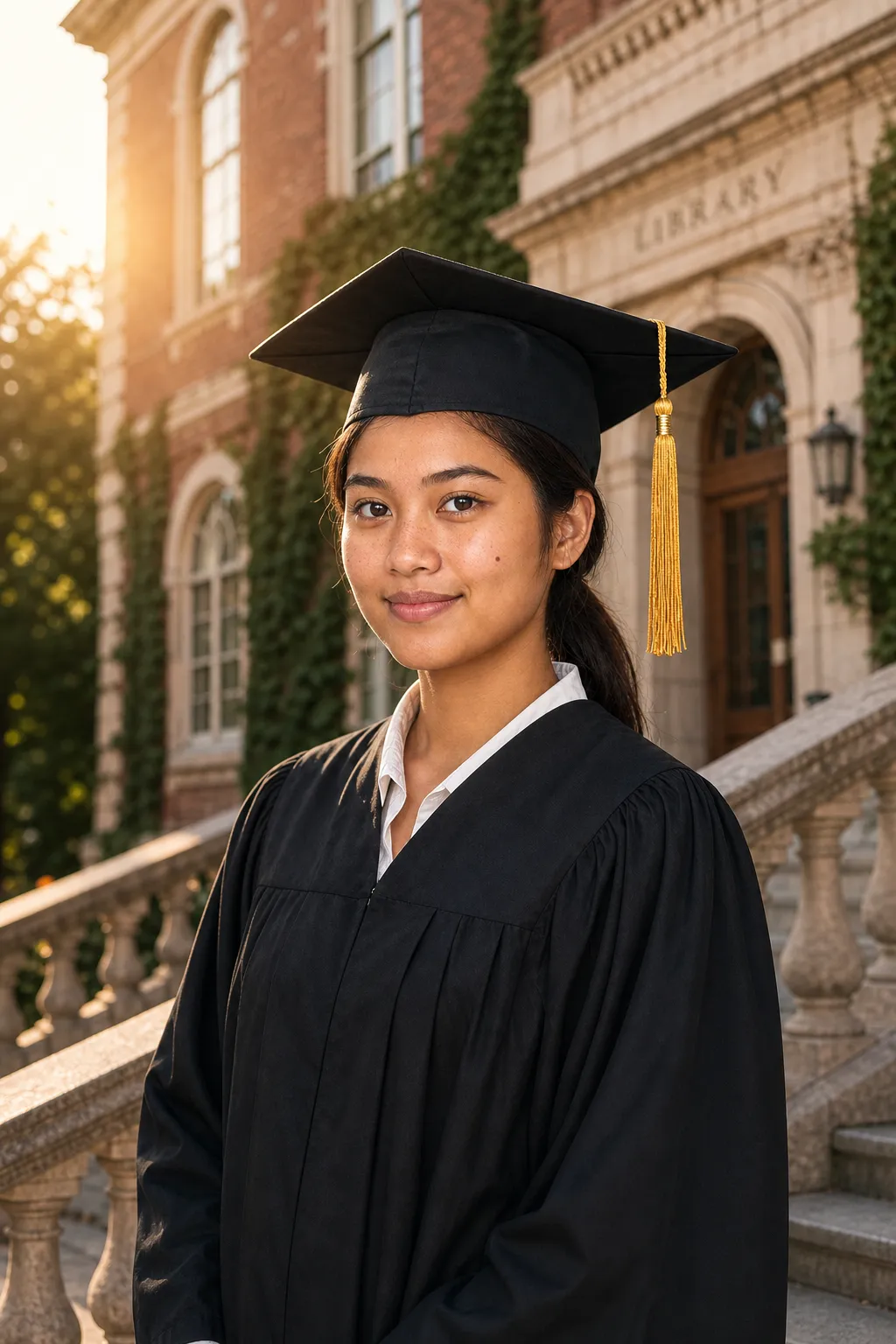
Widener Library opened in 1915, designed by Horace Trumbauer.1 Beaux-Arts limestone over red-brick lateral wings. Granite balustraded steps that descend into Harvard Yard. The prompt renders mid-afternoon golden hour, ivy fully out, the subject standing on the upper landing with the columned entry behind.
Yale, in the Gothic Revival arches of Old Campus.
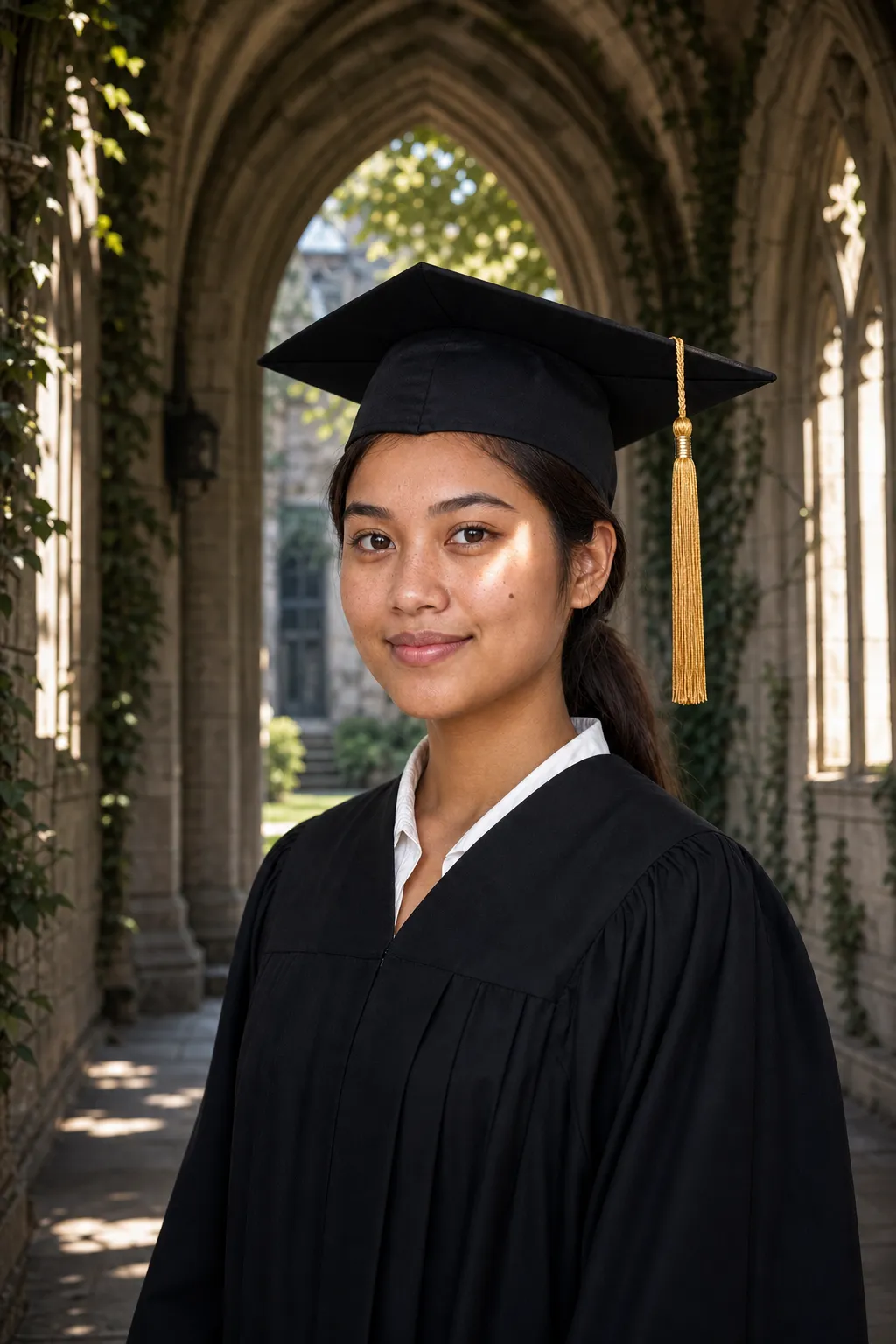
Yale’s Old Campus is bounded by the Gothic Revival residential colleges built in the 1920s and 1930s under James Gamble Rogers.2 Gray cut-stone, lancet windows, dense ivy. The prompt frames the subject in an arched stone passage, late-afternoon light filtering through.
Stanford, on the Memorial Church facade.
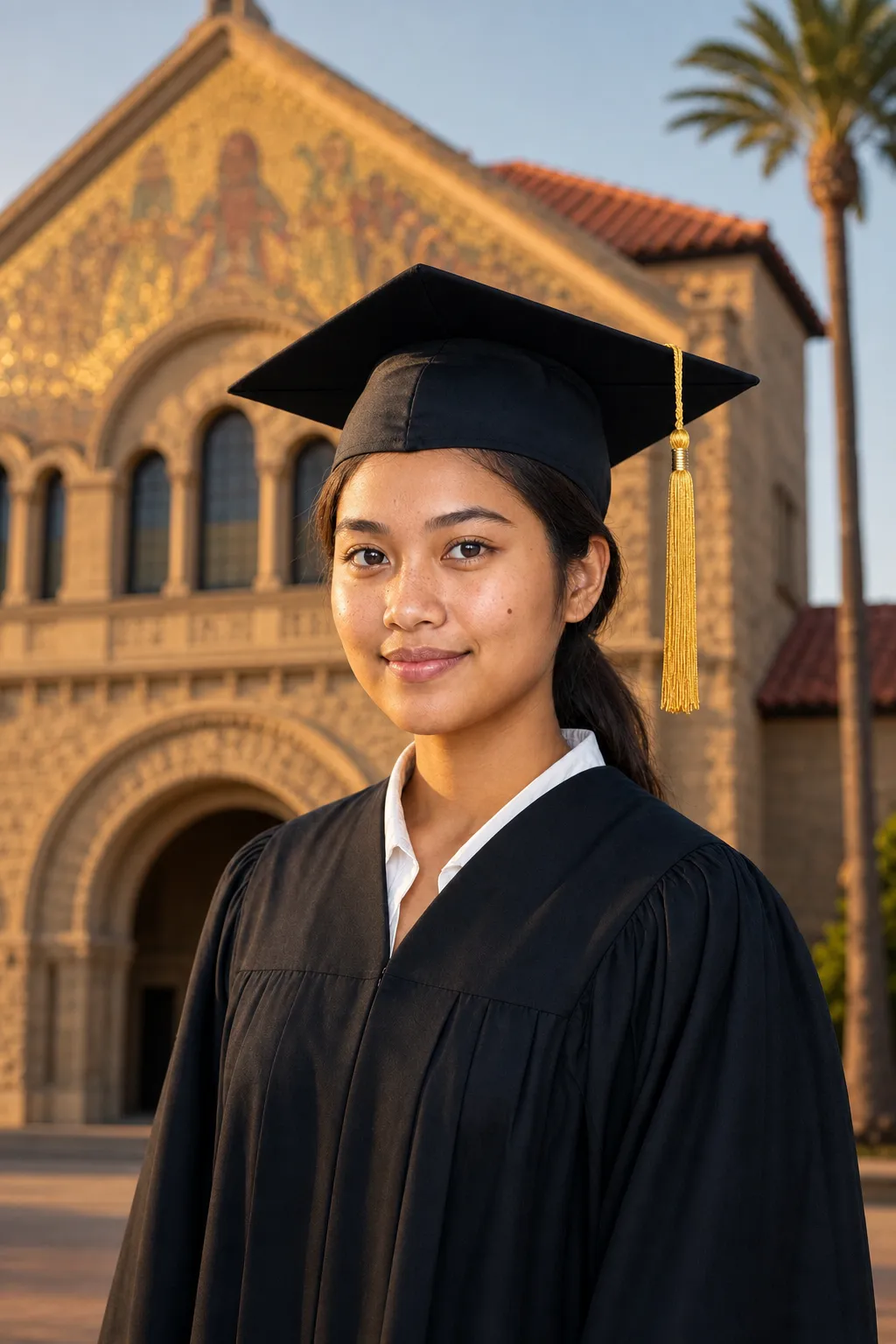
Stanford Memorial Church was dedicated in 1903 in Romanesque style, modeled after Italian sandstone cathedrals.3 The gold-mosaic gable above the rounded arched entry is the campus’s signature shot. Terracotta-tile roofline, dry California afternoon light, a single palm tree at the frame edge.
Princeton, in front of Nassau Hall.
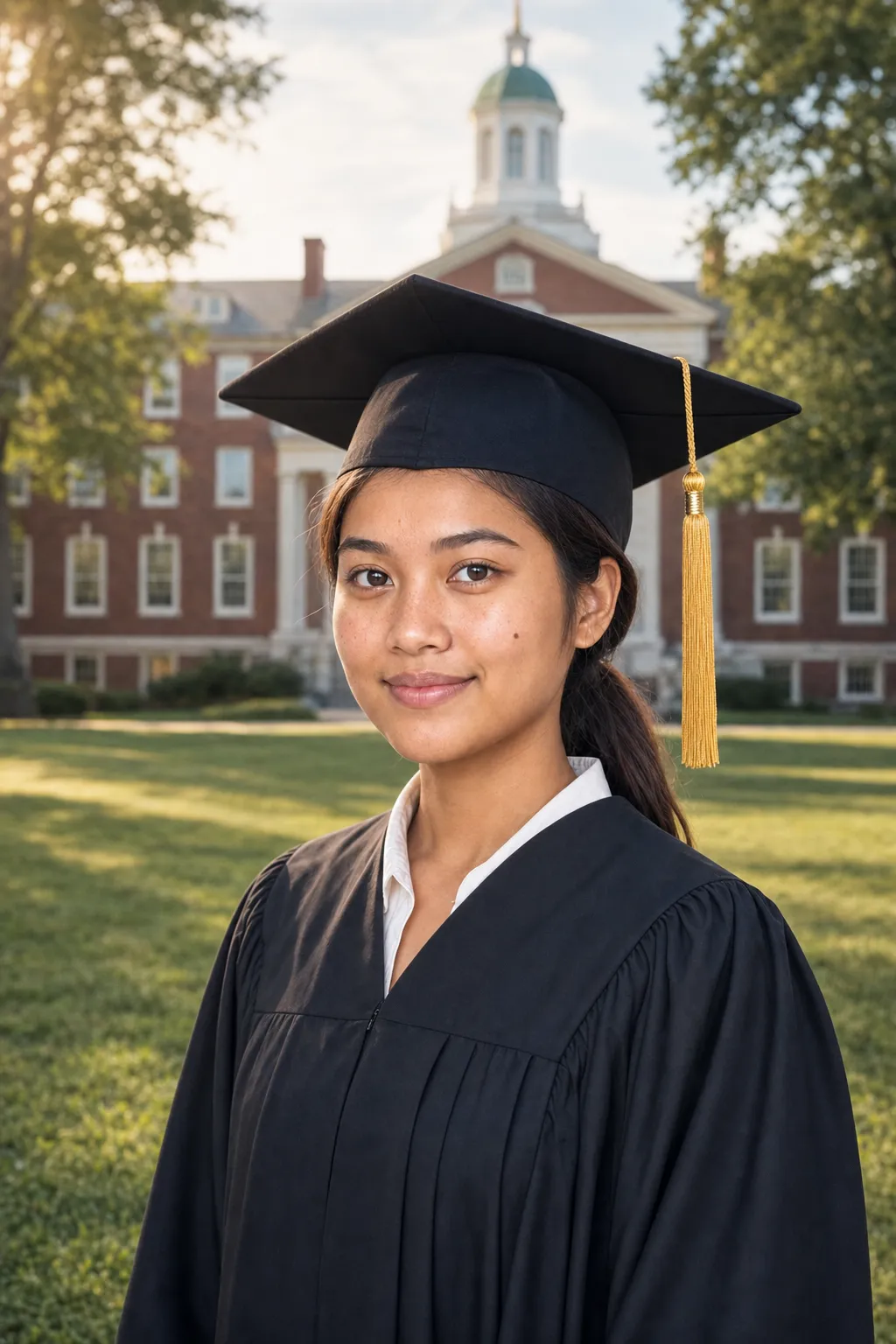
Nassau Hall is the oldest building on Princeton’s campus, completed in 1756.4 Georgian colonial brick, white-trimmed cupola at the center of the roofline, symmetric central entrance under a classical pediment. Broad front lawn, soft New Jersey afternoon light.
MIT, on the Killian Court colonnade.
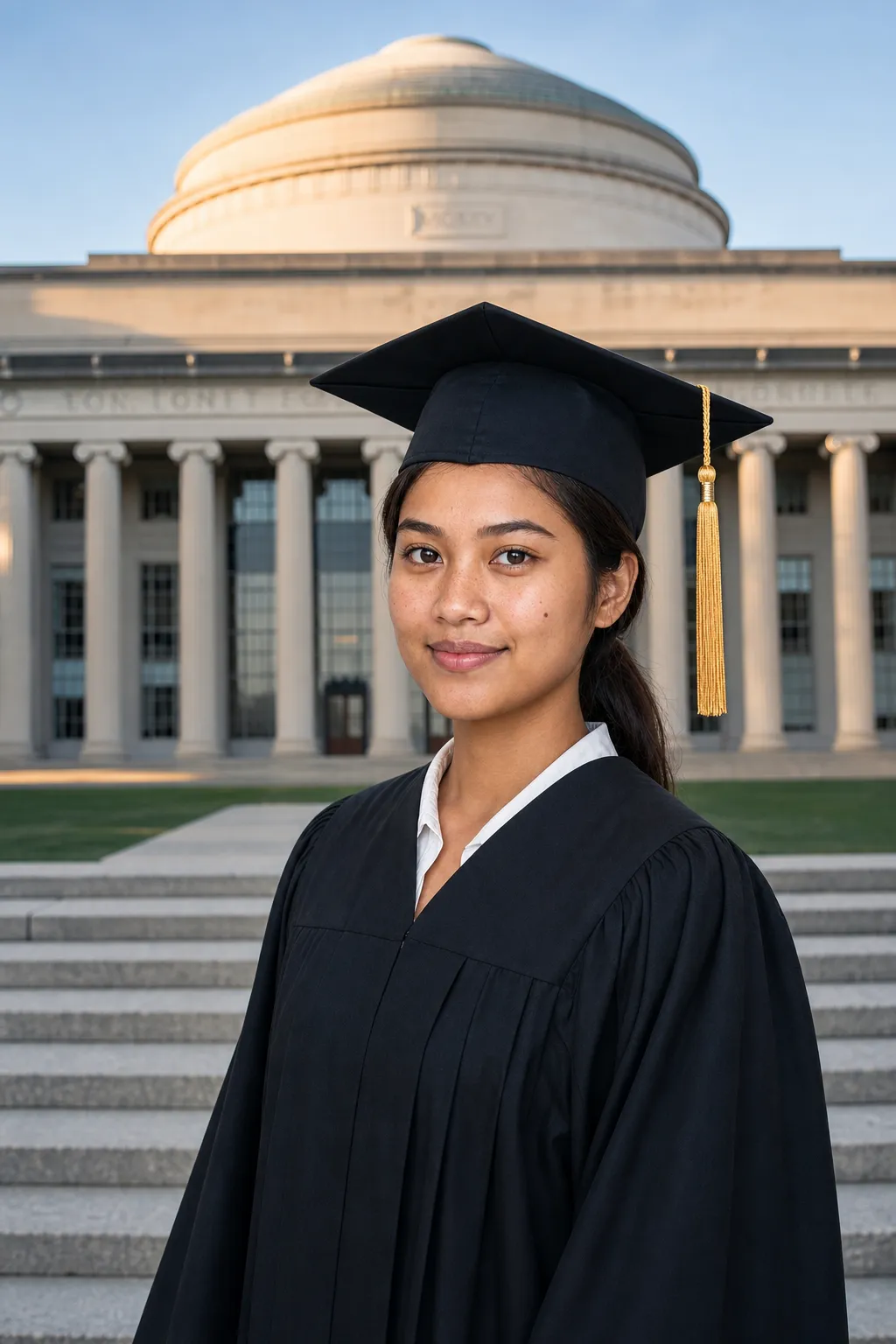
The Great Dome above Killian Court was completed in 1916 in Neoclassical style.5 Limestone columns, classical pediment, an open quadrangle of cropped lawn. Cooler Boston afternoon light, no warm grade, the architecture rendered crisp behind the subject.
Berkeley, at the foot of Sather Tower.
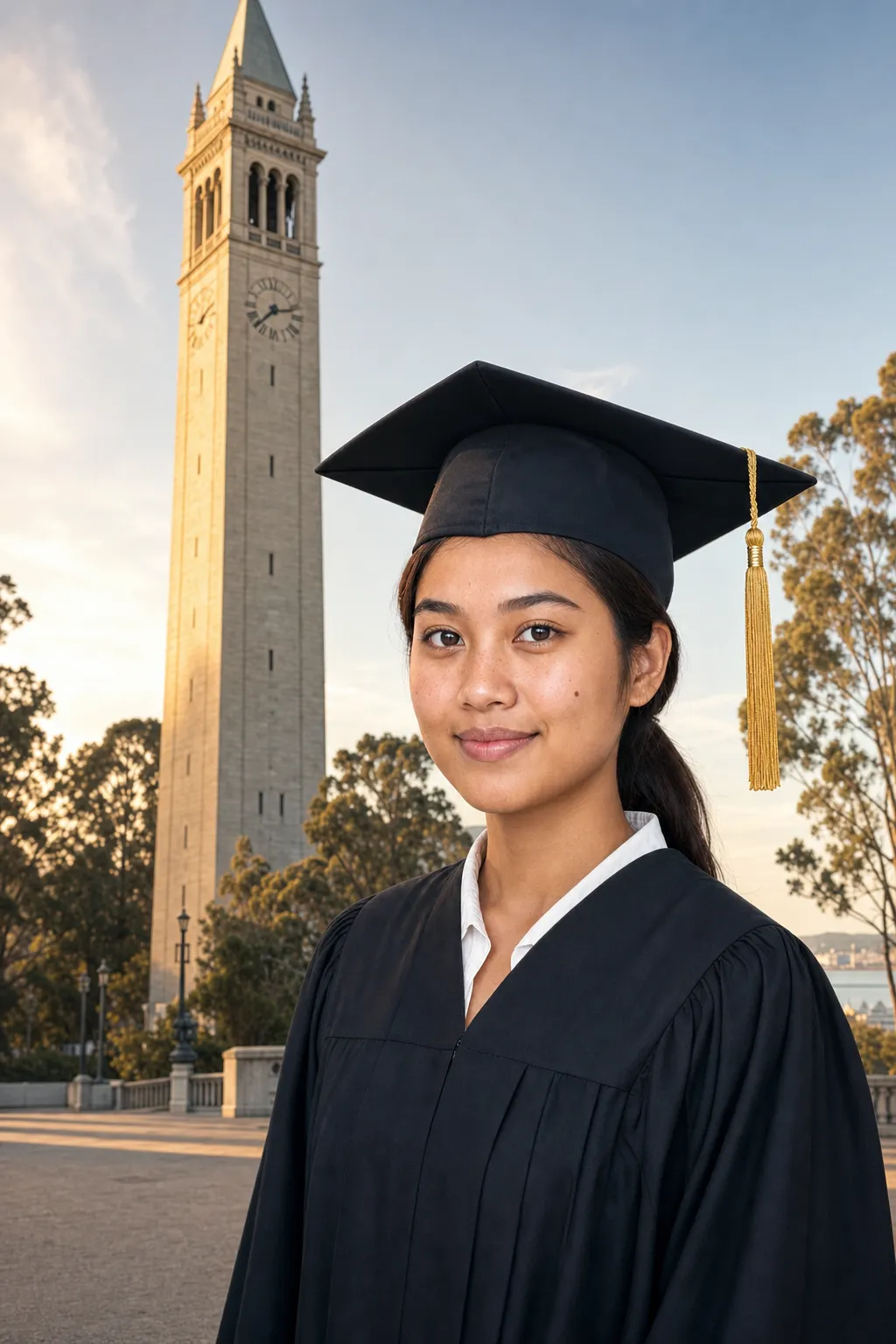
Sather Tower, also called the Campanile, is 307 feet of granite modeled on St Mark’s Campanile in Venice. Dedicated in 1914.6 The base plaza is fringed with eucalyptus. California golden-hour light, the tower rising far above the frame.
Columbia, on the Low Library steps.
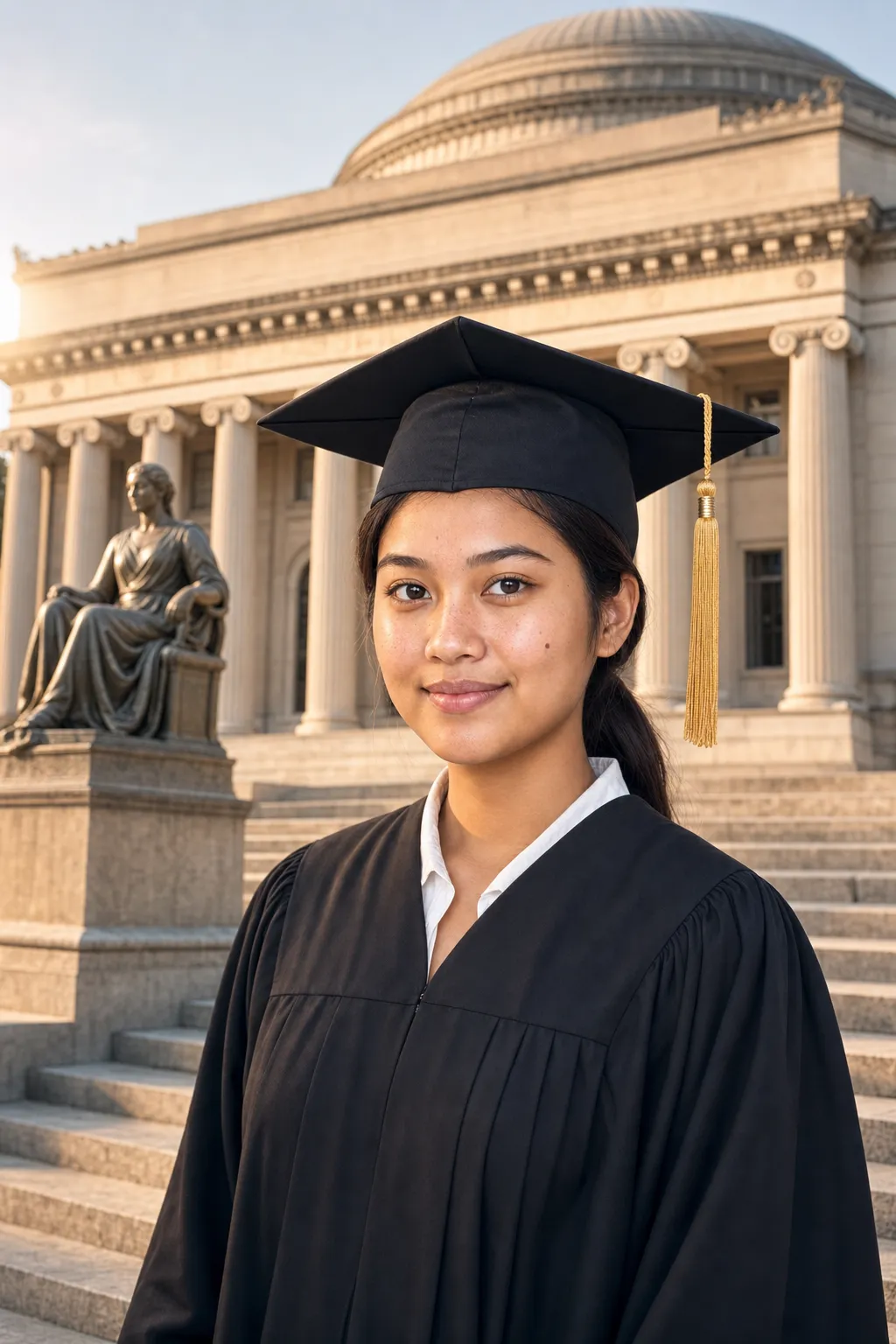
Low Library was completed in 1897 in Beaux-Arts style, with a Pantheon-style domed rotunda.7 The Alma Mater bronze sits at the foot of the steps and has been a Columbia graduation portrait spot for generations. Manhattan late-afternoon light, broad sweeping steps.
Michigan, on the Diag.
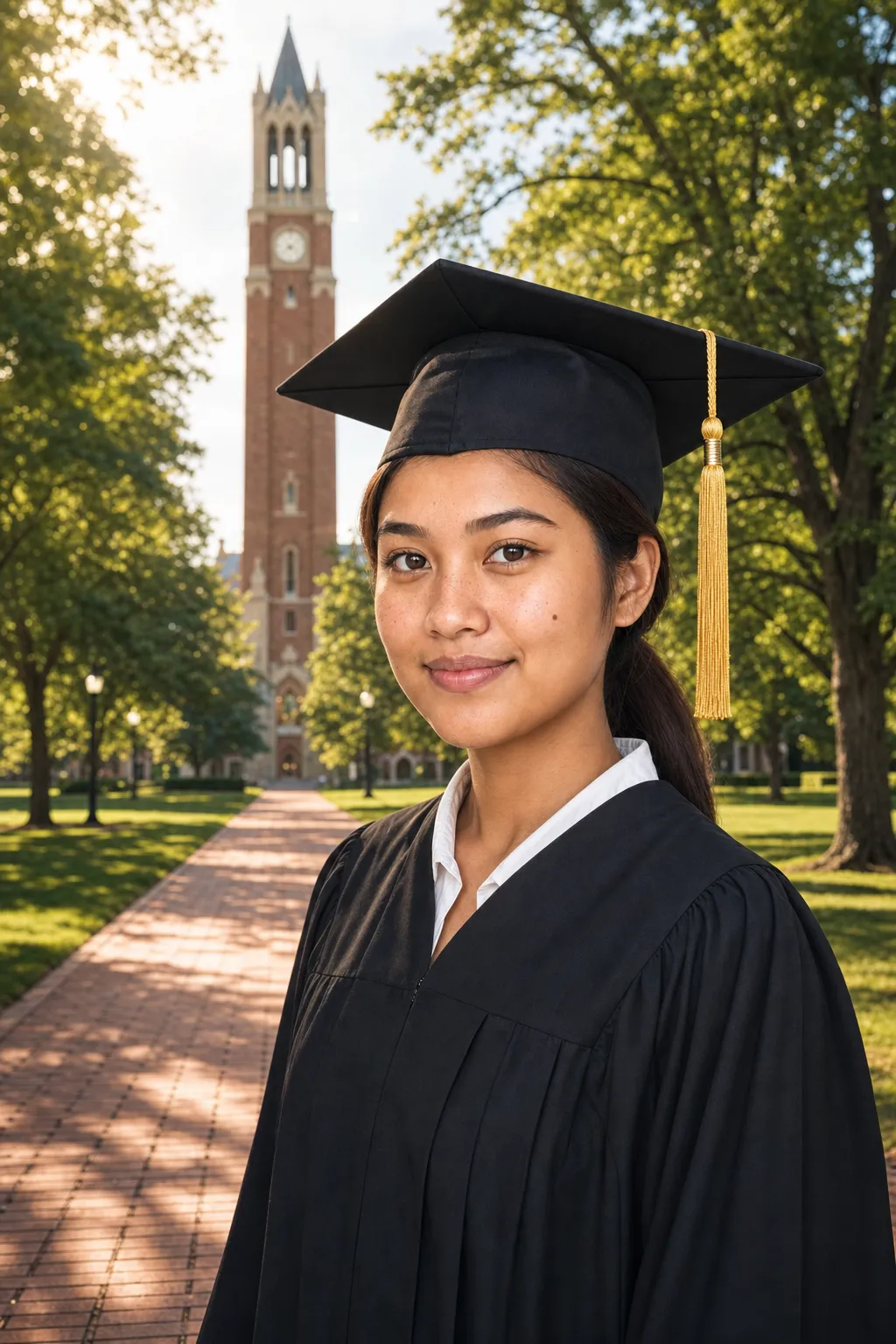
For non-Ivy reach, the Michigan Diag with Burton Memorial Tower in the background reads instantly as American collegiate. Brick belfry with limestone trim, a clock face high on the shaft, a diagonal walkway cutting through a treed quadrangle. Warm Midwestern afternoon light.
Same face. Eight schools. One paste.
The five-line recipe
The prompt has two variables: the campus, and your photo. Everything else is fixed. Paste it into ChatGPT, Claude, or Gemini after uploading one clear front-facing photo of the graduate, then swap the campus line with whichever school you want. The default renders Harvard Widener Library.
Show the full promptTap to expand
Paste this into your AI (ChatGPT, Claude, Gemini, and many other AI image tools).
REQUIRED upload before pasting: one clear front-facing photo of the graduate (eyes open, face well-lit, no sunglasses). This is the face the AI will lock identity to.
Generate this image: A 2:3 vertical editorial graduation portrait, three-quarter mid-shot of the same person from the uploaded reference photo, identity-locked to that exact face, same skin tone, same eye shape, same freckles or moles, same hair color and length, same micro-asymmetry around the mouth, recognizable as unmistakably one person. The graduate is in their early-to-mid 20s, wearing a standard black bachelor’s cap-and-gown with a gold tassel hanging to the right side of the mortarboard, a white blouse or shirt collar just visible at the gown’s V-neck, body angled fifteen degrees to the left of camera, with a confident soft half-smile. The subject occupies roughly 55-65% of the frame, head sitting on the upper third per the rule of thirds. Behind them is {CAMPUS_LANDMARK}. The lighting is warm golden-hour afternoon, with a directional cinematic key from the upper-left at 45 degrees and a cool fill on the shadow side, shot with an 85mm lens look at f/2.0, shallow depth of field so the architecture reads clearly but stays slightly soft behind the subject. Editorial color grade, magazine-grade polish. Final output is a 2:3 vertical portrait suitable for printing or for pinning to Pinterest at native aspect ratio.
Rules the AI must follow:
- Aspect ratio: 2:3 vertical, strict, locked at start and end
- Identity lock from the uploaded reference photo is the highest-priority constraint, the rendered face must be visually unmistakable as the same person; preserve skin tone, eye shape, nose shape, lip shape, hair, and any freckles or moles
- Render visible skin pores, fine micro-texture, natural micro-asymmetry, and any freckles or moles from the reference, no porcelain-AI skin, no plastic flat digital look
- Describe and render the campus by architectural style only, never render a school logo, school crest, school name, banner, wordmark, Greek letters, or any readable signage of any kind
- No Lorem Ipsum, no garbled text, no fake text, the only acceptable text in the image is none at all
- Single image output, one composed portrait, no moodboard, no contact sheet, no variant grid
- Realistic imperfection required: natural cap-and-gown fabric wrinkles, slight tassel sway, weathered stone or asymmetric ivy in the background
- Output the image directly without explaining the prompt back
- All text in English Latin script, but render NO text in the image itself
Replace these placeholders with your details:
{CAMPUS_LANDMARK}= a Georgian red-brick library facade with limestone-trimmed arched windows, granite balustraded steps leading up to its entry, ivy climbing the lateral walls, mid-afternoon golden light raking across the masonry
Bonus tips. This is for you, not the AI. The prompt above already produces the Harvard-Widener-style portrait. Here are paste-ready replacement strings to take the same graduate to a different campus without rewriting from scratch.
Want a different campus?
- Yale Old Campus → “a Gothic Revival stone archway and lancet-windowed facade in gray cut limestone, dense ivy climbing the surrounding masonry, late-afternoon light filtering through a courtyard tree”
- Stanford Memorial Church → “a Romanesque sandstone facade with a large gold-mosaic gable above a rounded arched entry, terracotta-tile roofline, a single palm tree at frame edge, warm dry California afternoon light”
- Princeton Nassau Hall → “a Georgian colonial brick hall with white-trimmed cupola and tall multi-pane windows, a broad front lawn with mature trees, soft New Jersey afternoon light”
- MIT Great Dome at Killian Court → “a Neoclassical limestone dome rising above a classical colonnade and pediment, broad limestone steps leading up, open quadrangle of cropped lawn, cooler clear Boston afternoon light”
- Berkeley Sather Tower (Campanile) → “a tall granite Venetian-style campanile reaching far above the frame, an open plaza at its base with eucalyptus trees at the edge, warm California golden-hour light”
- Columbia Low Library → “a Beaux-Arts limestone facade with a Pantheon-style domed rotunda behind broad sweeping steps, a generic seated bronze figure at the foot of the steps, Manhattan late-afternoon light”
- Michigan Diag (Big Ten option) → “a tall brick belfry tower with limestone trim and a clock face high on the shaft, a diagonal walkway cutting through a treed quadrangle, warm Midwestern afternoon light”
Want a different vibe (same campus)?
- Overcast moody → swap the lighting line to “soft overcast diffused daylight, no hard shadows, cool slightly desaturated editorial grade”
- Dusk twilight → swap the lighting line to “blue-hour dusk light just after sunset, warm interior glow spilling from the building’s windows, cinematic”
- Spring blossom → add to the campus line: “with flowering dogwood or cherry blossom branches in the foreground, soft petal-strewn ground”
Other tweaks.
- Want a horizontal 16:9 print instead → change the aspect line to “16:9 horizontal landscape” and reduce subject framing to 40-50%
- Want a two-person portrait (graduate + parent) → upload both reference photos and add “two people side by side, both identity-locked to the uploaded references, the graduate in cap-and-gown on the left, the parent in business-casual on the right”
- Want the cap mid-toss → swap “soft half-smile” with “laughing mid-toss with the mortarboard cap in mid-air just above their head, motion-blur on the cap only”
The default produces Harvard. The Bonus Tips section at the bottom of the prompt has paste-ready replacement strings for the other seven schools, plus three vibe variants (overcast moody, dusk twilight, spring blossom) and three format tweaks (16:9 landscape, two-person, mid-toss).
Two of those use cases have full walkthroughs of their own. If a parent couldn’t be there when the shot was taken, here’s how to add a missing parent into the graduation photo. And if you’re making this for someone else’s big day, here are more graduation gift ideas you can make from a single photo.
The same identity-lock plus architectural-cue structure works for twelve more photo use cases — founder portraits, product shots, social pins, brand palette. They are packaged in the Independent Brand Visual Kit, free. One email to receive it, plus one short AI move per week. Send me the kit →
Going beyond graduation? The full Image Prompt Pack carries this Ivy prompt plus 124 more, across portraits, gifts, listings, and wallpapers — one paste-ready library.8
The two tricks the prompt does at once
The recipe above does two things that are not obvious from looking at it.
The first is identity-lock. Without specific anchor language, AI image tools default to a generic-handsome face that shifts every time you regenerate. The prompt forces the model to match the uploaded photo’s bone structure, eye shape, hair, and skin micro-texture (visible pores, freckles, mole position), and it repeats that constraint at the start and again at the end of the prompt because models attend more strongly to first and last tokens. The face stays the same across eight environments. Read why most AI portraits still look fake if you want to see the texture rules behind the lock.
The second is architectural description over logos. AI image generators refuse to render trademarked content (school crests, university wordmarks, fraternity Greek letters), per the usage policies of OpenAI and similar providers.9 The prompt sidesteps the refusal completely by describing the campus’s architectural language instead: Beaux-Arts limestone, Gothic Revival arches, Romanesque sandstone, Georgian colonial brick. The model happily renders the building. The reader who knows the school recognizes it immediately. The same identity-lock pattern shows up in our founder portrait prompt if you want to see it applied to one face in one setting.
Identity stays locked. Architecture does the location work. That is the entire recipe.
FAQ
Q: Is it worth paying for graduation photos?
A: Compare the math. A local graduation photographer runs $200-$500 for one location, with travel-and-photographer combos at distant campuses commonly exceeding $700.8 This prompt with an 8x10 print and a $12 frame from Target lands near $19 per portrait, takes one Saturday afternoon, and produces eight portraits at eight campuses instead of one. The professional shoot is still worth it for the one definitive senior portrait you’ll frame for the living room. The DIY version is worth it for the seven other portraits you would have never gotten, the alma mater your parent went to, the school you almost picked, the campus that meant something to you.
Q: What about the four Ivies not in this list (Brown, Cornell, Dartmouth, Penn)?
A: The Ivy League is officially eight schools: Brown, Columbia, Cornell, Dartmouth, Harvard, Penn, Princeton, Yale. This article covers four of them (Harvard, Yale, Princeton, Columbia) plus four other iconic American campuses (Stanford, MIT, Berkeley, Michigan) because those are the campuses most people actually want photos at. The pattern works for any school. For Brown, swap the campus line for “a Georgian colonial brick facade with green shutters and a small classical cupola, ivy-trimmed quadrangle, early-fall light.” For Cornell, swap for “a Romanesque arts-and-crafts stone facade overlooking the Cayuga Lake gorge, fall foliage, late-afternoon light.” Same recipe, different architectural cue.
Q: Can I use this prompt for a school that isn’t on the list?
A: Yes. The architectural description is the only thing that changes between schools. If you want Notre Dame, swap the campus line for “a Gothic Revival limestone facade with a gold-dome basilica behind, classical quadrangle, late-autumn light.” If you want UCLA, swap for “a Romanesque Revival twin-tower brick facade with a Westwood plaza in the foreground.” The framework works for any campus with a recognizable architectural silhouette. The bonus tips at the bottom of the prompt show the pattern: name the architectural style, name two or three signature materials, name the light.
Q: Why doesn’t the AI render my school’s logo or crest?
A: AI image generators refuse to render trademarked visual content, including university crests, wordmarks, and the small heraldic symbols that often appear on official graduation regalia. The refusal is not a bug. It is what the platforms’ usage policies require. The prompt works around the refusal by never asking for the logo. Architecture is enough signal: anyone who has seen Widener Library knows Widener Library when the building is in frame.
Q: How do I keep my face the same across all eight campuses?
A: Identity-lock is the first instruction the prompt gives the model, and it is repeated at the end. That repetition matters because language models pay more attention to the first and last tokens of a prompt. The middle of the prompt can describe a campus, a lighting setup, a wardrobe; the start and end keep saying “the face from the uploaded photo, not a generic face.” If you regenerate eight times with the same uploaded reference, the face holds.
Q: Can I use this prompt for a graduation gift, not my own graduation?
A: That is the more common use. Upload a clear front-facing photo of the graduate, run the prompt at one or two campuses they have a connection to (alma mater, the school they would have gone to, a parent’s alma mater), print at 8x10 from any same-day photo print service, frame from Target or Michaels for under $20. Total cost lands near $19, and the result is on the wall the same weekend.
Key Takeaways
- One AI prompt, one selfie, eight identity-locked graduation portraits at the seven Ivy League campuses plus one Big Ten anchor (Michigan).
- Identity-lock is enforced by repeating the “match the uploaded face” instruction at the start and end of the prompt, where models pay the most attention.
- Architectural description (Beaux-Arts limestone, Gothic Revival arches, Romanesque sandstone) replaces school logos and crests, which AI image generators refuse to render.
- The pattern works for any campus with a recognizable architectural silhouette, including non-Ivy schools and international universities.
- Total cost lands near $19 including the prompt pack, a same-day print, and a frame from Target or Michaels.
Pick a campus
Pick the school you went to. Or the one you would have gone to. Or all of them.
The prompt does not care.
Want the same one-selfie magic beyond campuses? Dream Photo Studio drops your face into any dream scene you pick — same idea, more places to stand.
Footnotes
-
Widener Library, Harvard University. Architect Horace Trumbauer, completed 1915. Beaux-Arts limestone facade with red-brick lateral wings. https://en.wikipedia.org/wiki/Widener_Library ↩
-
Yale’s residential college Gothic Revival architecture by James Gamble Rogers, built 1917-1933. https://en.wikipedia.org/wiki/Yale_residential_colleges ↩
-
Stanford Memorial Church, Stanford University. Dedicated 1903. Romanesque style with mosaic gable. https://en.wikipedia.org/wiki/Stanford_Memorial_Church ↩
-
Nassau Hall, Princeton University. Completed 1756. Georgian colonial brick architecture. https://en.wikipedia.org/wiki/Nassau_Hall ↩
-
Great Dome over Killian Court, MIT. Completed 1916. Neoclassical limestone. https://en.wikipedia.org/wiki/MIT_Building_10 ↩
-
Sather Tower (Campanile), UC Berkeley. Dedicated 1914. Granite, modeled on St Mark’s Campanile in Venice. https://en.wikipedia.org/wiki/Sather_Tower ↩
-
Low Memorial Library, Columbia University. Completed 1897. Beaux-Arts style with Pantheon-style dome. https://en.wikipedia.org/wiki/Low_Memorial_Library ↩
-
Graduation photographer pricing per Thumbtack runs roughly $200 to $500 for a local session, with travel-and-photographer combos at distant campuses commonly exceeding $700. https://www.thumbtack.com/p/graduation-photographer-cost ↩ ↩2
-
OpenAI’s usage policies prohibit generating images that infringe trademarked content, including third-party logos and brand marks. Similar policies apply at Anthropic and Google. https://openai.com/policies/usage-policies/ ↩