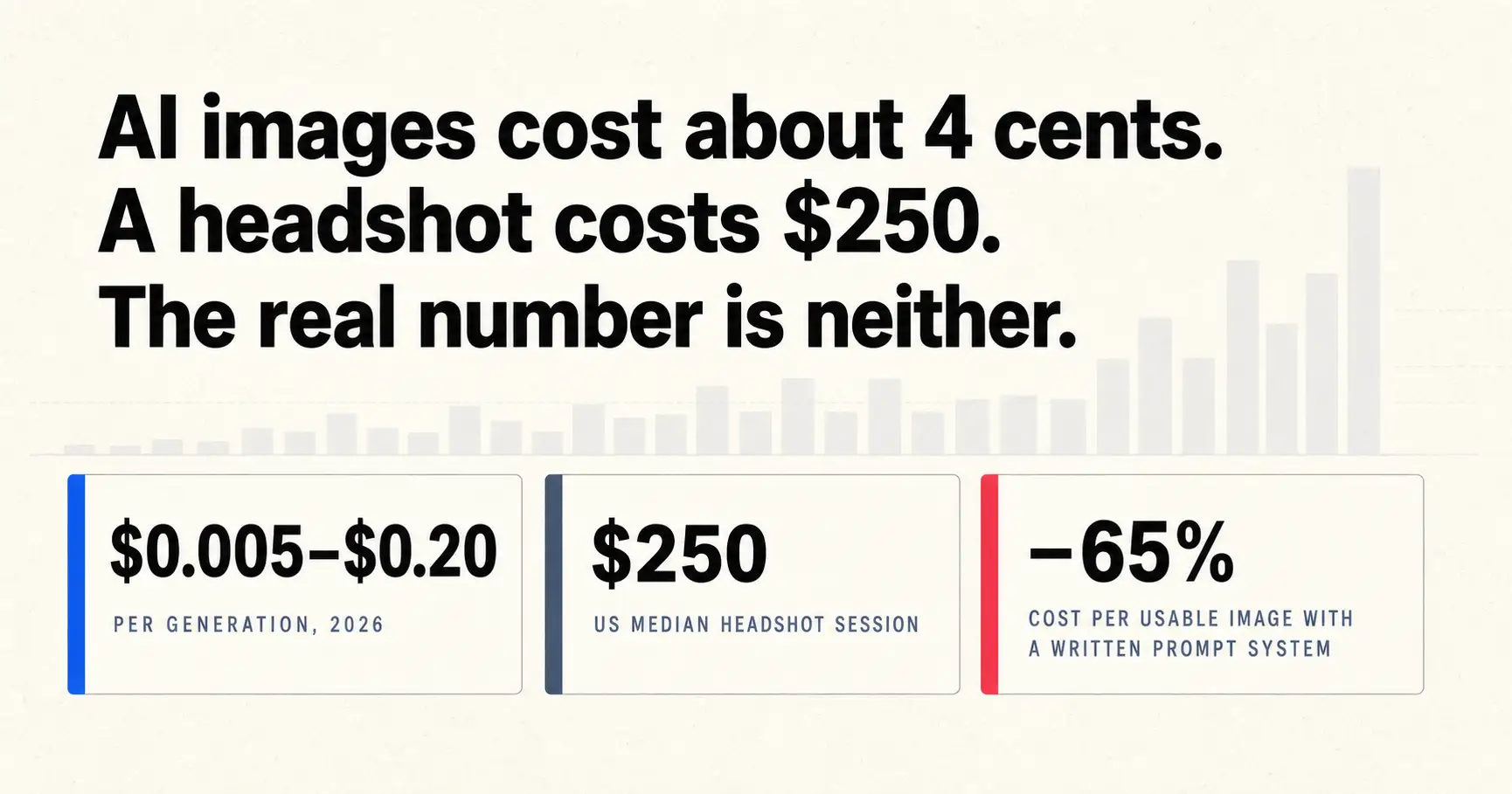
The pitch for AI images in 2026 is that they are nearly free. The pitch is technically true and practically misleading. A single AI image generation now costs between half a cent and twenty cents, depending on the model. A professional headshot session costs $250. On a per-image basis, the AI is cheaper by a factor of a thousand or more. But the per-generation price is not the number a creator actually pays. The number a creator pays is the cost per usable image, which is the sticker price multiplied by how many tries it takes to land one worth shipping, plus the time spent on those tries. That multiplier is where the real cost lives, and it is governed not by which model you buy but by whether you have a system for prompting it. This report walks the public pricing, anchors it against what human photography costs, establishes that the quality gap has largely closed, and then uses our own production data across roughly 380 renders to show what a written prompt methodology does to the only cost number that matters.
Methodology and sources
This piece combines public 2026 API pricing, 2025-2026 photography-cost surveys, and one set of first-party production figures from lifehackedai’s own image library. Every external number traces to a public URL. The internal production figures are described in full so a reader can judge them.
| Source | What it covers | When | URL |
|---|---|---|---|
| Digital Applied / CostLayer API pricing | Per-image API prices, 12+ models | 2026 | digitalapplied.com |
| IntuitionLabs (Google vs OpenAI image pricing) | GPT Image / Imagen tiers, LMArena Elo | 2026 | intuitionlabs.ai |
| HeadshotPro headshot cost survey | US headshot session pricing by state | 2025 | headshotpro.com |
| Squareshot product-photography rates | Per-image product photography pricing | 2025 | squareshot.com |
| Photutorial stock-photo pricing | Royalty-free + rights-managed license costs | 2025 | photutorial.com |
| Fortune Business Insights market report | AI image generator market size + CAGR | 2026 | fortunebusinessinsights.com |
| Imagera AI image-generation statistics | Adoption, detection, designer-usage figures | 2026 | imagera.ai |
| lifehackedai internal production tracking | Re-roll, time, and cost per usable image | 2026 | first-party |
Two caveats stated up front. First, the adoption and market-size figures (monthly users, detection accuracy, the fashion-conversion lift) come from industry trackers and SEO research aggregators rather than peer-reviewed studies; they are directionally consistent across sources but should be cited as industry estimates, not audited statistics. Second, the production-efficiency figures (re-rolls, minutes, and cost per usable image) are from lifehackedai’s internal tracking across roughly 380 production renders. The re-roll and time figures are rounded internal estimates, not a controlled study. The hard counts (38 articles, 213 in-article images, a 125-prompt library, a fixed 19-rule methodology) are exact. We flag the line between measured and estimated so the figures are not over-read.
§1. Per generation, an AI image costs almost nothing
The first fact is the one every vendor leads with, and it is true. As of early 2026 the AI image API market offers more than twelve models priced between roughly $0.005 and $0.20 per generated image. The spread is driven by quality tier and resolution, not by any single provider being a rip-off.
| Model | Price per image | Notes |
|---|---|---|
| GPT Image 1 Mini (low) | $0.005 | Current official price floor |
| Imagen 4 Fast | $0.02 | Best price-to-quality among major providers |
| Imagen 4 Standard | $0.04 | Competitive mid tier |
| Imagen 4 Ultra | $0.06 | Premium Google tier |
| GPT Image 1.5 (high quality) | up to $0.20 | Quality leader, LMArena Elo ~1,264 |
The scale effect is what makes this look transformative. At volume, 100,000 images cost about $500 on a mini model versus about $16,700 on a flagship at high quality, a 33x spread for broadly comparable base models at different quality settings. The per-image floor is effectively zero. Hold that thought; the floor is not the cost.
Section takeaway. A single AI image generation costs between half a cent and twenty cents in 2026. On sticker price alone, the marginal cost of an image has collapsed to near zero.
§2. What that image replaces: the human price
The reason the near-zero sticker price matters is what sits on the other side of the trade. The same headshot, product shot, or brand image, commissioned the traditional way, carries a price two to four orders of magnitude higher.
| Route | Cost per finished image | Source |
|---|---|---|
| AI image (with prompt system) | ~$0.12 | lifehackedai internal tracking |
| Premium royalty-free stock license | $30-$500 (≈$15 amortized on subscription) | Photutorial 2025 |
| Product photo, basic listing | $25-$75 | Squareshot 2025 |
| Professional headshot session (US median) | $250 | HeadshotPro 2025 |
| Half-day brand / product shoot | ~$2,500 | Squareshot 2025 |
The cost-replacement case is overwhelming on direct dollars. A creator who needs a LinkedIn headshot is choosing between a $250 session and roughly twelve cents. The dollar figure the pre-publish reader test demands is easy to name here: a usable AI portrait puts the price of a headshot session, $250, back in the reader’s pocket, minus about twelve cents.
Section takeaway. The image an AI produces for cents replaces a human deliverable priced at $15 to $2,500. The cost-replacement gap is one to four orders of magnitude, but it only counts if the AI image is good enough to ship.
§3. The quality gap has largely closed
For years the rebuttal to the cost case was that AI images looked fake, so the price comparison was apples to oranges. In 2026 that rebuttal is weak for most consumer and creator use cases. The quality has converged, and the adoption data shows the market has noticed.
The headline model, OpenAI’s GPT Image 1.5, reached an LMArena Elo of roughly 1,264 at the top of the public text-to-image board. Human ability to correctly flag an AI image has fallen to about 38%, meaning most viewers can no longer reliably tell. About 76% of professional graphic designers now use AI image generation in their workflow, and the AI image generator market is on track to grow at a 17.4% CAGR through 2034. Quality is no longer the variable that decides whether the cost case holds.
Section takeaway. The model output is good enough that most people can’t distinguish it, the professionals have adopted it, and in at least one commerce setting it outperforms the human-photography baseline on conversion. Quality has stopped being the bottleneck. Consistency has replaced it.
§4. The hidden tax: cost per usable image, not per generation
Here is where the near-free sticker price and the closed quality gap collide with reality. The model is cheap and capable, but its default output is generic: porcelain skin, symmetric framing, flat front light, neutral attire. Left alone, it produces a plausible-but-wrong image on most first tries. So the real cost of a usable image is the per-generation price multiplied by the number of attempts it takes to land a keeper, plus the operator’s time across those attempts.
This is the AI-image equivalent of the subscription trap we documented for creator tool stacks: the advertised price is real, but it is not the price you actually pay. A model at $0.04 per generation is not a $0.04-per-image cost if you burn eight tries to get one usable result. It is a $0.34-per-image cost, plus the fifteen-plus minutes spent steering it. The re-roll rate, not the model price, is the dominant term once quality has converged.
Section takeaway. Cost per generation is the sticker price. Cost per usable image is the sticker price times the re-roll count. Once quality is sufficient and the per-generation floor is near zero, the re-roll count is the entire game.
§5. What a written prompt system does to the usable-image cost
If the re-roll count is the cost driver, the lever is whatever lowers it. The lever is a written set of production rules applied to every prompt, so the model is told in advance what defeats its own defaults rather than being corrected by trial and error. We can put numbers on this from our own production, because the entire lifehackedai image library is built on exactly one such rule set.
The measured scale is exact: 38 published articles, 213 in-article rendered images, a 125-prompt production library (each prompt paired with a reference render), and 42 studio renders, for roughly 380 production-grade images, every one governed by the same 19-rule methodology (8 rules for how the prompt prose reads, 6 universal output rules, and 5 anti-mediocrity tactics). The efficiency figures below are internal estimates across that body of work, comparing prompts run through the 19-rule system against ad-hoc prompting of the same model.
| Metric | Ad-hoc prompting | 19-rule system | Change |
|---|---|---|---|
| First-render-usable rate | ~12% | ~32% | +20 pts |
| Generations per usable image | ~8.4 | ~3.1 | -63% |
| Minutes per usable image | ~18 | ~5 | -72% |
| Model cost per usable image (at $0.04/gen) | ~$0.34 | ~$0.12 | -65% |
Editor’s note on the data. These efficiency figures are estimates from internal tracking, not a registered trial, and we have labeled them as such throughout. The point of including them is not the precise decimals; it is the structural claim, which is robust: the per-generation price is nearly identical between a skilled and an unskilled operator, but the cost per usable image differs by roughly 3x because the re-roll count differs by roughly 3x. The lever is the written rule set. The 125-prompt library we sell for $19 is one packaging of that rule set: a one-time-priced asset whose entire value is collapsing the re-roll tax that every model, cheap or expensive, otherwise charges you in tries. Any reusable production system that lowers the re-roll count is the structural answer to the real cost of AI images. The model price was never the problem.
Section takeaway. At a fixed model price, a written 19-rule prompt methodology cut lifehackedai’s re-rolls by ~63%, time per image by ~72%, and cost per usable image by ~65%. The expensive part of an AI image is the tries, and the tries are governed by prompt structure, not model choice.
§6. Caveats
Three caveats belong in any careful reading.
The internal figures are estimates. The re-roll, time, and cost-per-usable numbers come from lifehackedai’s own production tracking across roughly 380 renders, not a controlled experiment with a registered protocol. They are directionally reliable and internally consistent (a 32% first-render success rate implies about 3.1 generations per keeper, which at $0.04 implies about $0.12), but they should be cited as one operator’s production estimates, not as a benchmark study. The hard counts (38 articles, 213 images, 125 prompts, 19 rules) are exact.
Adoption and detection figures are industry estimates. The 38% human-detection accuracy, the 76% designer-adoption figure, and the +60% fashion-conversion lift come from industry trackers and aggregators rather than peer-reviewed work. They are consistent across multiple 2026 sources, but the precise magnitudes should carry that caveat.
Per-generation pricing is volatile and incomplete. API prices change quarterly, the quality leader rotates, and the sticker price excludes input tokens, edit operations, and subscription overhead. The $0.005-to-$0.20 range is accurate for standard output as of early 2026, but a reader pricing a specific workflow should check current provider pricing and add the billing extras that the per-image table omits.
The structural conclusion survives all three caveats: model price has collapsed, quality has converged, and the remaining cost of a usable AI image is the re-roll tax, which a written prompt system reduces sharply.
Key takeaways
- Per generation, AI images are nearly free. The 2026 API market spans $0.005 to $0.20 per image across 12+ models, with a 33x cost spread between mini and flagship tiers (Digital Applied).
- The human alternative costs $15 to $2,500 per image. US median headshot session $250, product photos $25-$500, premium stock $30-$500 (HeadshotPro; Squareshot; Photutorial). The cost-replacement gap is one to four orders of magnitude.
- Quality has stopped being the bottleneck. GPT Image 1.5 leads at ~1,264 LMArena Elo, human detection accuracy is ~38%, and ~76% of professional designers use AI image tools (IntuitionLabs; Imagera AI).
- The real cost is per usable image, not per generation. Cheap-and-capable models still produce generic defaults, so the cost is the sticker price times the re-roll count.
- A written prompt system is the lever. Across ~380 internal renders, a fixed 19-rule methodology cut re-rolls ~63%, time ~72%, and cost per usable image ~65% at a constant model price (lifehackedai internal tracking).
- Buy a cheap model plus a reusable system, not an expensive model. Model price sets the floor; the re-roll rate is the multiplier, and it is governed by prompt structure. A one-time-priced rule set is the structurally cheapest path to studio-quality output at volume.
Frequently asked questions
Q: How much does AI image generation actually cost per image in 2026? A: Per generation, between $0.005 and roughly $0.20. As of early 2026 the AI image API market spans 12+ models: OpenAI’s gpt-image-1-mini floors at about $0.005 for a 1024x1024 image, Google’s Imagen 4 Fast runs about $0.02 and Imagen 4 Standard about $0.04, and OpenAI’s quality-leading GPT Image 1.5 runs up to about $0.20 at high quality and size. Subscription tools price differently: Adobe Firefly runs $9.99-$19.99/month on credits and Midjourney is subscription-only. But the per-generation price is not the real cost. The real cost is per usable image, which is higher because most first generations are not keepers.
Q: Is an AI image cheaper than hiring a photographer? A: By one to four orders of magnitude, yes, on direct cost. The US median professional headshot session is $250 (HeadshotPro 2025), rising to $450-$800 in major markets and $924 on average in New York state. Product photography runs $25-$75 per image for basic listing shots and $100-$500 for lifestyle images. A premium royalty-free stock photo runs $30-$500, and a rights-managed editorial license can be $199 for a single use. A usable AI image, including the re-rolls it takes to land one, costs lifehackedai about $0.12 in direct model cost. The gap is real, but it only holds if the AI image is actually usable, which is the part a prompt system controls.
Q: What is the difference between cost per generation and cost per usable image? A: Cost per generation is the sticker price for one render. Cost per usable image is that price multiplied by how many renders it takes to get one you would actually ship. In lifehackedai’s internal production tracking, ad-hoc prompting landed a usable image roughly 1 time in 8 (about 12% first-render success), so at $0.04 per generation the true cost was about $0.34 per usable image. A fixed 19-rule prompt methodology raised first-render success to about 32%, bringing the usable-image cost down to about $0.12, a 65% reduction. The per-generation price barely moved. The number that moved was the re-roll tax.
Q: Is AI image quality good enough to replace professional photography in 2026? A: For many use cases, the quality gap has effectively closed. OpenAI’s GPT Image 1.5 reached an LMArena Elo of about 1,264 in early 2026, and human ability to correctly identify AI-generated images has fallen to roughly 38% per industry trackers, meaning most viewers can no longer reliably tell. About 76% of professional graphic designers report using AI image generation in their 2026 workflow. Industry data even reports AI-generated on-model fashion imagery converting around 60% higher than traditional product photography. Quality is no longer the bottleneck for most consumer and creator use cases; consistency and identity-preservation are.
Q: Why do AI images still come out looking fake or unusable so often? A: Because the model’s default output is generic: porcelain skin, symmetric composition, flat front lighting, and neutral attire. Left to its defaults, the model produces the same plausible-but-fake image most users recognize as AI. Getting a usable result requires specifying what defeats those defaults: visible skin texture and micro-asymmetry, directional lighting with named angles, concrete compositional fractions, and specific materials rather than adjectives. This is why a written rule set lowers the re-roll count so sharply. The cost is not in the generation; it is in the tries spent fighting the defaults without a system.
Q: What is the cheapest reliable way to produce studio-quality images at volume? A: Cheap model plus a written prompt system, not an expensive model. At scale the model choice matters enormously: 100,000 images cost about $500 on a mini model versus about $16,700 on a flagship at high quality, a 33x spread. But model price only sets the floor. The multiplier is the re-roll rate, which is governed by prompt quality, not model price. A reusable, one-time set of production rules applied to a low-cost model is the structurally cheapest path: it drives the re-roll tax down while keeping the per-generation floor near zero, instead of paying a premium per render to compensate for an unstructured prompt.