
The 52-year-old uploads his clearest selfie to the AI image tool on a Sunday night, asks for a Hinge-ready lead photo, and the render comes back at 35. The under-eye softness is gone. The lines that frame his smile are gone. The cheek volume he had a decade ago is back. He posts it anyway. Tuesday at the cafe, the woman walks in, looks past him twice, and the recognition slip is the rejection that happens before the date starts. The photo was never the problem.
The choice nobody told you about: aging-down vs aging-up
The over-40 dater has one photo decision to make, and it is not which selfie to lead with. The decision is which version of the face the algorithm sees: the face on date day, or a face from a decade ago.
Aging-down is what the AI does by default. The model has been trained on dating-app and lifestyle-photo corpora that skew young, and “make me look good” is interpreted as “make me look thirty.” Under-eye softness is smoothed. The lines that frame the smile are erased. Cheek volume is restored to a 30-year-old default. The render comes back as a polished younger person with the same eye shape and hair color as the reference, and an almost entirely different face.
Aging-up is what the rule line in the next section forces. Same reference selfie, same wardrobe, same scene. The AI is told, in one sentence, to keep the face the reader sees in the mirror: the half-grey hair, the nasolabial lines, the under-eye softness, the expression lines around the eyes. The face that walks into the cafe.
Aging-down is the rule-break. Aging-up is the rule-following.
Hinge’s published guidance on profile photos names a true full-body shot, photo variety, and a confident lead-photo smile as three of the strongest signals it surfaces. None of those signals matters if the face in the photo does not match the face on date day. The variety credit does not survive the recognition slip. The match does not either.
Everything downstream (lighting, outfit, smile) runs through that one upstream call.
Why the default AI render quietly ages you down
The mechanism is not malice. It is a default.
Image models that render dating-profile photos were trained on millions of pictures of attractive people, and the training distribution skews young the same way Instagram’s distribution skews young. When a 52-year-old uploads a reference selfie and asks for a “good photo,” the model interprets “good” against that training distribution. Skin smoothing is on by default. Cheek volume restoration is on by default. The lines that mark a face as mid-fifties are absent from most of the training distribution, so the model treats them as flaws to fix.
The first marker the default render attacks is the under-eye area. A 50-year-old face has soft texture under the eyes from fifty years of sleep, sun, and laughter. The default render flattens that into porcelain. Nasolabial lines from nose to mouth corners are next. Then the slight softness in the jawline. Then the expression lines at the outer corners of the eyes. Four markers gone, and the rendered face reads ten years younger than the face it was supposed to render. The auto-aging-down default is one of the named AI failure modes the methodology piece on why AI images look fake takes apart. The over-40 dating context is where it costs the most.
The cohort affected is not small. Pew Research’s published data shows online-dating use has risen substantially among adults over 50 over the past decade.
The fix is not a different tool. The fix is a different paste-line.
The aging-preservation rule line {#the-aging-preservation-rule}
The aging-preservation rule line is one sentence the reader pastes into the rules block of any dating-app AI prompt. It defeats the auto-smoothing default.
preserve under-eye softness, nasolabial lines, natural mid-30s-and-up skin texture; do not auto-smooth to a 20s default.
Four things make that line the line.
It names specific anatomical markers. “Make me look my age” is a vague quality and the model ignores it. “Preserve under-eye softness” is a specific instruction the model can act on. The model is good at preserving named features; it is bad at acting on aesthetic preferences.
It uses “preserve,” not “add.” Preservation tells the model the markers exist in the reference and must survive the render. Addition would tell the model to invent markers that may not be there. Preservation is the correct frame for an identity-locked render.
It gives an explicit lower bound and an explicit negative case. “Mid-30s-and-up skin texture” is the hard floor below which the render cannot drift. “Do not auto-smooth to a 20s default” names the failure mode the rest of the line prevents. AI models are more reliable when both the positive and the negative case appear in the same rule.
It is short. Long rule lines get ignored.
Here are the age markers the default attacks, and what the rule line defends.
| Age marker | What the default AI render does | What the rule line preserves |
|---|---|---|
| Under-eye area | Smooths the softness flat into porcelain | Keeps the soft texture from fifty years of sleep, sun, and laughter |
| Nasolabial lines (nose to mouth corners) | Erases them entirely | Holds them visible on every render |
| Mid-50s skin texture | Replaces with porcelain-smooth glass | Visible pores, micro-asymmetry, faint sun-spots |
| Expression lines (outer eye corners) | Airbrushes them clean | Holds them visible when the subject smiles |
| Hair (genuine half-grey at the temples) | Re-darkens, makes hair appear fuller and younger | Keeps the actual mix of brown and silver |
| Jawline / cheek volume | Restores 30-year-old cheek volume, sharpens the jaw | Keeps the soft jawline appropriate to mid-fifties |
The rule line covers all six in one sentence. Drop it into the prompt’s rules block. The face that comes back is the face that walks into the cafe.
Same face, with and without the rule line
The proof is empirical. Below are four renders of the same two people: one male reference at fifty-two, one female reference at fifty. The left column is the default render. The right column is the same prompt with the rule line added. Nothing else changes.




Photofeeler’s research on dating-profile photo testing, published on its blog, finds that the “trustworthy” and “authentic” axes consistently out-perform the “attractive” axis in predicting match rate. The before tile scores higher on attractive. The after tile scores higher on trustworthy and authentic. The over-40 dater is not optimizing for attractive; the date already knows roughly what attractive looks like at fifty. The over-40 dater is optimizing for the read of someone the date can trust to be the same person across the photo, the message thread, and the cafe table.
The proof is in the under-eye softness and the nasolabial lines that survive the render.
One paste-ready AI move a week, in your inbox. Free to start: the Independent Brand Visual Kit, twelve copy-ready prompts for the photo jobs that come up in a normal year, plus the weekly newsletter that drops one new move every Tuesday. Same rule-line discipline as this article.
The 6-tile dating pack with the rule line held across every render
The full output looks like a six-photo profile pack where the same 50-year-old face reads as 50 in every shot. The hero image at the top of this article is exactly that pack: same woman, same age markers, six different scenes. Hinge’s guidance on what those scenes should be is unambiguous: photo variety across at least five distinct settings, at least one true full-body shot from mid-thigh up, a lead photo with eye contact and a real smile. The over-40 version of the pack adds nothing to those rules; it just preserves the face while applying them.

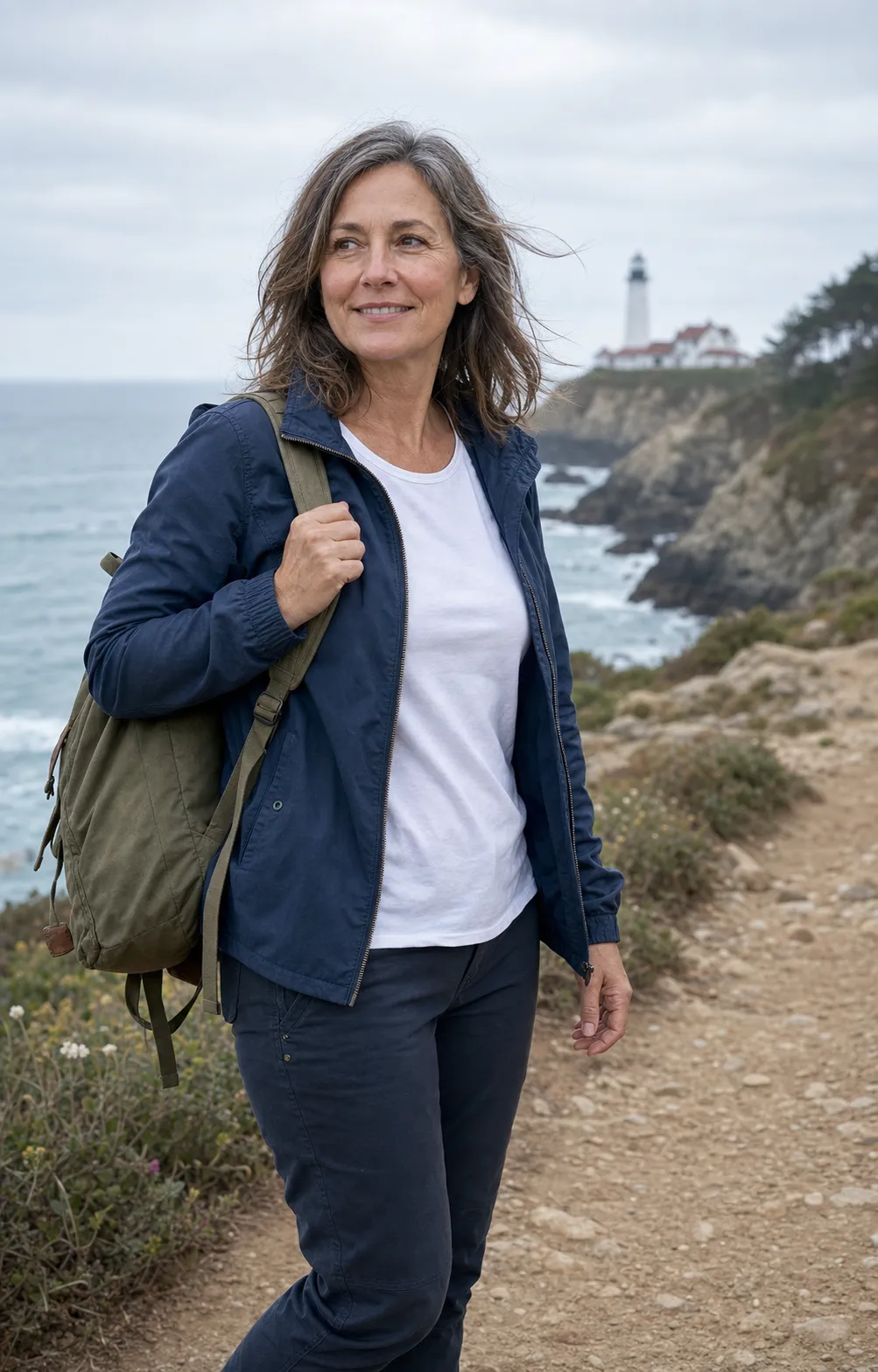

The master-pack prompt, with the rule line woven into the rules block, is below. The reference selfie locks identity across all six tiles. The rule line locks age markers across all six. Wardrobe, light, and setting differ in every tile, the way the gender-neutral 5-photo dating pack prescribes.
Show the full promptTap to expand
Paste this into your AI (ChatGPT, Claude, Gemini, or any AI image tool).
REQUIRED upload before pasting: one clear, well-lit front-facing photo of your face. The single upload is what locks identity across all six tiles.
Generate this image:
A set of six photoreal 4:5 vertical dating-profile photos of the person in the uploaded reference image, rendered as a single 2-row by 3-column grid output, with the SAME face across all six tiles. Bone structure, eyes, nose, lips, proportions, and skin tone identical in every tile so the subject is unmistakably one person across the whole grid.
The six tiles are: Tile 1 is a close-up candid head-and-shoulders selfie with eye contact and a warm half-smile, soft natural window light, plain charcoal cotton tee, quiet at-home interior. Tile 2 is an at-home cozy lifestyle on a soft-grey linen couch in an oatmeal heavyweight knit sweater holding a beige ceramic mug, mid-laugh looking off-camera, soft sunlit living room behind. Tile 3 is an outdoor full-body candid on a coastal cliff path in a navy zip-up jacket and dark canvas pants, soft overcast diffused daylight, full body visible from mid-thigh up. Tile 4 is a mid-action hobby candid mid-laugh while painting at an easel in a paint-flecked denim shirt, warm window-light. Tile 5 is a golden-hour outdoor portrait on a maple-shaded park path in a soft denim jacket over a cream sweater, head turned off-camera mid-smile, warm side-light. Tile 6 is a close-up casual second-angle selfie at a sunlit kitchen counter, plain white tee, late-morning soft light.
Rules the AI must follow:
- Aspect ratio 4:5 vertical for each tile; output as a single 2x3 grid image with thin neutral cream dividers between tiles
- Identity preservation is the highest-priority constraint and applies GLOBALLY across all six tiles
- AGING-PRESERVATION RULE: preserve under-eye softness, nasolabial lines, natural mid-30s-and-up skin texture; do not auto-smooth to a 20s default
- Realistic skin texture required on every tile: visible pores, fine micro-asymmetry, hair flyaways, natural unevenness, faint sun-spots; no porcelain smoothing, no over-retouched beauty filter, no waxy AI-plastic surface
- One human figure per tile
- No text, captions, watermarks, logos, dating-app UI chrome, badge text, or readable signage
- Single grid image output: one file containing all six tiles in 2x3 layout
- Output the image directly without explaining the prompt back
Replace these placeholders with your details:
- REQUIRED upload before pasting: one clear, well-lit front-facing photo of your face (this single upload locks identity across all six tiles)
- (No other placeholders. The tile lineup above is the default; if you want to swap a tile, change only its sentence in the “Generate this image” block above and keep all other rules identical.)
Variety is the ceiling. Age-honesty is the floor.
Don’t want to paste the rule line yourself? AI dating photos render from one selfie inside Dream Photo Studio. Then run the only quality bar that matters on the result: the cafe-table read. If the face that walks in is the face in the photo, it holds.
When aging-up is the rule-break (the honest counter-case)
One narrow counter-case to flag honestly. Sometimes the AI is not aging the reader down; it is aging them up. The reader who uploads a reference selfie that is five years old (taken before the half-grey crept in, before the line at the corner of the mouth set) is uploading the wrong reference. If the reference is a 47-year-old version of a 52-year-old face, the render comes back at 47. The match-day reveal still bites.
The rule is not “always preserve aging markers.” The rule is render the face on date day. If the reference is five years stale, the rule line cannot fix the gap; only a more recent selfie can. Pull a current one from the camera roll, even with mediocre lighting. The lighting is fixable. The wrong year is not.
Photofeeler’s photo-testing data holds on lead-photo eye contact and the real-smile rule, for every age cohort — eye contact with no smile is the one lead that backfires. (OkCupid’s 2010 “4 Big Myths” post argued the contrarian opposite for men; a larger dataset did not back it up.) What neither could say, because no one had an AI image tool in 2010, is that the lead photo also has to render the right year of the right face.
The test is the cafe-table read: the date walks in and recognizes the photo.
FAQ
Q: Is using an AI-rendered photo on a dating profile dishonest if I’m over 40?
A: It is dishonest only if the photo does not look like the person who walks into the cafe. Hinge, Bumble, and Tinder all forbid catfishing, defined as photos that misrepresent how the person actually looks. An AI-rendered photo of your real face in clothes you wear, with the aging-preservation rule line holding your real age markers, does not cross that line. The face has to be yours, at the age you actually are.
Q: My reference selfie is five years old. Will the aging-preservation rule still work?
A: Partly. The rule line preserves the age markers visible in the reference photo. If the reference is five years old, the markers in it are the five-year-old ones, and the render inherits those. The rule line cannot age you forward to today’s truth; only a more recent reference can. Pull a current selfie from your camera roll, even one with mediocre lighting. The AI fixes the lighting. The reference has to fix the year.
Q: Should I write “make me look my age” in the prompt instead of the rule line?
A: “Make me look my age” is too vague for the model to act on; it gets ignored and the default smoothing wins. The aging-preservation rule line works because it names specific anatomical markers (under-eye softness, nasolabial lines, mid-30s-and-up skin texture) that the model can hold against. Specificity is what makes the rule survive the render. The shorter, less specific version is what makes the render quietly drift back to the 30-year-old default.
Q: I’m a woman over 50. Do the same rules work for me as for an over-40 man?
A: Yes, with one practical addition. The default render attacks the same markers across genders: under-eye softness, nasolabial lines, skin texture, expression lines. The rule line is gender-neutral and works on every render. The one woman-specific addition is hair. The default model is especially aggressive at re-darkening grey streaks into a uniform shade. Adding “preserve natural grey-streaked hair, do not re-darken or homogenize” to the rule line, if your reference shows grey, gives the model the same kind of specific instruction the rest of the line gives for facial markers.
Key Takeaways
- The over-40 dater’s only real photo decision is aging-down vs aging-up. Everything else (lighting, outfit, smile, scene variety) runs through that one upstream call.
- The default AI render quietly ages the over-40 reference photo down by roughly ten years: under-eye softness smoothed, nasolabial lines erased, cheek volume restored, hair re-darkened. The model is not malicious; the model is following its training distribution’s idea of “good.”
- The aging-preservation rule line (“preserve under-eye softness, nasolabial lines, natural mid-30s-and-up skin texture; do not auto-smooth to a 20s default”) is one pasteable sentence that defeats the default. Drop it into any dating-app prompt’s rules block.
- The test is the cafe-table read. The face that walks in has to be the face in the photos. If it is not, the match does not survive, regardless of how good the prompt was.
The Tuesday after
The 52-year-old from the opening scene opens his app the following week. The lead photo is the after-tile from the section above. The half-grey hair is in it. The lines around his smile are in it. The under-eye softness is in it. On Tuesday at the cafe, the same woman who had walked past him twice walks in, sees him, and walks straight over. The recognition is the part that did not happen the first time. The rule line is the part that made it happen the second.
The rest of the photo jobs in a normal year (LinkedIn headshot, founder portrait, listing photo, personal-brand grid) hold the same rule-line discipline. They live in the $19 Image Prompt Pack, one of 125 prompts for the visual jobs that come up across the year. Prefer to skip pasting? AI dating photos render from one selfie inside Dream Photo Studio.
Render the face on date day. Then post it.