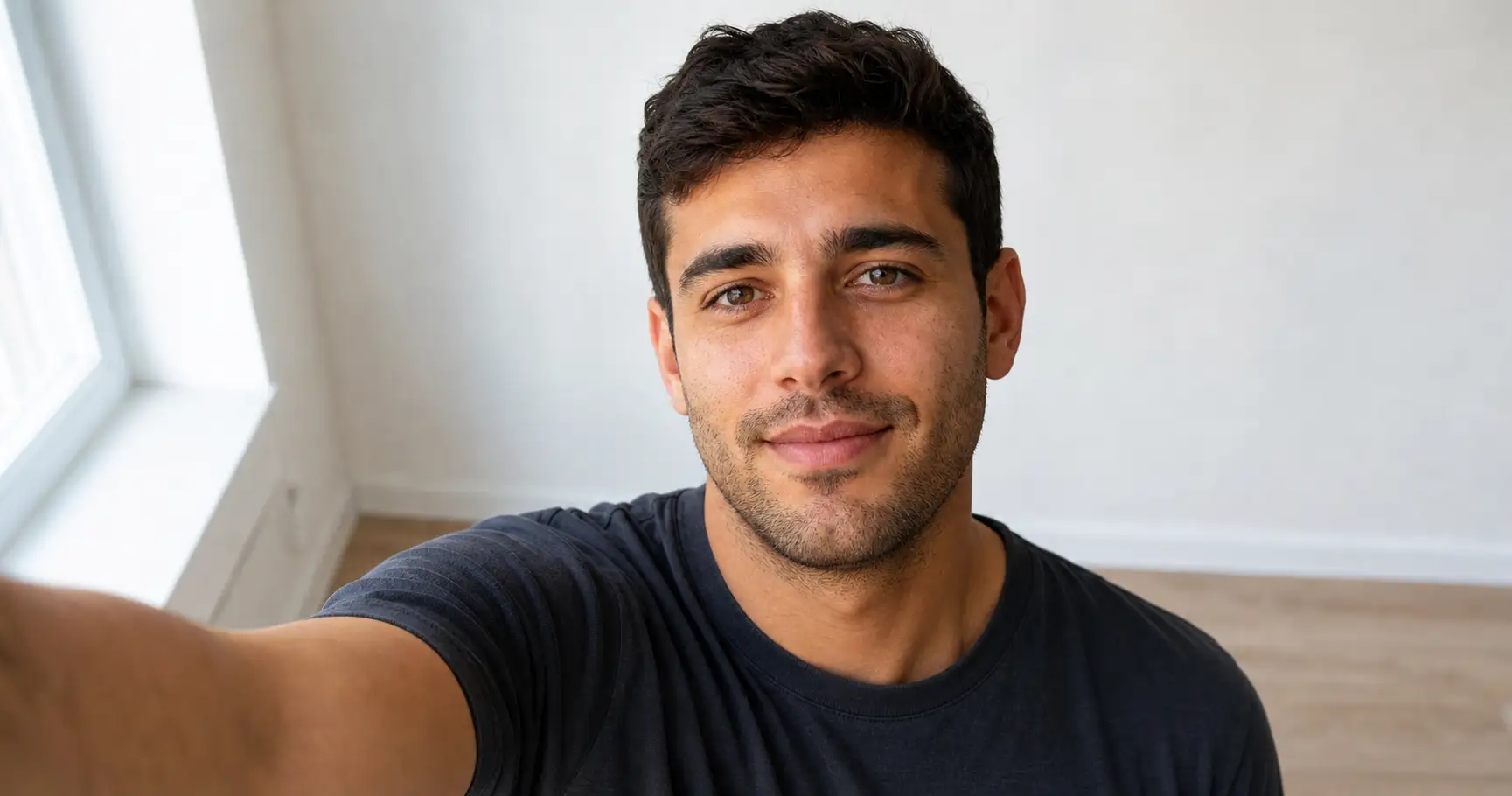
You raise the phone, take a selfie, hate it, and take another. Thirty frames later you use the least-bad one and still wince a little. The front camera seems to have a grudge. It doesn’t, and the fix isn’t your face. It’s three small things you’re probably not doing, and once you stack them you can stop the thirty-retake ritual for good.
The front camera has its own quirks, but the phone-camera basics underneath, the ones in how to take good photos with your phone, apply to every shot you take.
Why the front camera seems to hate you
A selfie is taken at the one distance designed to flatter you least. Arm’s length puts the lens about a foot from your face, and a close lens stretches whatever is nearest it. A 2018 Rutgers and Stanford study in JAMA Facial Plastic Surgery put a number on it: a nose looks roughly 30% wider at that distance than from a few feet back. You can’t move the camera much on a selfie, so the trinity is about countering the distortion instead of escaping it.
Hold the phone low and you add a second problem on top: it shoots up your nostrils and folds your chin into your neck. You are not unphotogenic. You are fighting a close, low lens with a flat ceiling light, and you can beat all three.
This is also why selfies are worth getting right rather than avoiding: a 2025 PhotoAID survey found 60% of US adults take one at least once a week, 84% of Gen Z. It is the photo of you that people see most.


The selfie trinity
Three moves. Stack them in any order; the photo gets better with each one.
Move 1: Put the light in front of you
Find the biggest soft light in the room, almost always a window, and turn so it is on your face, not behind you. Front light fills in shadows and brightens your eyes. Backlight turns you into a silhouette, and the overhead bulb you default to indoors carves shadows under your eyes and nose. If you can only fix one thing, fix the light.
Move 2: Lift the camera above eye level
Raise the phone a little higher than your eyes and look up to it. This is the single move that undoes the classic bad selfie: a camera below your chin looks up your nose and doubles your chin, while a camera slightly above does the reverse. A touch above eye level is the sweet spot; way overhead just shrinks you.

Move 3: Push your chin forward and down
It feels strange and it looks right. Gently extend your forehead toward the lens and drop your chin a little, the “turtle” move. It separates your jaw from your neck and removes the double-chin the lens invents. Pair it with a three-quarter face turn rather than a flat, square-to-the-lens stare, which reads like an ID photo.
Tweak it for the situation
The trinity is the base. A few adjustments handle the specific selfies you take most.
Best angle, by default: camera a touch above, face turned three-quarters, looking just off the lens rather than dead into it. Eyes-off reads as caught, not posed.
For a dating app: one clear, well-lit head-and-shoulders shot with a real smile that reaches your eyes. Skip heavy filters, which read as hiding something. Approachable beats polished.

For a candid feel: don’t hold the pose. Wharton’s Jonah Berger found candid-looking photos make a better impression than careful posed ones, so do a small real thing (laugh, look away, then back) and shoot a burst.

If you want poses to copy rather than rules to follow, that is its own thing: selfie poses and ideas lays out the angles and setups, and if you’d rather set the phone down entirely, how to take good photos of yourself covers the hands-free setups.
One short paste-ready habit a week, the kind you can use on a Tuesday. Subscribe to the newsletter and you get a free kit of twelve copy-ready prompts to start.
The no-retakes shortcut
Some days the light is bad, the angle won’t cooperate, and you have taken the same shot fifteen times. When the trinity can’t save it, there is another way in: upload one clear selfie and let AI render a better one in good light, keeping your actual face. It is the fastest path to a usable photo when retaking isn’t working, and it costs nothing to try. The selfie you took is enough input.
FAQ
Q: What is the trick to taking good selfies?
A: There isn’t one trick, there are three, and they work together: light in front of your face, the camera held just above eye level, and your chin pushed slightly forward and down. The light removes shadows, the height undoes the up-the-nose distortion, and the chin sharpens your jaw. Get those three and you can stop firing off thirty frames.
Q: What is the most flattering way to take a selfie?
A: Hold the phone a little above your eye line so it looks gently down at you, turn your face about three-quarters instead of square to the lens, push your chin forward and down, and face the nearest soft light. Then add a real expression instead of a held one. That combination flatters almost everyone, which is why it’s the default to fall back on.
Q: How do you make your face look good in selfies?
A: Most of what you dislike is the lens, not your face. A phone held close and low widens your nose and stacks your chin. Lifting the camera above eye level and pushing your chin forward and down counters both, and turning toward a window adds the soft light that smooths everything. None of it changes your face; it changes the geometry.
Q: How do you take a good selfie when you’re older?
A: The trinity matters even more: the above-eye-level angle and chin-forward move do the most to define the jaw, and soft front light from a window is far kinder than overhead or flash. Skip heavy filters, which read as trying to hide something. A real expression in good light beats a smoothed one every time.
Key Takeaways
- The front camera isn’t the enemy; a close, low lens with flat light is. Selfies sit at the most distorting distance there is, so a nose can look about 30% wider than from a few feet back (JAMA, 2018).
- The selfie trinity counters it: light in front of you, camera just above eye level, chin forward and down.
- Turn your face about three-quarters and look just off the lens for the default flattering angle.
- For dating apps, go clear and warm over filtered; for a candid feel, do a real thing and shoot a burst.
- When retaking isn’t working, one selfie can be turned into a better shot with AI in seconds.
Try the three on the next one
Next time you raise the phone, run the three in order: turn to the window, lift the camera above your eyes, push your chin out. Take five, not thirty. The difference between the selfie you delete and the one you keep was never your face; it was those three moves.