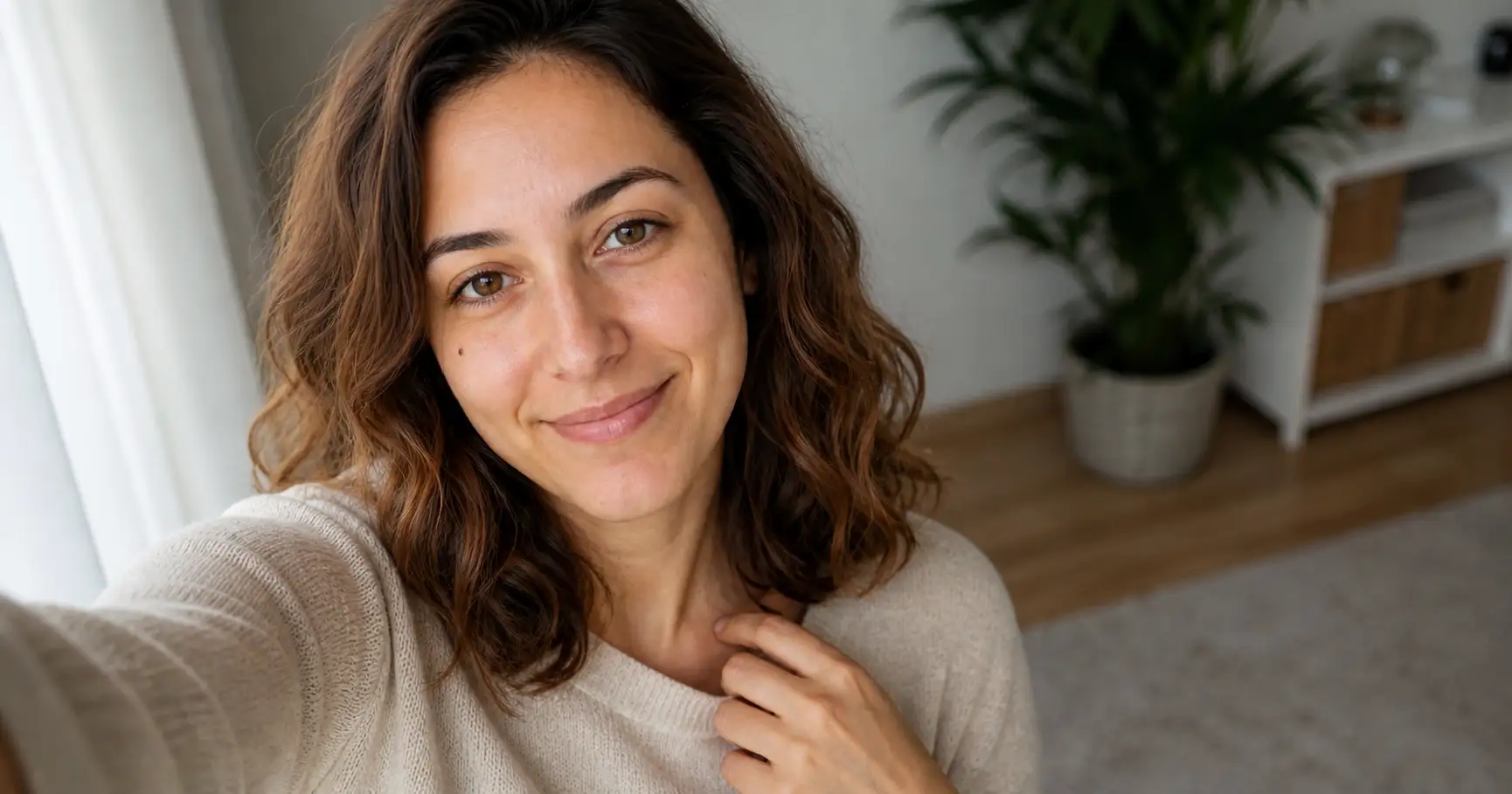
You take ten selfies in a row and hate all ten. One’s weirdly flat, one’s all chin, one looks like you’re trying way too hard, and you can’t even say what’s wrong with the rest. So you delete them and use the slightly-less-bad one. The fix isn’t your face. It’s two small things about the angle, plus giving yourself something to do. Here are 30 ideas grouped by situation, each with the one move that makes it work, plus a way to put yourself in any of them from a single selfie.
Why your selfies look off, and the two fixes
You’re not alone in the ten-bad-takes ritual. A 2025 PhotoAID survey of just over a thousand US adults found that 60% take a selfie at least once a week, and among Gen Z it’s 84%. So a lot of people are quietly hating a lot of their own photos. And most of why has nothing to do with how you look and everything to do with where the camera is. A selfie shot at arm’s length, about a foot from your face, makes your nose look roughly 30% wider than the same face shot from a few feet back, according to a 2018 Rutgers and Stanford study published in JAMA Facial Plastic Surgery. The phone is right there, close and low, so it stretches whatever’s nearest the lens. That’s the wide nose. That’s the heavy chin.
The fix for that one is almost stupid. Lift the phone a little above your eye line so it looks gently down at you, and lean back an inch. The distortion eases, the chin softens, and you didn’t change a thing about your face.
The second fix is the pose itself. Square to the lens with a held smile reads like an ID photo, because that’s exactly the geometry of an ID photo. Turn your face about three-quarters instead, push your chin slightly forward and down, and give your free hand a job. And don’t hold the expression. Wharton marketing professor Jonah Berger analyzed thousands of profiles and found that candid-looking photos make a better impression than careful posed ones, so the trick is to do a small thing and let the camera catch you mid-it.


That’s the whole engine. Camera up, face off-flat, do one small thing. Every idea below is just a different setting for the same three moves.
Selfie poses and ideas, by situation
You don’t need all 30. Find the group that matches where you are, steal two, and shoot a burst of each.
Best angles (start here if you only learn one)
The reliable defaults. If you do nothing else, do these.


More to try here: tilt your head a few degrees toward the higher shoulder, drop one shoulder back to slim the line, hold the phone at full arm’s length so your face isn’t the closest thing to the lens, and try both profiles to find your better side.
Mirror selfie (full-body, without hiding your face)
The full-length shot that usually goes wrong because the phone eats your face.
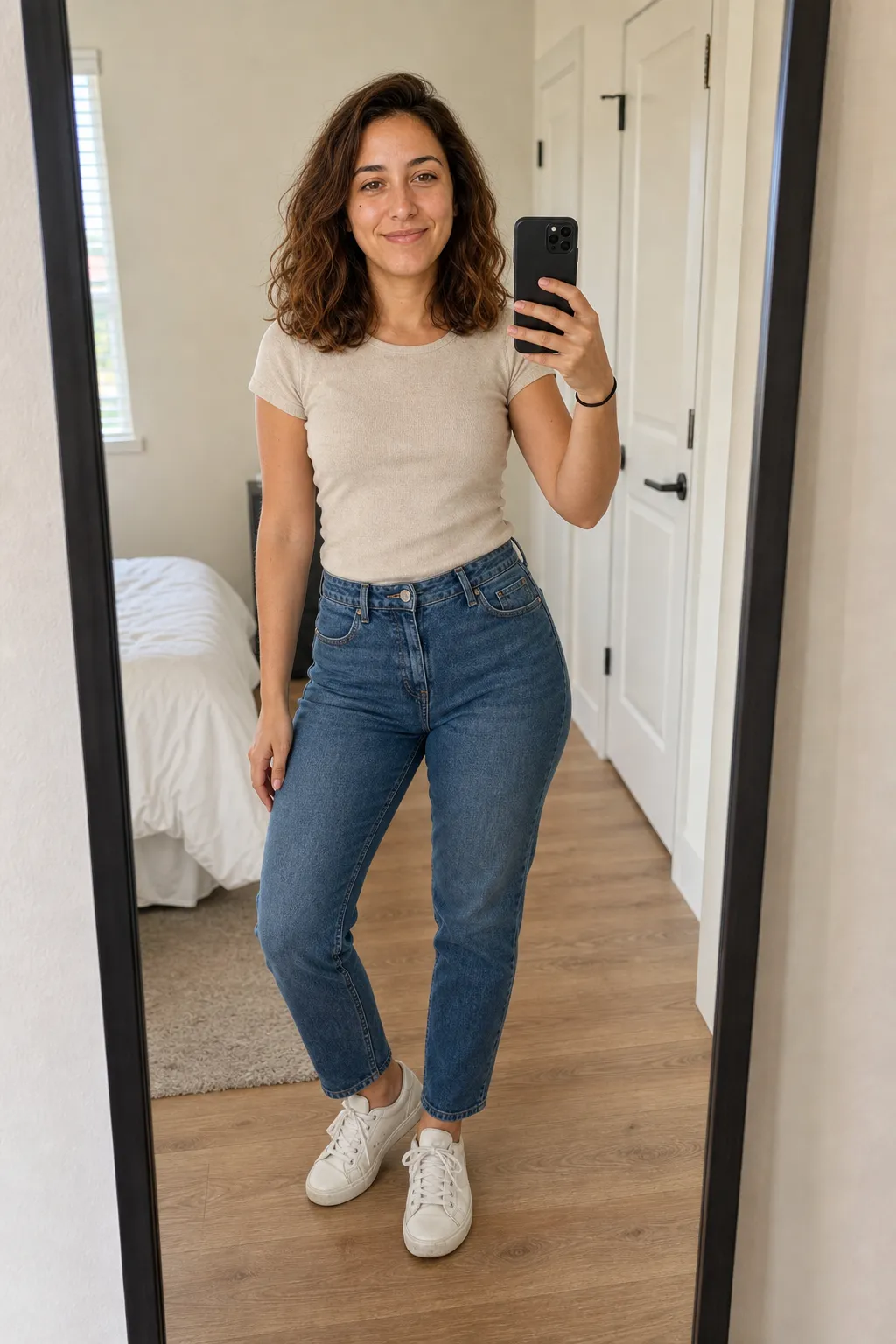
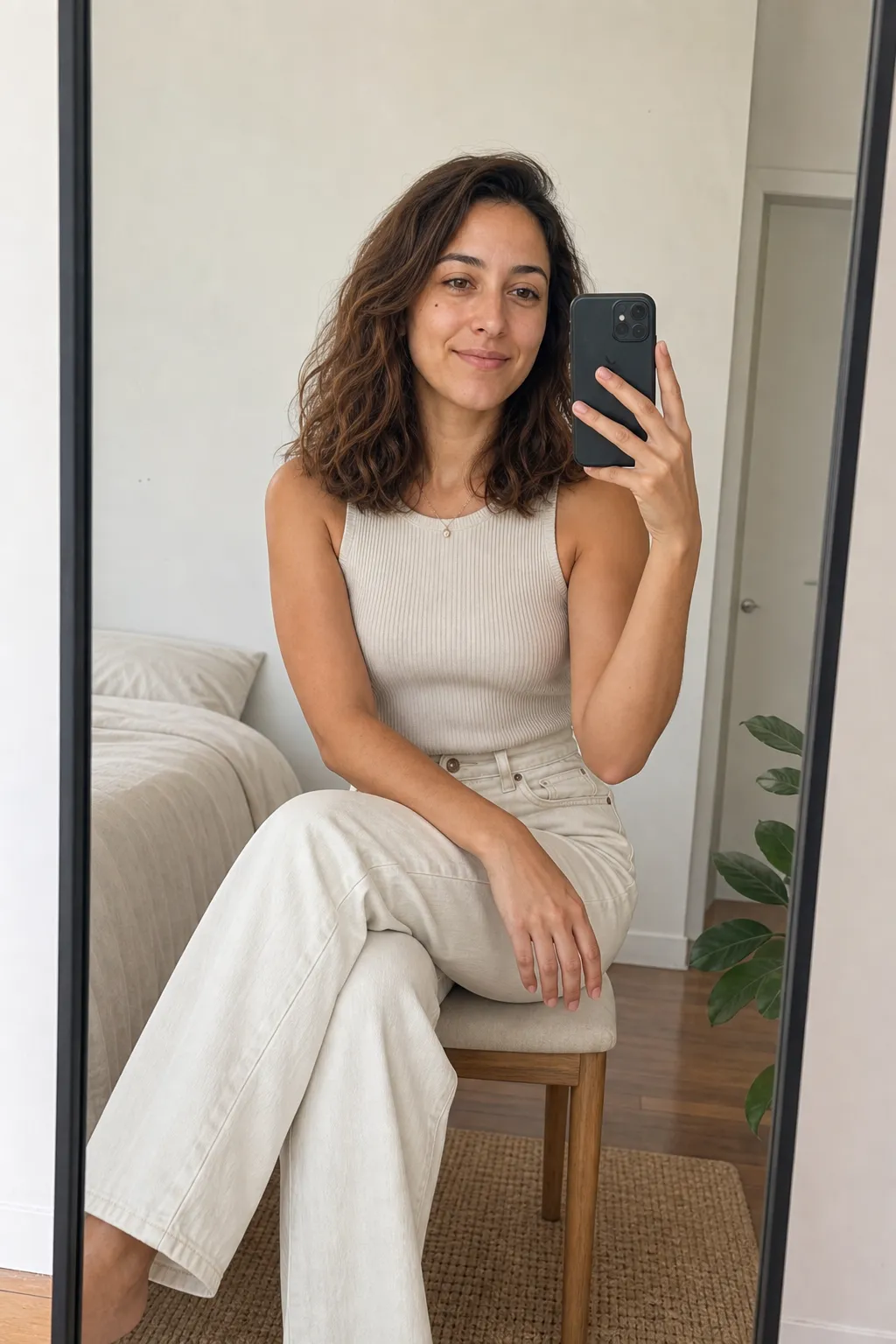
More to try here: clean the mirror and the floor behind you first, point your toes slightly to lengthen your legs, catch yourself in a side-on doorway mirror for a profile, and shoot from a step or two further back so the phone shrinks in the frame.
If you end up wanting these for more than just your camera roll, here’s a small offer. New subscribers get a free kit of twelve copy-ready prompts, the brand-photo and headshot kind, and after that it’s one small AI move a week. You can grab it here.
Selfie poses for women
Softer light, a turn in the shoulders, and a hand with somewhere to be.


More to try here: catch the light from a window on one side of your face, lift your chin a touch when you smile so your neck lengthens, try a low loose ponytail to keep the focus on your eyes, and let a real laugh break the held look.
Selfie poses for men
The fixes are the same. The thing to fight is the flex.
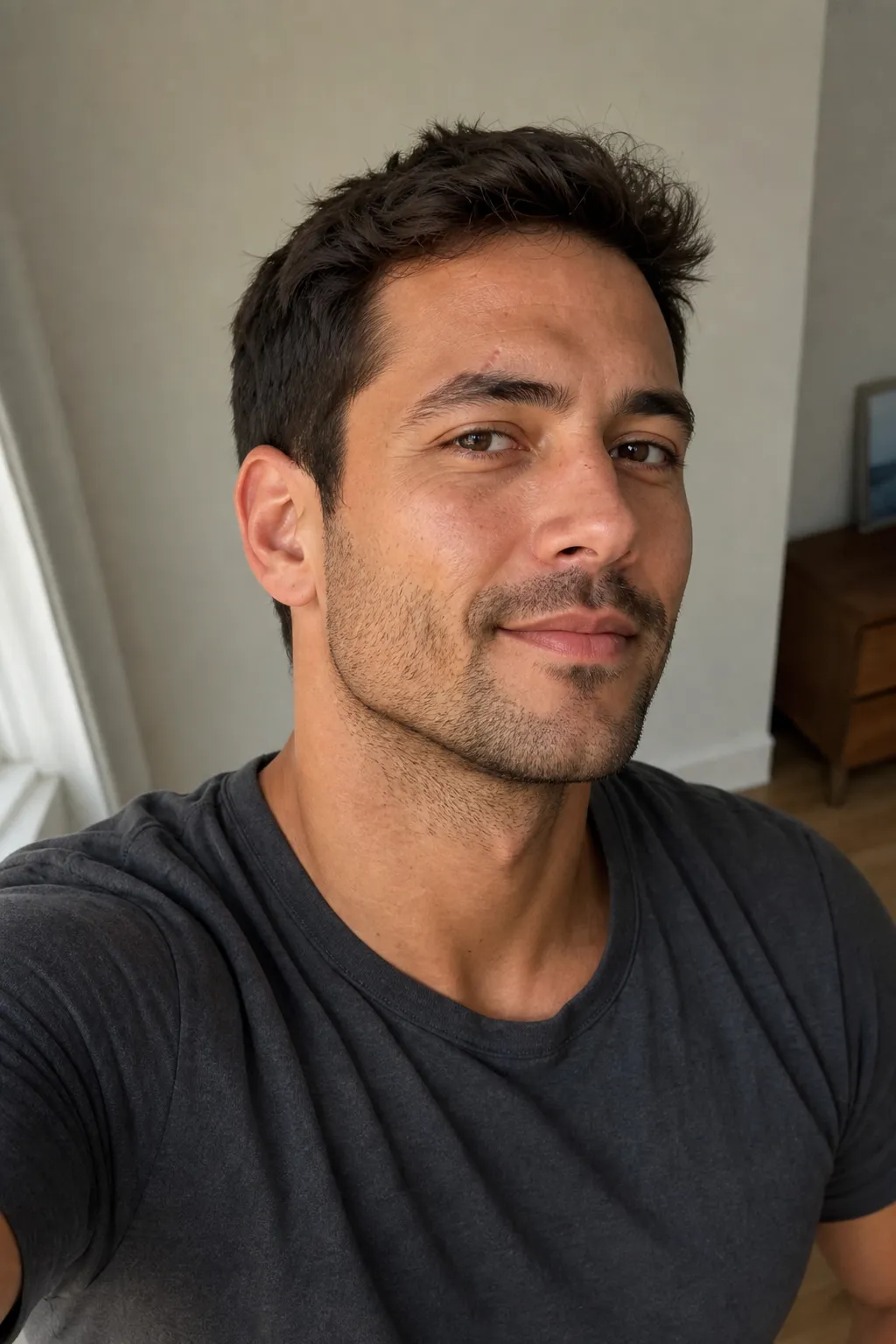

More to try here: drop your shoulders down and back instead of bracing them, find side light to bring out the jaw and brow, try it outdoors with the sun behind you for a softer rim, and unclench. A calm half-smile beats a hard line every time.
At-home aesthetic selfies
No location, no outfit, just the light by your window.


More to try here: shoot in the hour before sunset when the light goes warm, use a plain wall so nothing competes with your face, catch the window-frame shadow across the wall for a quiet bit of drama, and skip the overhead bulb. Side light is always kinder than top light.
Candid-feel selfies (the un-posed pose)
If you freeze the second the camera’s up, don’t hold still. Do something so there’s no time to freeze.


More to try here: look off to the side as if something caught your eye, react to your phone like you just read something good, glance down and back up so the camera grabs the up-beat, and let your hair be a little out of place. Perfect is what reads as posed.
What still throws a selfie off
Even with the angle fixed, a few habits drag it back. Watch for these.
- Phone too low. The single biggest one. A camera below your chin looks up your nose and stacks your chin. Lift it above your eye line every single time. This is also the fix for the distortion the Rutgers and Stanford study measured, since pulling the lens back and up undoes most of that 30% nose stretch.
- Dead front-on stare. Square to the lens with a frozen smile is mugshot geometry. Turn your face off-flat and look slightly past the camera.
- Holding the smile. A grin held longer than a second curdles into a grimace. Shoot a burst while you actually laugh or talk, and keep the frame from between the words.
- Trying too hard. Berger’s research also found that photos which look effortful land worse than ones that look caught in the moment. So don’t run forty takes of the same locked face. Pick one small action, do it a few times, and let the camera grab the real version.
Skip the retakes: put yourself in any of these
Here’s the part where I’ll be honest about the shortcut. Sometimes the light’s bad, the angle won’t cooperate, or you’ve taken the same shot forty times and still hate it. So if you can’t get the window, the golden hour, or the patience, there’s another way in. You can upload one clear selfie and generate yourself into the pose and the setting, the high-angle one, the window-light one, the walking-outdoors one, without standing in any of them. It keeps your actual face, so it still reads as you on a good day, not a stranger who vaguely resembles you. It’s the same one-selfie trick people use for couple photos, pointed at just you.
This page is about the poses, the ideas, the what-to-do-with-your-face part. The mechanics of actually taking a clean selfie — where to stand, how to steady the phone, how to light your face — are their own thing. For the angle-and-pose craft on any photo, not just selfies, there’s how to pose for pictures. Either way, the poses above are the part that doesn’t change.
FAQ
Q: What is the best pose for a selfie?
A: Hold the phone a little above your eye line, turn your face about three-quarters instead of straight-on, push your chin slightly forward and down, and give your free hand something to do. That single combination flatters almost everyone, which is why it’s the default to fall back on when you don’t know what else to try.
Q: What is the most flattering pose for photos?
A: Anything shot from slightly above, with your face angled off-flat rather than square to the lens. The high camera undoes the wide-nose, heavy-chin distortion you get from a low close phone, and the angle gives your face shape instead of flattening it. Add a real expression instead of a held one and you’re done.
Q: What are the 7 posing points?
A: There’s no official list, despite how often the phrase gets searched. The fundamentals that actually move a selfie are fewer than seven: camera above eye level, face turned off-flat, chin forward and down, free hand given a job, weight shifted onto one leg for full-body shots, and an expression you didn’t hold for three seconds. Master those and you can skip the made-up numbered checklists.
Q: How do you take a good mirror selfie?
A: Hold the phone out to the side at about face height instead of in front of your face, so your face stays visible in the reflection. Shift your weight onto one leg so your body has a line instead of standing square, keep the mirror and the room behind you clean, and turn slightly rather than facing dead-on.
Key Takeaways
- Most of why you hate your selfies is the camera, not your face. A close low phone stretches your nose about 30% wider, per a 2018 study in JAMA Facial Plastic Surgery.
- Two fixes do most of the work: lift the phone above your eye line, and turn your face about three-quarters off-flat instead of square to the lens.
- Give your free hand a job and add a small action. Candid-looking beats held, per Wharton’s Jonah Berger.
- Pick the group that matches where you are. Best angles is the one to learn first; mirror and at-home need zero location.
- When the light or the patience isn’t there, one selfie gets you into any of these poses without the retakes.
Take ten and keep one
You don’t need a ring light, a location, or a good hair day. Pick one pose from your group, hold the phone a little higher than feels natural, and do the small thing instead of freezing for it. Shoot a burst. Delete the rest. Worst case you’re back where you started. Best case you finally have a selfie you’d actually post.