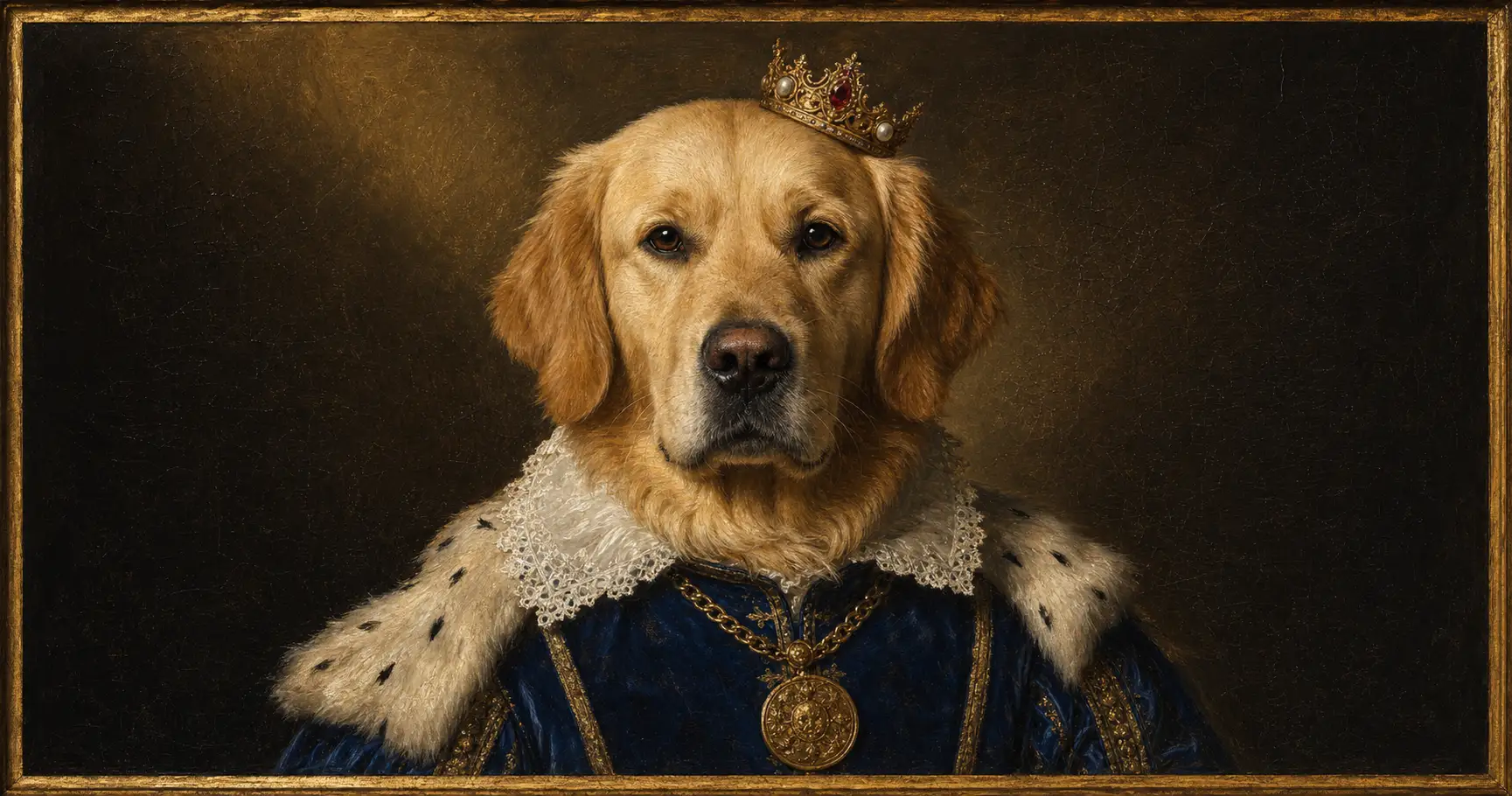
You opened Crown & Paw last night, found their Renaissance collection, and saw it: a chocolate labrador in a velvet doublet for $179, ship-by-end-of-next-week, and the dog’s face placed onto one of fifty pre-painted noble templates. The dog wasn’t yours, exactly. The wardrobe was theirs. One AI prompt does the same job in ninety seconds, identity-locked to your specific dog, for about $19 once you frame it.
Why Crown & Paw charged you $179
Sir Joshua Reynolds painted his first royal portrait in 1769. Two hundred and fifty-seven years later, the entire category of “your animal as a 17th-century noble” has been re-platformed into Etsy shops, drop-ship retailers, and the dominant brand in the space, Crown & Paw, whose Renaissance collection runs roughly $89 to $219 on their own storefront (crownandpaw.com/collections/renaissance) and ships in five to ten business days. The painted result is real and the polish is real. The dog on the canvas, though, is your dog’s face composited onto one of their pre-painted noble templates from a stock library of about fifty roles.
The Etsy band runs higher. A search for “royal pet portrait hand painted” on Etsy returns listings in the $120 to $300 range with three-to-four-week processing windows. The artists worth the money quote longer.
That’s the market, and it’s a real one. The American Pet Products Association’s 2023-24 National Pet Owners Survey put U.S. pet-industry spending at $147 billion across 86.9 million pet-owning households. A small slice of that, the slice that wants the dog on the mantel and not just the dog on the couch, is what Crown & Paw and the Etsy hand-painters compete for.
The framing matters here. Crown & Paw doesn’t paint your specific dog. Crown & Paw paints a Renaissance king and drops your dog’s face into the king-shaped slot. That’s a wardrobe. The Etsy hand-painter does paint your specific dog, but you wait a month and you pay $220 to find out whether the artist saw what you see when you look at your dog.
Both products are honest about what they are. The question is whether what they are is what you actually want for the dog on your couch right now.
Paste this. Royal portrait in 90 seconds.
Upload one clear front-facing photo of your pet, paste the block below into ChatGPT (or Claude, Gemini, or any AI image tool), and swap the {NOBLE_AESTHETIC} line for the role you want your pet to play.
Show the full promptTap to expand
Paste this into your AI of choice (ChatGPT, Claude, Gemini, any image-capable tool).
REQUIRED upload before pasting: one clear, front-facing photo of your dog or cat with the face well-lit. Sunglasses, hats, costumes off. The face is the only thing the AI needs to anchor; the costume is the prompt’s job.
Three placeholders to swap: your pet’s actual breed (be specific), the noble aesthetic register (king / queen / cardinal / merchant prince / general, see the speed card and the five worked examples), and the background color register that matches the aesthetic.
Generate this image:
A single 3:4 vertical oil-painting royal portrait of the pet from the uploaded reference image, rendered in the visual language of a 17th-century European court painting on canvas. Head-and-chest framing, with the pet’s face occupying roughly one-third of the frame height and a calm contemplative expression. Identity-locked to the uploaded photo: preserve the specific {PET_BREED} structure, ear shape, eye color, muzzle proportions, coat color, and individual markings exactly as in the uploaded reference; oil-painting styling is applied as a rendering register, not as an identity redesign. The pet is dressed as {NOBLE_AESTHETIC}, with all garment details (velvet, lace, ermine, silk, metalwork, jewelry, headwear) rendered in believable 17th-century European court-portrait period detail. Lighting is chiaroscuro from the upper-left at 45 degrees, with a warm key light on the face and the costume’s highlight points (collar, crown jewels, gold chain, metalwork) and a deep cool-shadow fill on the right side of the muzzle. Background is a {BACKDROP_COLOR} painted void with subtle radiance behind the head, visible canvas-weave texture, and faint cracking varnish micro-detail across the surface. Visible oil-paint impasto on the costume highlights and metalwork, soft glazing on velvet and silk, and dry-brush fur strokes that show actual brush direction across the pet’s coat. Single 3:4 vertical oil-painting royal portrait of the pet from the uploaded photo, rendered with the texture of a real 17th-century court painting.
Rules the AI must follow:
- Aspect ratio 3:4 vertical, strict, locked at the start and the end of the prompt.
- Identity preservation is the highest-priority constraint. The breed structure, ear shape, eye color, muzzle, coat color, and individual markings of the pet in the uploaded photo must remain instantly recognizable. The pet must look like the SAME pet, not a generic AI dog or cat or a different breed.
- Real oil-painting imperfection required. Visible impasto on the costume highlights, micro-cracking varnish texture across the canvas, dry-brush fur strokes showing actual brush direction, slight natural asymmetry in collars and trim. No porcelain-smooth fur, no flat plastic-AI render, no clean digital vector look, no smooth Photoshop oil-paint filter shortcut.
- 17th-century European court-portrait register only. No modern fashion, no cartoon stylization, no fantasy-game armor, no anime aesthetic. The painting should read as believably belonging in a museum room of period portraits.
- No text, signature, watermark, caption, regimental insignia, or visible script anywhere on the painting. Pure painted artwork only.
- Single image output. No contact sheet, no before/after split, no variant grid, no multi-panel layout.
- Output the image directly without explaining the prompt back.
- All text in English Latin script if any incidental marks appear (none expected).
Replace these placeholders with your details:
- REQUIRED upload before pasting: one clear, front-facing photo of your pet (without this the AI invents a generic version of the named breed instead of YOUR pet).
{PET_BREED}= the specific breed with its key markings (e.g., “tricolor beagle with white blaze and tan eyebrow spots”, “fawn French bulldog with darker muzzle mask”, “brown-mackerel tabby cat”). Be specific. “Dog” or “cat” alone is too generic.{NOBLE_AESTHETIC}= the role + costume specifics (or pick one of the five swap one-liners below the speed card; default value = “a king in a deep-blue velvet doublet with ermine collar, gold medallion, and miniature jeweled crown”).{BACKDROP_COLOR}= the background color register that matches the role (default value = “deep-umber”; alternates = “deep-emerald” for king, “deep-charcoal” for Vermeer queen, “near-black” for Caravaggio cardinal, “deep-burgundy” for Rembrandt merchant, “deep-cobalt” for Velazquez general).
The prompt does four things that matter.
It identity-locks to the breed structure, ear shape, eye color, muzzle, and markings of the photo you uploaded. Oil-painting styling is a rendering register, not a face redesign. Without this line the model defaults to its mental image of the named breed and you get a generic golden retriever instead of yours. The same identity-lock principle runs the old-photo restoration prompt. That’s where the line is documented if you want to understand why it’s load-bearing.
It locks the visual register to 17th-century European court painting on real canvas. Visible oil-paint impasto on the collar highlights. Micro-cracking varnish texture across the surface. Dry-brush fur strokes that show actual brush direction. These are the specific phrases that defeat the AI-default plastic look. For the longer version of why AI images go waxy by default, the anti-plastic article is the reference.
It locks the aspect ratio to 3:4 vertical at the start and the end of the prompt. The model attends most heavily to the first and last tokens; double-anchoring the ratio prevents the awkward square crop that breaks the frame shape.
It leaves one creative placeholder open, {NOBLE_AESTHETIC}, and locks everything else. That single placeholder is where your dog’s actual role enters the painting. King. Queen. Cardinal. Merchant prince. General. One line swapped, five different paintings.
Everything else is the prompt doing the work. You’re swapping one line.
Five royal aesthetics that actually land
Same prompt. One line swapped per variant. Five different pets, five different historical registers.
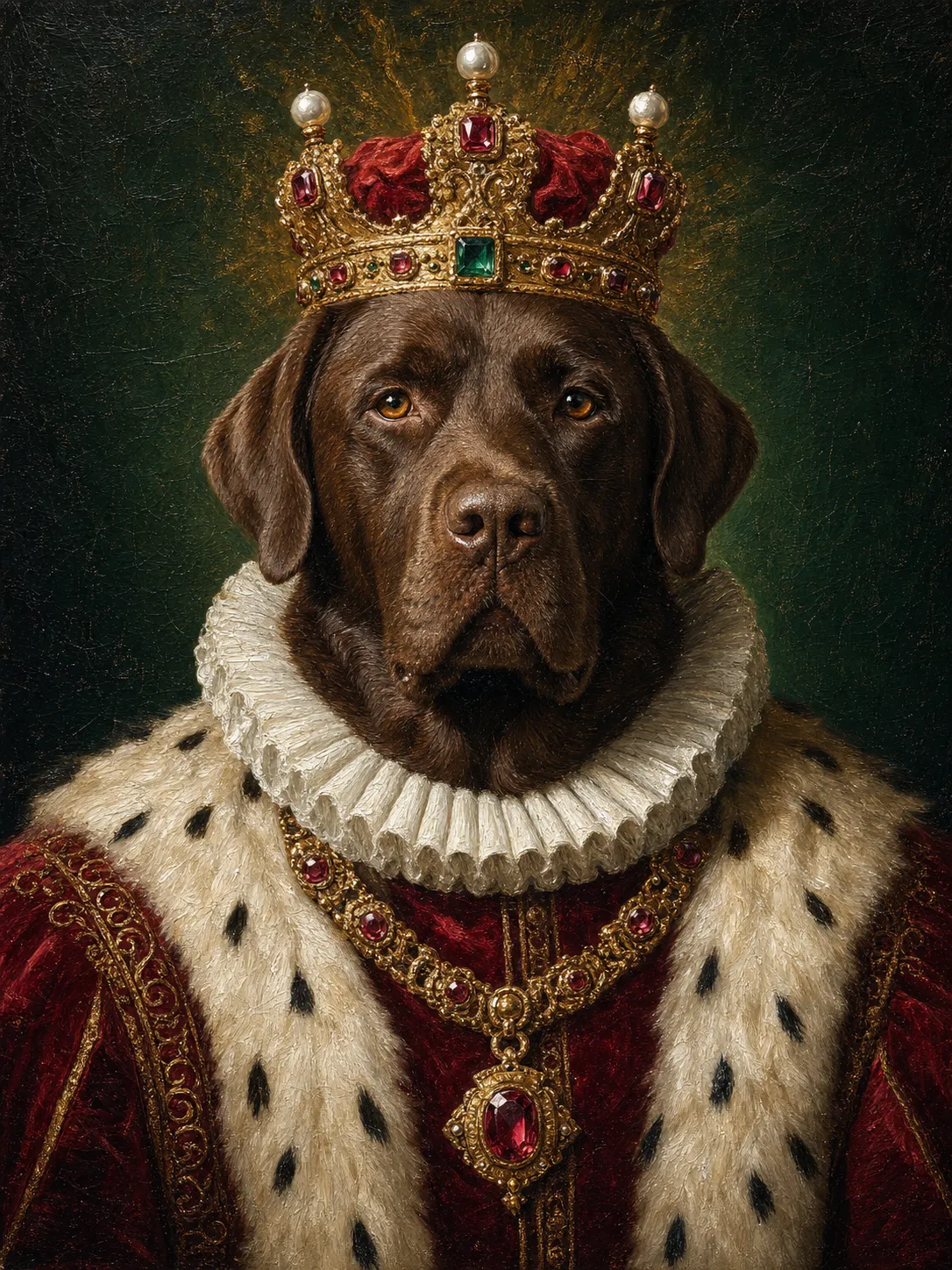
The king with the ermine cascade
{NOBLE_AESTHETIC} = a king in a deep-crimson velvet doublet with full ermine cascade, gold-embroidered shoulders, ruff collar, ruby pendant, and a full jeweled crown, against a deep-emerald background. This is the broadest-fit variant. It works for golden retrievers, labradors, and any dog whose face already reads as “noble” before you put a crown on it.
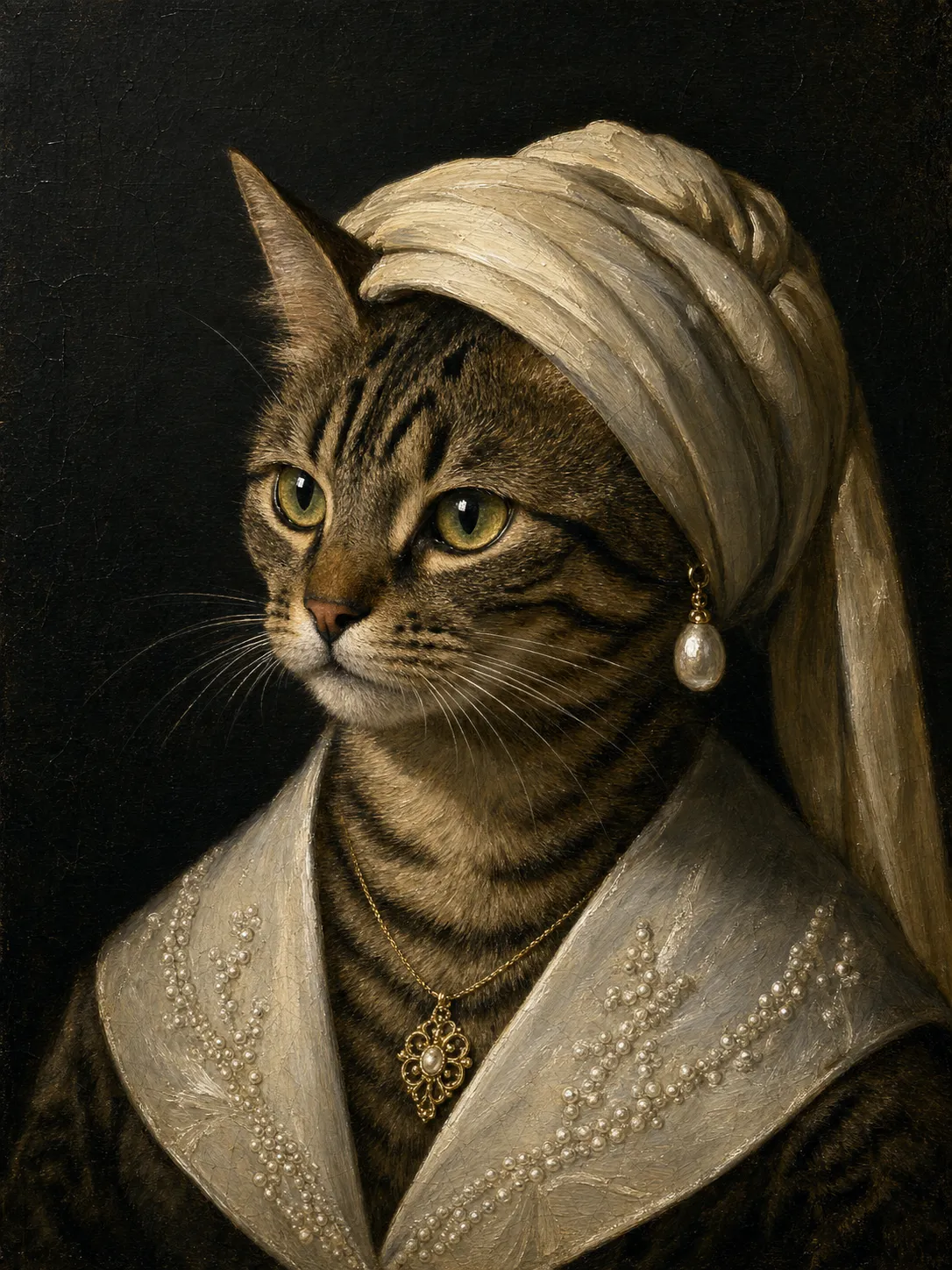
The queen with the pearl earring
{NOBLE_AESTHETIC} = a queen in the Vermeer style with a cream silk turban head wrap, a single baroque pearl drop earring, pearl-embroidered silk collar, and gold filigree pendant, against a deep-charcoal Vermeer background. This one is built for cats. Tabbies, persians, ragdolls, even short-haired strays. The Vermeer register suits the cat’s natural three-quarter head turn in a way no king-and-crown register does.
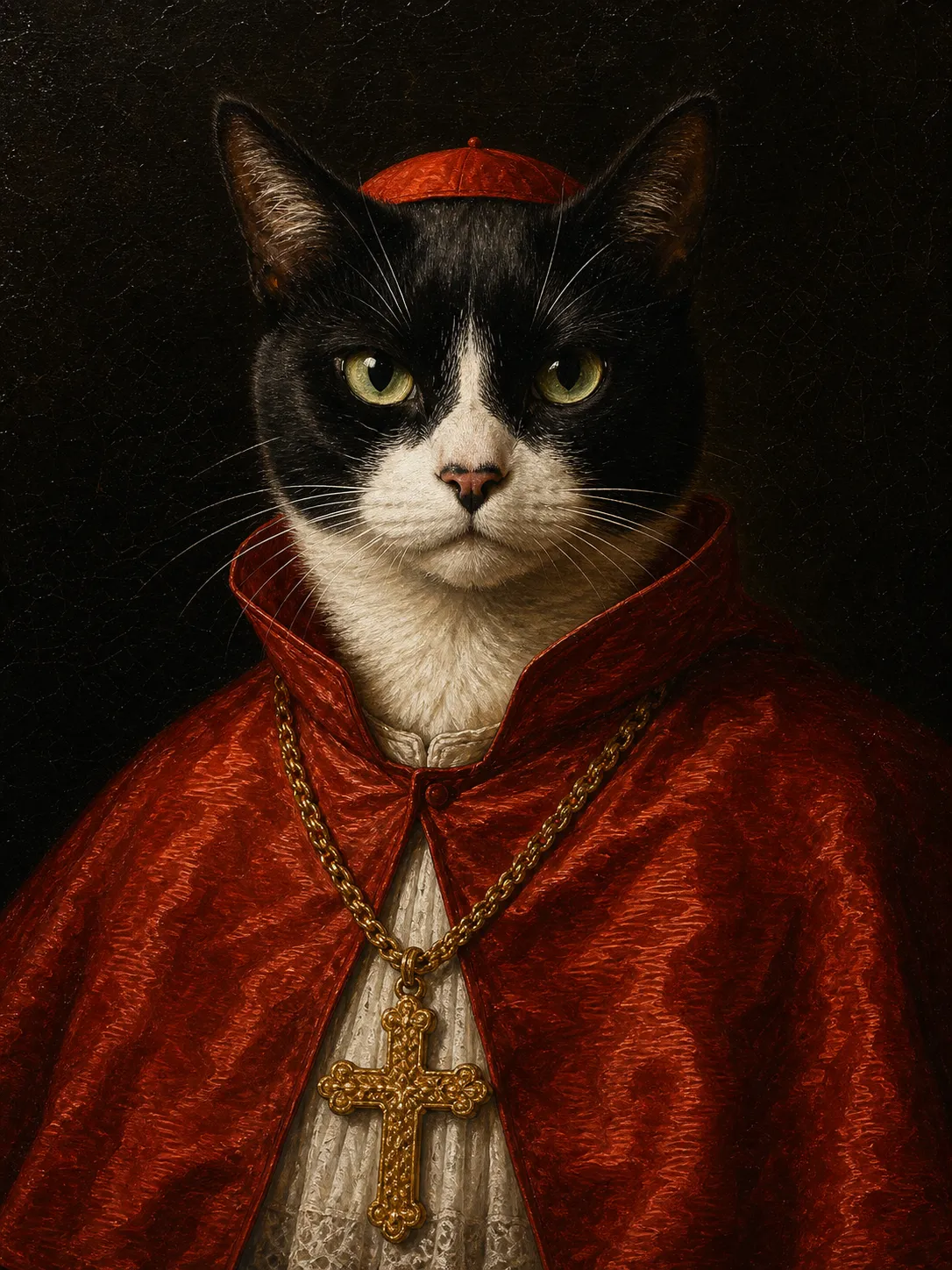
The cardinal in red watered silk
{NOBLE_AESTHETIC} = a cardinal in a deep-red watered-silk mozzetta cape with high collar, gold pectoral cross, and red zucchetto skullcap, against a near-black Caravaggio background with dramatic chiaroscuro lighting. The high-contrast register. Tuxedo cats, black labs, border collies, any animal whose coat is already a strong black-and-white pattern. The dramatic chiaroscuro lights up the red against the near-black background and the markings against the costume.
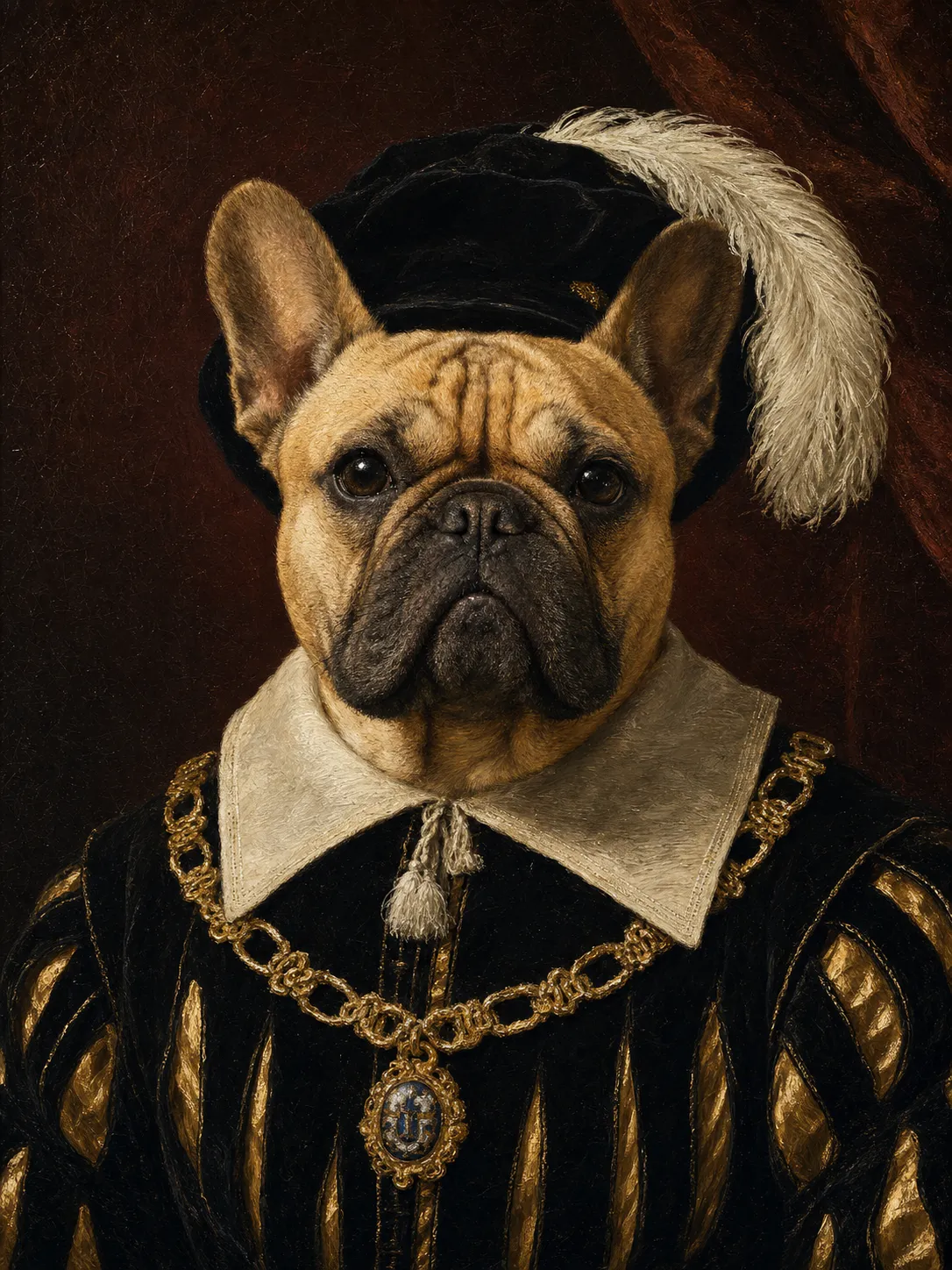
The merchant prince in slashed velvet
{NOBLE_AESTHETIC} = a Dutch merchant prince in a slashed black-and-gold velvet doublet with gold underlayer, flat white linen collar, heavy gold merchant’s chain, and a black velvet beret with a white ostrich feather, against a deep-burgundy Rembrandt background. The comedic register, but played straight. French bulldogs, pugs, Boston terriers, English bulldogs. The breeds whose natural face reads as “serious and slightly affronted.” The Rembrandt background does the rest.
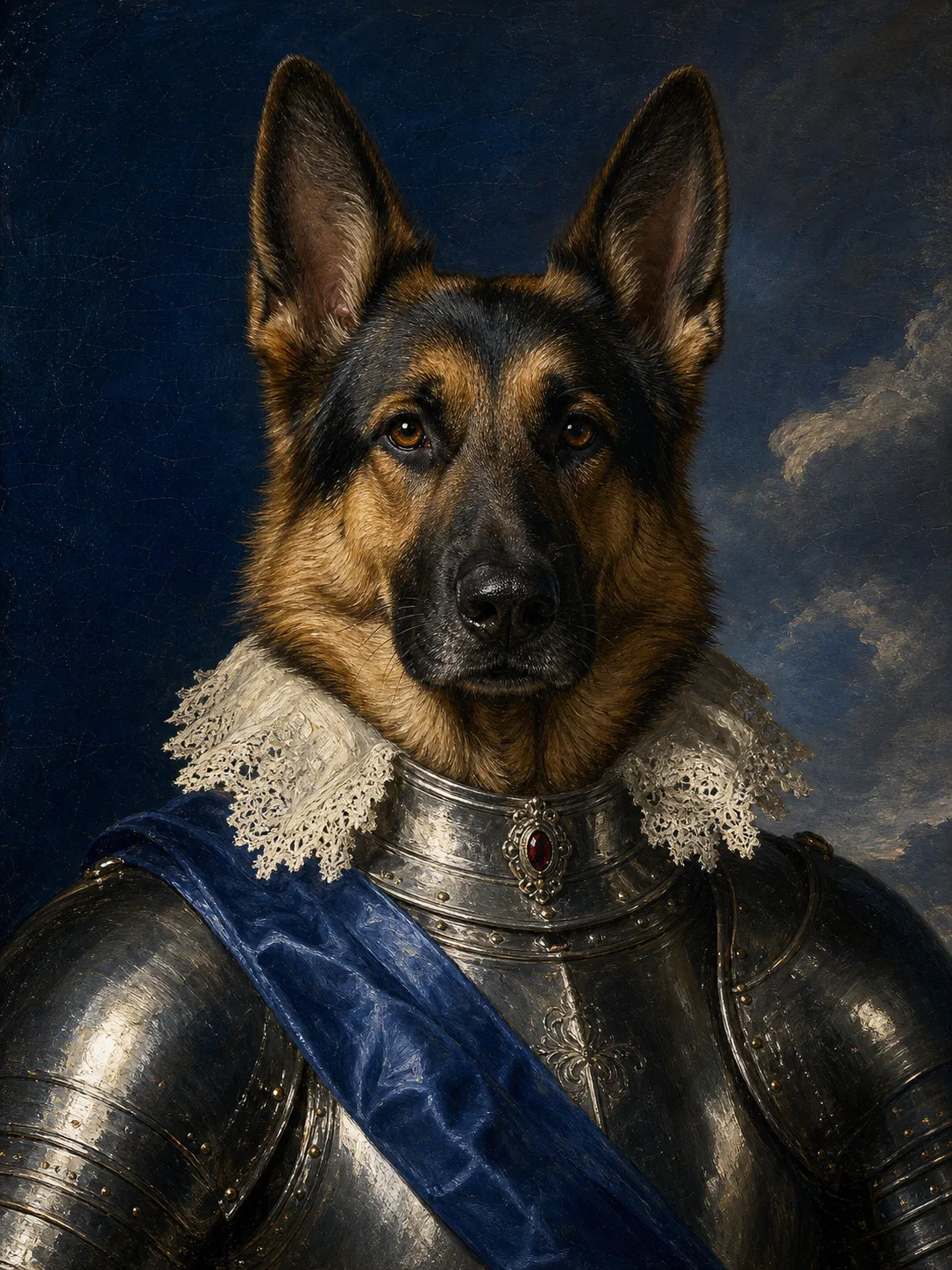
The general in the polished cuirass
{NOBLE_AESTHETIC} = a 17th-century general in a polished steel cuirass, wide white lace jabot, deep-cobalt-blue silk diagonal sash, and silver gorget with a central ruby, against a deep-cobalt Velazquez court-portrait background. The heroic register. German shepherds, Belgian Malinois, Dobermans, Rottweilers, border collies. The breeds people already photograph in profile against the sky.
Five breeds. Five registers. Same prompt, one line swapped.
Speed card: paste, swap, print
One block. Pin it. Screenshot it. Send it to a friend whose dog also belongs in velvet.
One paste-ready AI move a week, the same kind of thing as the Independent Brand Visual Kit you’ll get the day you subscribe. Sign up for the weekly newsletter and you’ll get the kit immediately, then a new prompt every Sunday afternoon.
The 10-minute walkthrough
Once you have a portrait you like, the rest is mechanical.
- Upload your pet’s photo to ChatGPT (or your preferred AI image tool). One clear, front-facing photo. Face well-lit. No hats, no costumes, no sunglasses. The face is the only thing the AI needs to anchor; the velvet doublet is the prompt’s job.
- Paste the prompt block. Don’t edit the rules. Edit only the
{PET_BREED}line (be specific: not “dog” but “tricolor beagle with white blaze and tan eyebrow spots”), the{NOBLE_AESTHETIC}line, and the{BACKDROP_COLOR}line. Three placeholders, no more. - Generate. If the breed isn’t reading right, regenerate. This is the half-step Crown & Paw and the Etsy artist can’t give you. You’re not paying $179 to find out next week whether the labrador looks like a labrador. You’re paying for a paste. Run it three or four times until the ear shape, eye color, and markings match your specific animal.
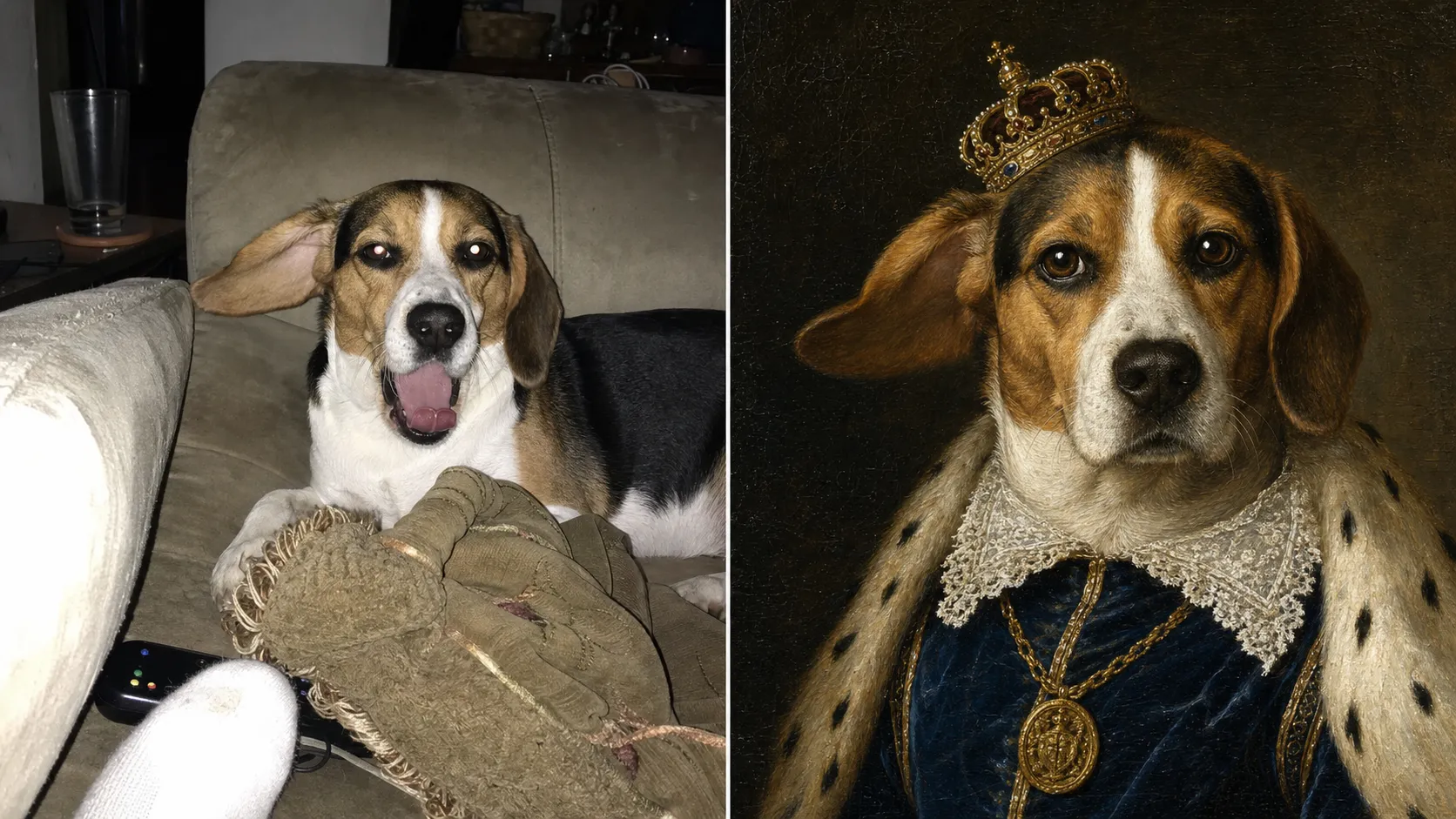
- Download at the largest size the tool offers (aim for 300 dpi at 8x10 or larger). Save it as PNG, not JPEG, if you can. Oil-paint impasto loses detail in JPEG compression.
- Print and frame Saturday morning. Target’s same-day photo service prints 8x10 for a few dollars; Michaels carries 8x10 ornate gold-leaf frames in the $12 to $18 range. The frame on the kitchen counter by Saturday afternoon is the whole point.
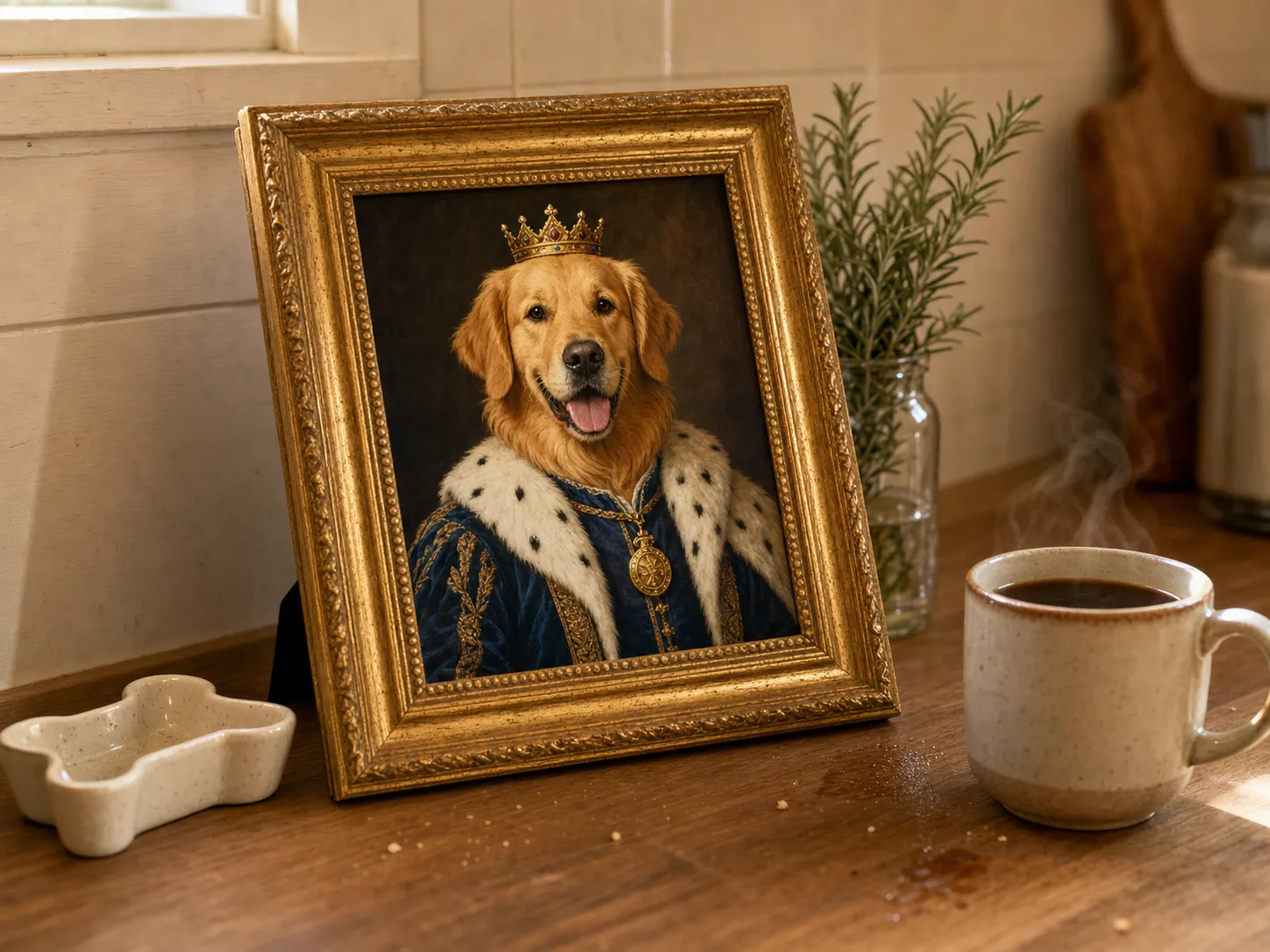
Total cost: about $19 for the prompt pack, a few dollars for the print, and a frame under $20. The same gift on the mantel for less than a tank of gas.
Year-round reuse
The prompt does not know it’s Father’s Day. It does not know it’s anyone’s birthday.
It knows there’s a face, a breed, and a noble role, and it paints the second onto the first.
That portability is why this prompt earns its frame.
- Father’s Day pet gift. If the dad in question is a dog person, the royal portrait of his dog is a better gift than another tie. If he’s a human person, the pencil-sketch double-exposure portrait is the human-subject sister piece. Same paste-and-frame rhythm, different visual register.
- Mother’s Day. The Vermeer-queen variant for the cat she raised after the kids moved out.
- A memorial frame. The pet you lost, in the same identity-locked register, with the same costume your kids would have laughed at. The old-photo restoration prompt handles damaged source photos first, then the royal portrait prompt runs on the restored face.
- A Christmas gift for a friend’s dog. You don’t need to meet the dog. Ask the friend for one front-facing photo. Run the prompt. Frame it. Ship it.
- A housewarming gift. Your friend’s new place needs one thing on the kitchen counter. Their cat in a Vermeer turban is that thing.
The prompt isn’t a holiday. The frame on the counter is.
The math: $19 vs $179 vs $300
The cost gap is a tenth. The time gap is a month. The risk gap is whether the dog on the canvas is your dog.
| Dimension | $19 AI prompt | Crown & Paw “Renaissance” canvas | Etsy hand-painted royal portrait |
|---|---|---|---|
| Total cost | $19 prompt pack + ~$20 print and frame | $89-$219 for the canvas, before any framing upgrade | $120-$300 for the painting, plus $25-$60 shipping |
| Lead time | 90 seconds for the image, plus a Saturday-morning print run | 5-10 business days production, plus shipping | 3-4 weeks production, plus shipping |
| Identity fidelity | Identity-locked to the breed structure, ear shape, and markings of the photo you upload | Your dog’s face composited onto a pre-painted noble template from a ~50-template library | Painter works from your photo; quality varies by artist and reviewer |
| Iterations | Unlimited until the breed reads as your dog | None. The canvas that ships is what arrives. | None. The painting that arrives is what you bought. |
| Frame ready by | Saturday afternoon | The Saturday two weeks out | After Father’s Day, after the birthday, after the deadline |
| ”Wrong breed look” risk | Zero. Keep regenerating. | Real, and you’ve paid. | Real, paid, and shipped from another time zone. |
| Aesthetic register | Any 17th-century court register: king, queen, cardinal, merchant, general | Crown & Paw’s pre-set library (knight, admiral, queen, etc.) | Whatever the artist’s listing shows |
Crown & Paw is honest about its production model: your dog’s face onto a pre-painted noble template. The Etsy hand-painter is honest about the wait. The $19 prompt is honest about the iteration cap, which is zero. The right product depends on which honesty you want to pay for.
FAQ
Q: How do I make a royal portrait of my dog with AI?
A: Upload one clear front-facing photo of your dog. Paste a single prompt into ChatGPT (or Claude, Gemini, or any AI image tool) that asks for a 3:4 vertical oil-painting royal portrait in the 17th-century European court register, with the breed structure, ear shape, eye color, and coat markings of the uploaded photo preserved as the head and chest of the painted subject. Swap one line for the noble role you want: king with ermine, Vermeer queen with a pearl earring, Caravaggio cardinal in red watered silk, Rembrandt merchant prince in slashed velvet, or Velazquez general in a polished cuirass. Download at 300 dpi, print 8x10, frame it. Total cost is about $19 including the prompt pack and a same-day frame from Target or Michaels.
Q: Is Crown & Paw worth it, or is the AI prompt actually better?
A: Crown & Paw’s Renaissance canvas runs roughly $89 to $219 and ships in 5 to 10 business days, and the production model places your dog’s face onto one of their pre-painted noble templates. That’s a real product with real polish, but it’s not a portrait of your specific dog as the central subject; you’re paying for a wardrobe library. The AI prompt does the opposite. It identity-locks to your specific dog’s breed structure and markings, lets you regenerate until the breed reads right, and lands the framed result on the counter Saturday afternoon for about a tenth of the cost. The right call depends on whether you want their painted catalog or your specific animal in oil paint.
Q: Can I use this same prompt for my cat?
A: Yes. The prompt is breed-and-species-agnostic. The five worked examples in the article cover both registers: a chocolate labrador and a German shepherd on the dog side, a brown-mackerel tabby and a black-and-white tuxedo cat on the cat side. The placeholder {PET_BREED} accepts any specific breed phrase, and the identity-lock rules apply to feline facial structure (muzzle shape, ear set, eye color, coat pattern) the same way they apply to canine. The Vermeer-queen variant in particular is built for cats.
Q: What if I want this as a memorial frame for a pet I lost?
A: The same prompt covers it. The identity-lock rules are designed for exactly this case. They preserve the bone structure, ear shape, eye color, and markings of the specific animal in the uploaded photo, rather than swapping to a generic AI rendering of the breed. If the only photo you have is faded or damaged, you can restore the photo first without changing the face, then run the restored version through the royal portrait prompt. The result is a framed oil painting of your specific pet, in 17th-century court register, on the mantel.
Q: How big can I print the AI royal portrait without it looking pixelated?
A: Most AI image tools return outputs at sizes that print cleanly at 5x7 or 8x10, around 1,500 by 2,100 pixels at 300 dpi. The article’s print spec uses 8x10 with a gold-leaf frame from Michaels or Target in the $12 to $18 range, which keeps the resolution comfortable. For prints larger than 8x10, ask the AI for the largest output the tool offers, save as PNG (not JPEG, so the oil-paint impasto doesn’t lose detail in compression), and check the pixel dimensions before printing.
Key Takeaways
- Crown & Paw’s Renaissance canvas line at $89 to $219 places your dog’s face onto a pre-painted noble template; the AI prompt at $19 identity-locks to your specific dog’s breed structure and markings. Different products, same shelf.
- A single AI prompt with one open placeholder,
{NOBLE_AESTHETIC}, replaces the entire royal-pet-portrait commission category, because the work the painter does (preserve the face, render the medium, costume the silhouette) is exactly what the prompt is locking in. - Five noble-role swaps cover most pets on the first try: the king with ermine, the Vermeer queen with the pearl, the Caravaggio cardinal in red, the Rembrandt merchant prince in slashed velvet, the Velazquez general in the polished cuirass.
- Same prompt re-skins for Father’s Day, Mother’s Day, a memorial frame, a Christmas gift, a housewarming. One line swapped, same Saturday-morning frame run.
What does your dog get to wear?
That’s the line you swap. The Image Prompt Pack carries this royal-portrait prompt alongside 124 others covering the 25 jobs a normal week actually asks of you: wedding invitations, headshots, Etsy listing photos, the pencil-sketch dad portrait, the chibi mini-me.
A king’s ermine? A Vermeer pearl? A Caravaggio cardinal’s red? You already know.