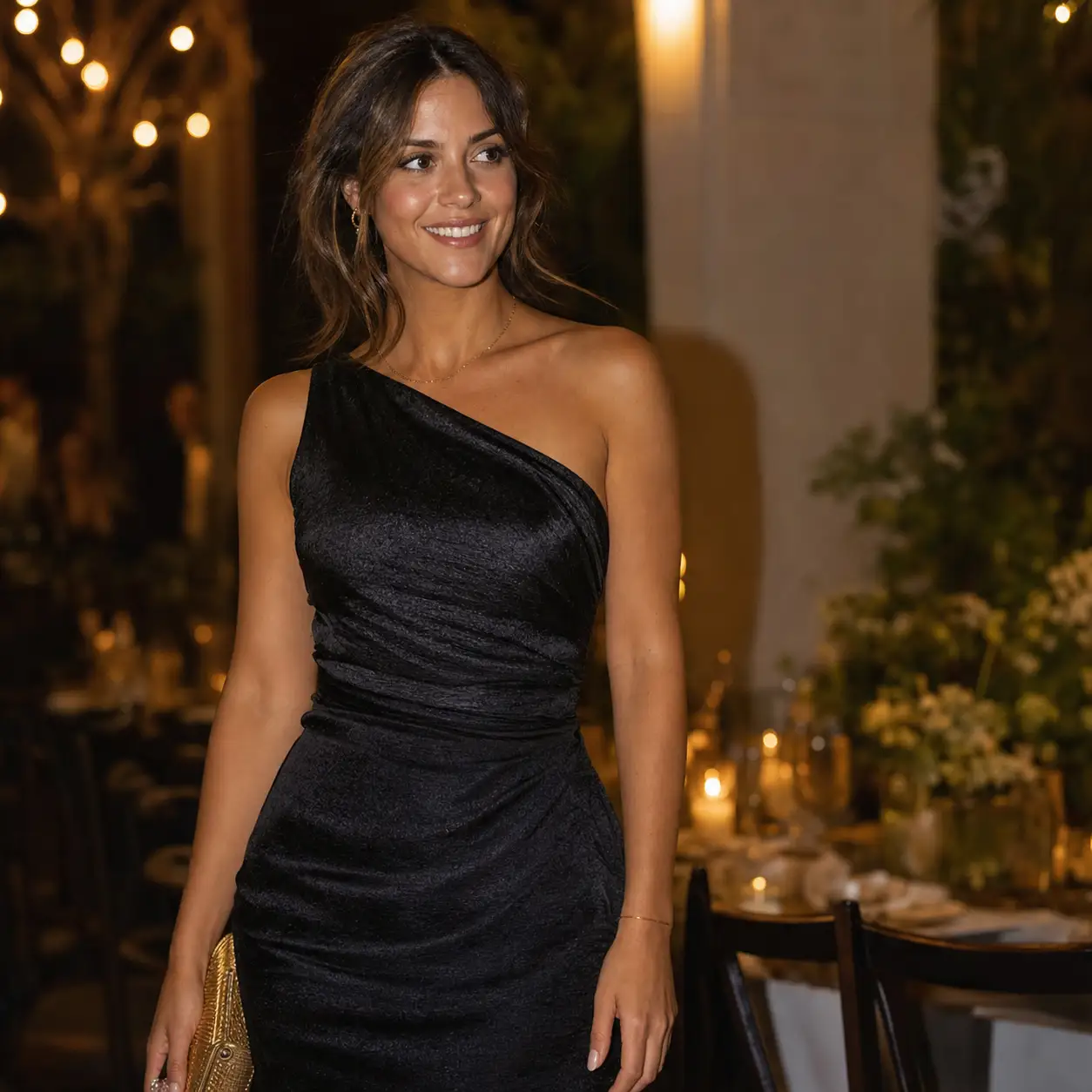
Yes, you can wear black to a wedding. At most modern US weddings it is a standard, elegant choice, and at a formal evening one it is close to expected. The old idea that black is rude, unlucky, or too funereal has faded. The only real failure is letting your black read like mourning instead of a celebration, and that is a styling problem, not a ban.
The black-dress superstition is dead
For a long time, black at a wedding carried a whisper of bad luck. It was read as the color of mourning, even as a quiet statement against the marriage. Etiquette books told guests to avoid it. That advice is now out of date.
The authorities who set the rules have moved. Anna Post of the Emily Post Institute says plainly that it is okay for guests to wear black, and that the question today is really about the cut and material of the dress and whether it fits the time and place. The Knot goes further: guests can absolutely wear black, and it is sometimes even encouraged. Zola notes the rules have loosened so much that brides and bridesmaids now wear black themselves.
So the worry was misplaced. A guest in black does not read as grief or as a snub. They read as someone who dressed up.
There is one caveat the same experts repeat. Anna Post’s line is that a black wedding outfit cannot have even a whiff of mourning about it. That is the whole game. The question was never whether black is allowed. It is whether your black reads celebratory or somber.
When black is the best thing you can wear
At some weddings black is not just permitted. It is the strongest choice in the room.
Evening is black’s home. Zola ties black to receptions that begin at 6 p.m. or later, and to formal and black-tie events, where dark colors are the expectation rather than the risk. The Knot agrees that a formal evening affair is exactly when to bring out the dark hues. If your invitation says black-tie, a sharp black look is not a gamble. It is the brief.
Cold weather is the other natural fit. Zola calls an all-black outfit perfect for a nighttime, cold-weather celebration, and wedding guidance from Brides points to the black-tie winter wedding as the place a black gown belongs. A city ballroom, a hotel reception, a candlelit dinner in November: black was made for these rooms.
Place your wedding in one of these settings and black stops being a question. The trouble only starts when the setting fights the color, which is the next thing to check.
The handful of times to skip it
The exceptions are real, but there are only a few of them. Here is the split, so you can place your own wedding in seconds.
| When black is a great choice | When to skip black (or check first) |
|---|---|
| Evening receptions, after 6 p.m. (Zola) | Traditional Indian or Chinese weddings, where dark reads as mourning (The Knot) |
| Formal and black-tie weddings, where dark is expected (Zola, The Knot) | Hindu ceremonies and traditional church weddings, where black still signals mourning (Zola) |
| City and indoor venues, ballrooms, hotels (The Knot) | When the couple requests a color theme or asks guests to avoid black (The Knot) |
| Fall and winter celebrations (Zola, Brides) | A hot midday outdoor or beach wedding, since black traps heat (The Knot, Brides) |
Sources: Zola, The Knot, and Brides wedding-guest guidance.
Culture is the first exception. The Knot notes that at traditional Indian and Chinese weddings, black represents mourning and is best avoided. Zola adds that Hindu ceremonies treat black as unlucky on the big day, and that a traditional church wedding can still carry black’s old funeral association. When the couple’s customs run this way, choose another color and save the black for a different invitation.
The couple’s own wishes are the second. The Knot points out that some couples request a color theme or ask guests to skip black outright. If the invitation or the wedding website says so, that instruction outranks every general rule here.
Heat is the third. Both The Knot and Brides note that black traps heat more than other colors, so an all-black look can feel heavy at a hot midday outdoor or beach ceremony. A black evening gown that is perfect at a winter ballroom can read wrong on the sand at noon. Outside these few cases, black is on the table, and what is left is making sure it reads festive.
One paste-ready idea a week, the kind you can actually use, plus the free Independent Brand Visual Kit the moment you join. That is the weekly newsletter, built for people who want a clear answer instead of a research project.
The celebratory-black test
Here is the move that settles it. Before you wear a black outfit to a wedding, run it through one question: does this look like a celebration, or a service? Call it the celebratory-black test. Pass it, and your black reads as a choice rather than a default.
Three levers move a black outfit from somber to festive, and every etiquette source names the same ones.
Lever 1: texture and fabric
Flat, matte black is the look that drifts toward mourning. Zola’s fix is a pop of pattern or a touch of texture to lighten an all-black outfit. A subtle sheen, a draped or structured fabric, a bit of shine: any of these tells the eye “party,” not “pew.”
Lever 2: a metallic or color accent
This is the lever the experts return to most. The Knot suggests colorful jewelry, a fun or printed shoe, a colorful wrap or stole, and a beautiful handbag. Brides points to metallic and gold accessories. Anna Post’s advice is the same: dress black up with colorful accessories. One warm gold cuff or a jewel-tone clutch does more work than the whole dress.
Lever 3: silhouette
A cut with intention reads as occasion wear. Brides points to a one-shoulder line, an elegant cut-out, and structured tailoring as the difference between a black dress that looks festive and one that looks like you came from somewhere sad.
There is one guardrail the test never touches, because it never changes. Whatever you wear, never wear white, ivory, cream, or champagne. Zola is direct about it: do not take focus from the couple by wearing white or anything close to it. That shade belongs to the bride, full stop. If you were leaning toward a pale or near-white dress, pick a color you love instead, and know that a bold shade like red is a confidence move rather than a faux pas. For the deeper logic of which colors flatter you on camera, our guide to what colors to wear in photos carries the full breakdown, and the full dress-code rundown sets every color choice inside the wedding’s formality level.
FAQ
Q: Is it rude to wear black to a wedding?
A: No. Etiquette authority Anna Post of the Emily Post Institute says black is fine for guests at modern weddings, as long as the cut and material suit the time and place and the look carries no whiff of mourning. A couple sees a guest in black as dressed up, not as a statement.
Q: Is it bad luck to wear black to a wedding?
A: Not at most modern US weddings. Zola’s etiquette guidance notes the old superstition has faded and black is now a standard, chic choice, with brides and bridesmaids themselves wearing it. The exceptions are cultural, such as Hindu ceremonies, where dark colors can still read as unlucky or as mourning.
Q: Can you wear a black dress to a wedding as a guest?
A: Yes. The Knot states guests can absolutely wear a black dress to a wedding, and that it is sometimes even encouraged, especially at formal and evening events. Match the dress to the formality on the invitation, lift it with a colorful or metallic accent, and you are correctly dressed.
Q: What should you not wear to a wedding?
A: The one hard line is white, ivory, cream, or champagne, which belong to the bride. Zola is direct: do not take focus from the couple by wearing white or anything close to it. Black is fine, a bold color is fine, but the bridal shades are off-limits for guests.
Q: Can you wear black to a daytime or outdoor wedding?
A: You can, but read the setting first. The Knot and Brides both note black traps heat, so an all-black look can feel heavy at a hot midday outdoor or beach ceremony. For a daytime event, lean toward a lighter fabric or break the black up with color, and save the full black gown for the evening.
Key Takeaways
- Black is fine at most modern US weddings. Anna Post, The Knot, and Zola all confirm the old mourning and bad-luck taboo has faded.
- Black is the strongest choice at evening receptions after 6 p.m., formal and black-tie events, and cold-weather weddings.
- Skip black at a few traditional cultural weddings, when the couple requests a color theme, and at a hot midday outdoor or beach ceremony where black traps heat.
- The celebratory-black test: lift black with texture, a metallic or color accent, and a flattering silhouette so it reads festive, not funereal.
- One rule never changes. Never wear white, ivory, cream, or champagne. That color belongs to the bride.
You were never asking the wrong question
The black dress was never the risk. An unstyled one was. Black is fine at almost every wedding you will attend, and the only thing standing between you and a look people compliment is whether it reads like a celebration. Add the texture, the warm accent, the cut, and leave the white at home, and you are dressed right by definition.
The one gap left is whether that dress reads right on your body, in that color, for that room. You can settle that before you buy it: our AI outfit try-on takes one photo of you and one of any black dress, from a store page or your own closet, and shows it on your real body, dressed for the occasion, so you can see it read celebratory on you before anyone else does. So which black are you wearing, the one that reads party, or the one you haven’t tested yet?