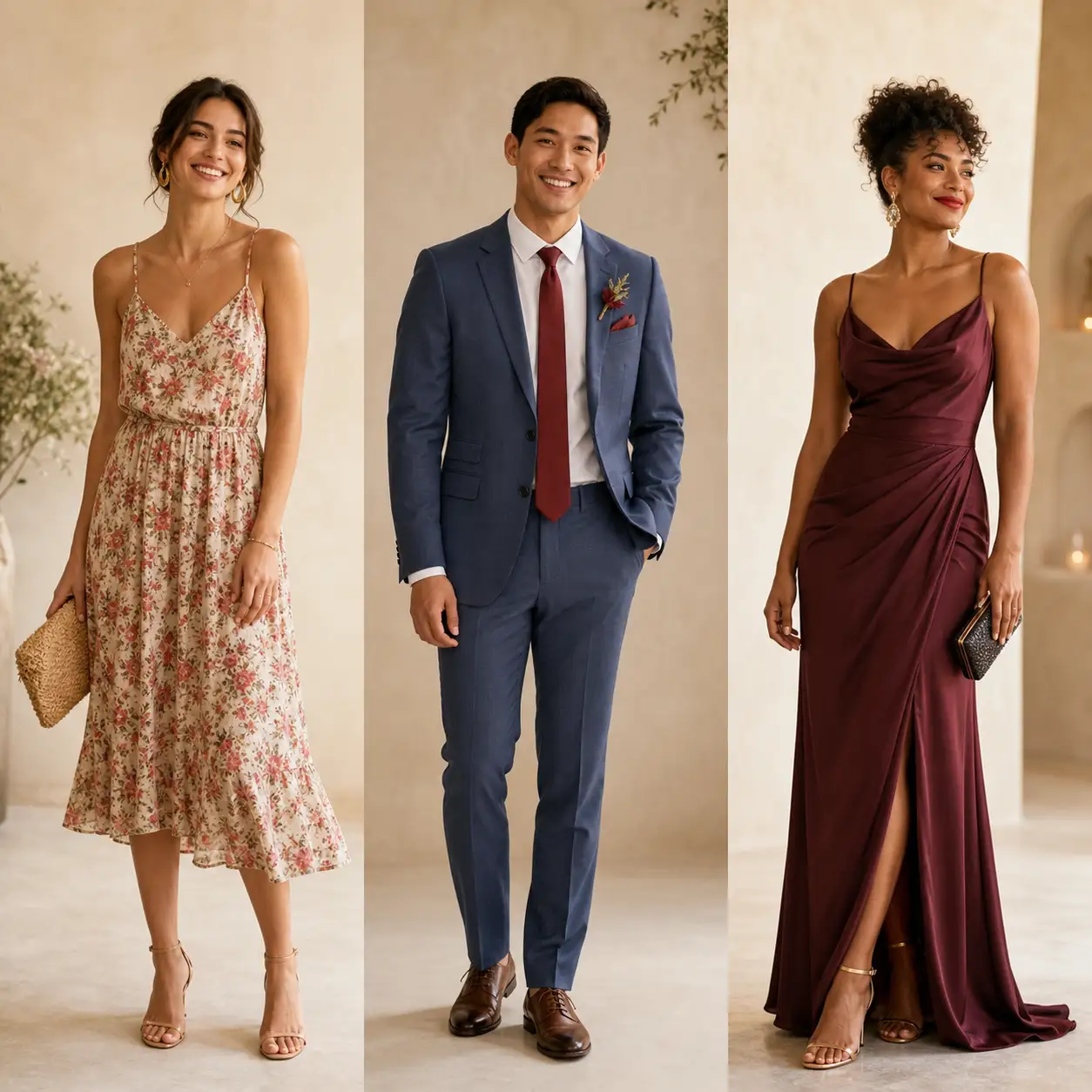
The invitation says “Cocktail attire,” and you have read it four times without it meaning anything. Here is the whole secret. A wedding guest’s outfit is decided by one variable: the dress code printed on the invitation. Find the formality level it names, lean a notch dressier rather than more casual, and never wear white. The color, the length, and the shoes all fall out of that one decision.
The one line that decides your whole outfit
Most people treat a wedding invitation as five separate panics. What color is safe. Is a jumpsuit allowed. Are these shoes too much. Will I be overdressed. Will I be the one everyone notices for the wrong reason.
It is not five questions. It is one.
The invitation is not asking what you like. It is telling you which rung to stand on. Wedding dress codes are not vibes; they are a ranked ladder of formality, and both the Emily Post Institute and The Knot publish that ladder in almost the same order, from casual up to white-tie. Call it the Dress-Code Ladder. Every wedding sits on exactly one rung, and that rung does most of your thinking for you.
Once you know the rung, the open question closes fast. “What should I wear” becomes “what works at this level,” which is a short list instead of a void. A floor-length gown is wrong for a backyard lunch and underdressed guests are conspicuous at a black-tie ballroom, but neither is a mystery once you have placed the event.
So the first move is never to open your closet. It is to find the one line on the invitation, or on the couple’s wedding website, that names the formality. Find your rung first, and every later choice gets easier instead of harder.
Decode the dress code, rung by rung
Here is the ladder in full, from the most relaxed wedding to the most formal, with a safe pick for each rung and the line you should not cross.
| Dress code | What it actually means | Safe pick (women) | Safe pick (men) | Never |
|---|---|---|---|---|
| Casual | Still means dressed, not jeans-and-a-tee. | A sundress, a high-low dress, or a jumpsuit. | A navy blazer, a blue button-down, or khaki pants. | Literal jeans + t-shirt, gym or athleisure, beach flip-flops. |
| Dressy casual / semi-formal | A relaxed step below formal; varies by time of day, lighter for daytime, darker for evening. | A midi dress, a chic jumpsuit, or a wrap dress (Emily Post “informal evening”: an afternoon or cocktail dress). | A dark suit (Emily Post semiformal); or a blazer + slacks, tie optional. | A floor-length ball gown (overdressed), shorts. |
| Cocktail | Semi-formal-to-formal; afternoon or evening. | A short cocktail dress, or an elegant jumpsuit with jewelry. | A suit and tie with a crisp black or white shirt and dress pants. | A full-length ball gown, anything white or ivory, an overly casual sundress. |
| Formal / Black-tie optional | A tuxedo is welcome but not required. | A floor-length gown OR a knee-length or midi cocktail dress (Emily Post formal-evening: a long evening dress or dressy cocktail dress). | A tuxedo, OR a dark suit with dress pants and nice loafers. | A daytime sundress, casual fabrics. |
| Black-tie | The most formal common code; evening. | A formal floor-length gown that touches the ground. | A tuxedo with a black bow tie (Emily Post: tuxedo required when the invitation states “Black tie”). | A cocktail-length dress (unless the couple signals it is OK), a regular business suit. |
| White-tie (rare, most formal of all) | The single most formal dress code. | A full-length formal ball gown, often with elbow-length gloves. | A black tailcoat with tails, a white piqué shirt, a white vest, and a white bow tie. | A tuxedo (too informal for white-tie), anything short. |
Sources: Emily Post Institute and The Knot wedding-guest attire guidance.
If you would rather see it as a path than a chart, this is the same decision in one flow: read the line, place the wedding, land on a safe pick, and keep the one rule that holds on every rung.
Three rungs cause almost all the confusion. They are worth pinning down.
Cocktail attire is the one everyone misreads
Cocktail is the most common wedding dress code and the most misunderstood. It means semi-formal to formal, for an afternoon or an evening. The Knot’s wedding-guest attire guide puts it plainly: for men, a suit and tie with a crisp black or white shirt and dress pants; for women, a short cocktail dress, or an elegant jumpsuit with jewelry. A jumpsuit is genuinely allowed here, not a risk you are taking. What cocktail does not mean is a floor-length ball gown. That reads as if you misjudged the event.
Semi-formal and “dressy casual” are a notch down, not a free pass
Semi-formal is a relaxed version of formal, and it shifts with the clock: lighter colors for a daytime ceremony, darker for the evening. The Knot lists a midi dress, a chic jumpsuit, or a wrap dress; the Emily Post Institute’s “informal evening” guidance lands in the same place with an afternoon or cocktail dress, and a dark suit or a blazer and slacks for men. The trap is hearing “casual” and reaching for what you wear on a Saturday errand.
Casual at a wedding still means dressed
This is the rung that embarrasses people. Casual is the couple’s permission to relax, not to show up in jeans and a tee. The Knot’s idea of wedding casual is a sundress, a high-low dress, or a jumpsuit for women, and a navy blazer with a button-down or khakis for men. Sneakers can work at this level for a backyard or beach celebration, but read the room before you commit. Place the wedding on a rung, and you have turned an open question into a short list.
One paste-ready idea a week, the kind you can actually use, plus the free Independent Brand Visual Kit the moment you join. That is the weekly newsletter, built for people who want a real answer, not a research project.
The three rules that outrank the dress code
You can land on the right rung and still get it wrong, because three guest rules sit above the dress code. Clear these, and you are dressed correctly by definition.
Rule 1: Never compete with the couple
The oldest rule is the one that still holds: do not wear white, ivory, cream, or champagne. Those belong to the bride, and a guest who reads as bridal in the photos is the guest people remember. The same logic rules out anything overly revealing or attention-grabbing. If you are wondering whether a white-ish dress is fine, the safe answer is to choose a different color you love instead.
Rule 2: The color question has changed
Black used to carry a superstition. It does not anymore. Zola’s wedding etiquette guidance notes that black is no longer considered bad luck or mourning at modern US weddings and is now a standard, chic choice, especially for evening and formal events. So black is genuinely fine at most weddings, and a bold color like red is a confidence move, not a faux pas. The exceptions are cultural: Zola points out that at traditional Indian and Chinese weddings, dark colors can still read as mourning, so check the couple’s customs. For the deeper logic of which colors flatter which skin tones, our guide to what colors to wear in photos carries the full breakdown.
Rule 3: Dress for the venue and the season, not just the rung
The same dress code wants different clothes in different rooms. The Knot’s guidance ties formality to time of day and place: darker fabrics for an evening wedding, lighter colors and fabrics for a daytime one, and the venue itself signals the level, since a barn invites casual where a ballroom expects cocktail at a minimum. A “cocktail” beach ceremony at noon and a “cocktail” hotel reception at eight want different fabrics and different shoes. If you are dressing for sand, our beach-wedding guest guide covers the fabric and footwear swaps. Get the rung right and clear these three lines, and the rest is taste.
See the look on you before you commit
Here is the gap the rules cannot close. You can know that a knee-length jewel-tone dress is correct for a cocktail wedding and still not know whether that dress reads right on your body, in that color, for that room. Reading “a navy suit works for a formal beach ceremony” is not the same as seeing it on you against the sand.
That is the part worth settling early, before the dress is bought or the suit is rented. Our AI outfit try-on takes one photo of you and one photo of any outfit, from a store page or your own closet, and shows it on your real body, dressed for the occasion, in seconds. You see the black dress, the jumpsuit, or the bold color on you, at the wedding, before anyone else does. The ladder tells you the rung. Seeing it on you is how you walk in sure.
FAQ
Q: What should you not wear to a wedding as a guest?
A: Avoid four things: white, ivory, cream, or champagne, which are the bride’s; anything overly revealing or flashy that pulls focus from the couple; an outfit that ignores the stated dress code; and, at the casual end, literal jeans and a t-shirt. Casual at a wedding still means dressed, not weekend-errand clothes.
Q: What does cocktail attire mean for a wedding?
A: Cocktail means semi-formal to formal, suitable for an afternoon or evening. The Knot describes it as a suit and tie with a crisp shirt and dress pants for men, and a short cocktail dress or an elegant jumpsuit with jewelry for women. It does not mean a floor-length ball gown, which reads as overdressed for the level.
Q: Can you wear black to a wedding?
A: Yes, at most modern weddings. Zola’s etiquette guidance notes that black is no longer considered bad luck or mourning and is now a chic, standard choice, especially for evening and formal events. The exceptions are cultural, such as traditional Indian and Chinese weddings where dark colors can read as mourning, so check the couple’s customs.
Q: Is it OK to wear jeans to a wedding?
A: Almost never, unless the couple explicitly asks for it. Even a “casual” wedding expects you to be dressed: a sundress or a jumpsuit, or a blazer with a button-down, per The Knot’s casual guidance. If the invitation says casual, read it as relaxed and pulled-together, not as denim.
Q: How do I know how formal a wedding is if the invitation gives no dress code?
A: Read the venue and the time. The Knot ties formality to both: a barn or backyard signals casual, while a hotel ballroom or country club expects cocktail at a minimum, and an evening start time runs more formal than a midday one. When in doubt, lean one notch dressier; overdressed is forgivable in a way underdressed is not.
Key Takeaways
- The dress code on the invitation is the one variable that decides your outfit. Find your rung on the ladder first, before you open your closet.
- The ladder runs casual, semi-formal or cocktail, formal or black-tie optional, black-tie, and white-tie. Each rung has a clear safe pick, documented by the Emily Post Institute and The Knot.
- One rule outranks everything: never wear white, ivory, cream, or champagne. That color belongs to the bride.
- Black is no longer off-limits, per Zola, and a bold color is a confidence move; venue and season shift the right fabric even at the same dress code.
- When the rules leave you unsure whether a look works on you, see it on your own body before you buy.
You were never being asked to guess
The invitation was never a riddle. It handed you one line that tells you exactly which rung to stand on, and the rung tells you almost everything else. Match the formality, lean dressier than casual, and leave the white at home, and you are, by definition, dressed right.
So before you spiral over a dress you have not bought yet, see it on you first. Which rung is your invitation pointing at?