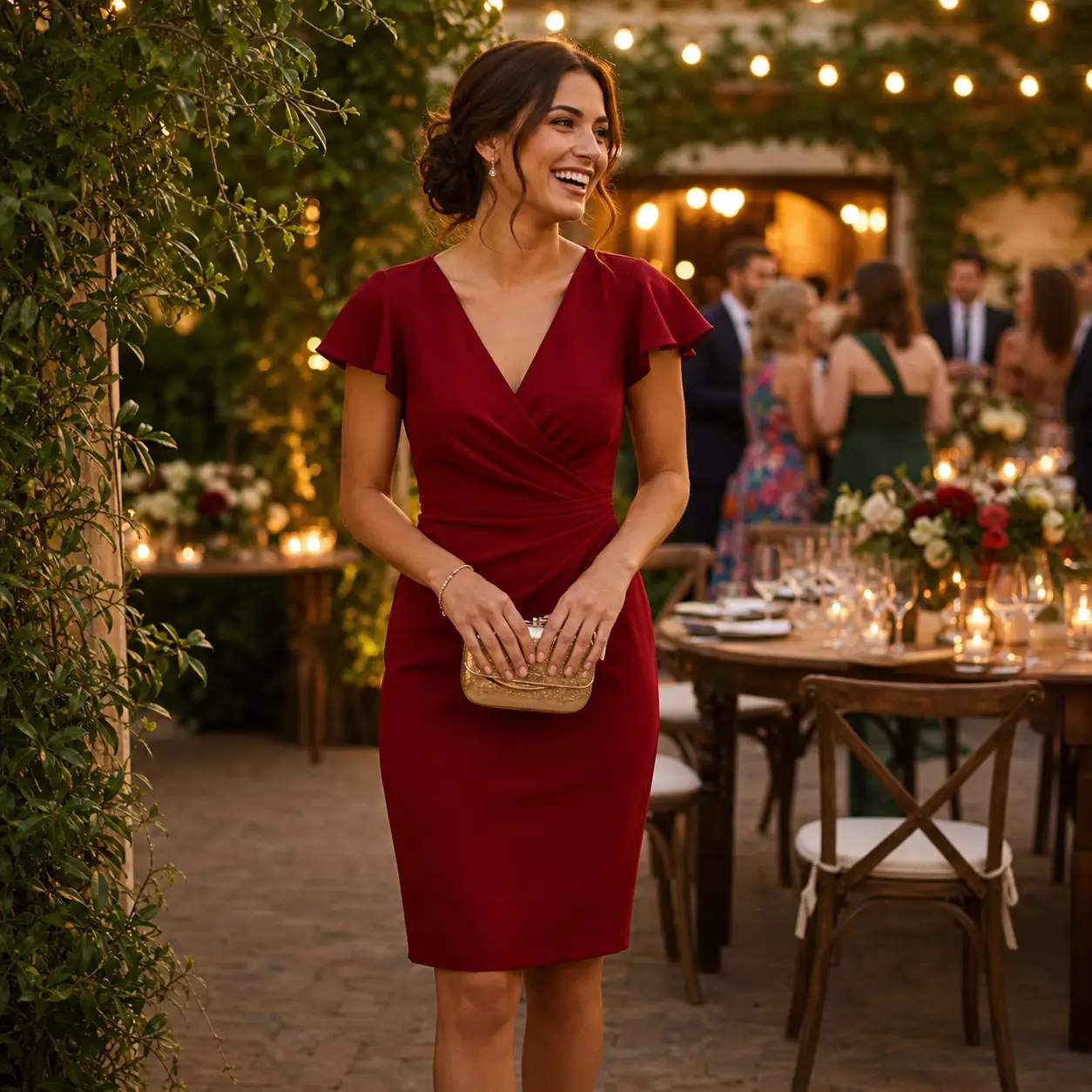
Yes, you can wear red to a wedding. At most Western weddings a tasteful red is welcome, and the fear behind the question is the wrong fear. Brightness is not what gets a guest in trouble. Looking like the bride is. The line you cannot cross at a wedding is bridal, not bold, and red sits on the safe side of it almost everywhere. The one place it does not is cultural, and that exception is the only part worth memorizing.
The fear behind the question is the wrong fear
Most people who ask whether they can wear red are really asking something else. They are asking whether they will look like they are trying to steal attention from the bride. That is a real worry, and it deserves a clean answer.
The answer is no, you will not. Etiquette expert Elaine Swann, speaking to TODAY about the recurring online debate, called the no-red rule “another internet fable” and said red is perfectly acceptable, especially in the U.S., where it reads as the color of love. The Knot makes the same point from the other direction: red may be eye-catching, but so are pink, orange, and yellow, and no one panics about those. If a bright color were the problem, half the guest list would be breaking the rule.
So here is the distinction worth keeping. There is a line at every wedding that a guest cannot cross. Call it the upstage line. You cross it by reading as the bride, which means white, ivory, cream, or anything that competes for the role she is the only one allowed to play. You do not cross it by being noticeable. Bold is not the same as bridal. Red is bold; it is not bridal, so at a Western wedding it stays on the right side of the line.
That reframes the whole question. The thing to manage is not how much you stand out. It is whether you stand in for the bride.
Which red, and where
Once red is cleared, the real decision is which red. The shade does more work than the color itself, and it shifts with the season, the venue, and the time of day. The Knot’s guidance is simple: darker reds like burgundy and maroon for fall and winter weddings, and brighter cherry or scarlet for spring and summer. Burgundy is also the safe pick for a formal or black-tie event, where a deep, longer cut reads as elegant rather than loud.
Here is the same idea as a quick reference you can match against your invitation.
| When or where | Shade of red that fits | Why |
|---|---|---|
| Fall or winter wedding | Burgundy, maroon, deep wine | The Knot recommends darker reds for cold-season weddings; they read rich, not loud |
| Spring or summer, daytime | Bright cherry, scarlet, or coral-red | The Knot’s warm-weather pick; lighter reds suit daylight and outdoor settings |
| Formal or black-tie | Deep burgundy in a longer cut | Darker, longer reds read as the most elegant at the formal end |
| Unsure of your tone | A red with a hint of blue, like cherry or wine | Blue-based reds flatter the widest range of skin tones; warm tomato-reds suit warmer complexions |
Source: The Knot wedding-guest attire guidance, plus general color-styling consensus.
Pick the red that fits the room and the season, and you have already done most of the work of looking right instead of loud. For the fuller logic of which colors flatter which skin tones, our guide to what colors to wear in photos carries the full breakdown.
The one real exception: when red is the bride’s
Now the part that actually matters. The upstage line does not disappear at a cultural wedding. It moves, and red moves with it.
At many traditional Chinese and South Asian weddings, red is the bride’s color the way white is in the West. Who What Wear’s reporting on these traditions makes the point through the people who live them. Designer Cheryl Leung of Sau Lee notes that the Chinese bride traditionally wears a red dress, so red is generally not worn by guests. Bengali bride Meeka Hossain says guests at her wedding were asked to avoid red because she wore it. The Knot adds that at Indian, Pakistani, and Chinese weddings, red is worn by the couple and symbolizes love, commitment, and prosperity, which is exactly why a guest in red can read as overshadowing them.
At a Chinese wedding there is an extra wrinkle. The bride often changes outfits several times, and even if the ceremony dress is not red, the reception dress may be. So “she is not in red yet” is not a safe read.
None of this is a hard ban; it is a check. If the couple’s background is Chinese, Indian, Pakistani, Bengali, Korean, or another tradition where red is bridal, the move is to confirm before you commit. Look at the invitation or the couple’s wedding website for any stated color guidance, and when you are unsure, ask. If red turns out to be off the table, blues, greens, deep purples, and rich jewel tones are all safe and celebratory, and even a well-judged black reads as chic at most modern weddings. At a wedding where red belongs to the bride, your bold color is simply a different one.
Style it so it celebrates, not competes
A red that respects the upstage line still has to be styled like a guest, not a headliner. The experts who clear red are consistent on the condition attached: wear it to celebrate, not to outshine. Keep it elegant, fit it to the formality of the event, and skip anything overly revealing or flashy, the same way you would in any color. A guest who reads as confident and considered is the one people remember warmly. A guest who reads as competing is the one they remember the other way.
If the couple put color guidance on the invitation or their wedding website, follow it, even if it rules out the red you love. Stated requests outrank general etiquette every time, and a guest who honors them is doing the one thing the day is actually about.
One paste-ready AI move a week, the kind you can use on a Tuesday, plus the free Independent Brand Visual Kit the moment you join. That is the weekly newsletter, built for people who want a real answer instead of a research project.
Here is the gap none of this closes. You can know that a deep burgundy is correct for a formal autumn wedding and still not know whether that red, in that cut, reads right on your body in that room. Reading “wine flatters most skin tones” is not the same as seeing it on you. That is the part worth settling before the dress is bought, and our AI outfit try-on settles it: one photo of you and one photo of any red dress, from a store page or your own closet, and it shows the look on your real body, dressed for the occasion, in seconds. You see the red on you, for the wedding, before anyone else does.
FAQ
Q: Is it OK to wear red to a wedding?
A: Yes, at most Western weddings. Etiquette expert Elaine Swann told TODAY that the no-red rule is “another internet fable,” and The Knot notes red is no more attention-grabbing than accepted colors like pink, orange, and yellow. The only line that matters is not wearing white, ivory, or cream, which belong to the bride. The exception is cultural, covered below.
Q: Will wearing red make it look like I’m trying to upstage the bride?
A: No, not at a Western wedding. Bold is not the same as bridal. You upstage the bride by reading as the bride, which means wearing white or anything that competes for her role, not by wearing a noticeable color. Keep the red elegant and fitted to the event’s formality and you read as a celebrating guest, not a competing one.
Q: Can you wear red to a Chinese wedding?
A: Usually no. Red is the traditional bridal color at Chinese weddings, and as designer Cheryl Leung of Sau Lee notes via Who What Wear, it is generally not worn by guests. Chinese brides also change outfits several times, so a red reception dress is likely even if the ceremony dress is not. Check with the couple, and choose another bold color if you are unsure.
Q: What shade of red is best for a wedding guest?
A: Match it to the season and formality. The Knot recommends burgundy and maroon for fall and winter weddings, brighter cherry or scarlet for spring and summer, and a deep burgundy for formal or black-tie events. A blue-based red like cherry or wine flatters the widest range of skin tones.
Q: What other colors are safe if red is off the table?
A: Blues, greens, deep purples, and rich jewel tones are all safe and celebratory at nearly any wedding. If the couple’s tradition makes red bridal, or the invitation states color guidance, pick one of these instead. The point is to wear a bold color the bride is not wearing.
Key Takeaways
- Yes, red is welcome at most Western weddings. Etiquette experts call the no-red rule a myth, and bold is not the same as upstaging.
- The line you cannot cross is bridal, not bold. You upstage the bride by reading as the bride, which means white, ivory, or cream, not by wearing a noticeable color.
- Shade follows the season and venue: burgundy and maroon for cold-weather weddings, cherry or scarlet for warm-weather ones, deep burgundy for formal, per The Knot.
- The one real exception is cultural. At many traditional Chinese and South Asian weddings, red is the bride’s color, so check the couple’s traditions and ask if unsure.
- When the rules clear a red but you still are not sure it works on you, see it on your own body before you buy.
Bold was never the line
The question was never really about red. It was about being the guest everyone notices for the wrong reason. The answer is that brightness does not make you that guest; standing in for the bride does. Wear the red, fit it to the room, and leave anything bridal at home. At a wedding where red belongs to the bride, wear a different bold color and feel just as sure.
So before you talk yourself out of a dress you have not even bought, see the red on you first. Which side of the upstage line is your invitation actually drawing?