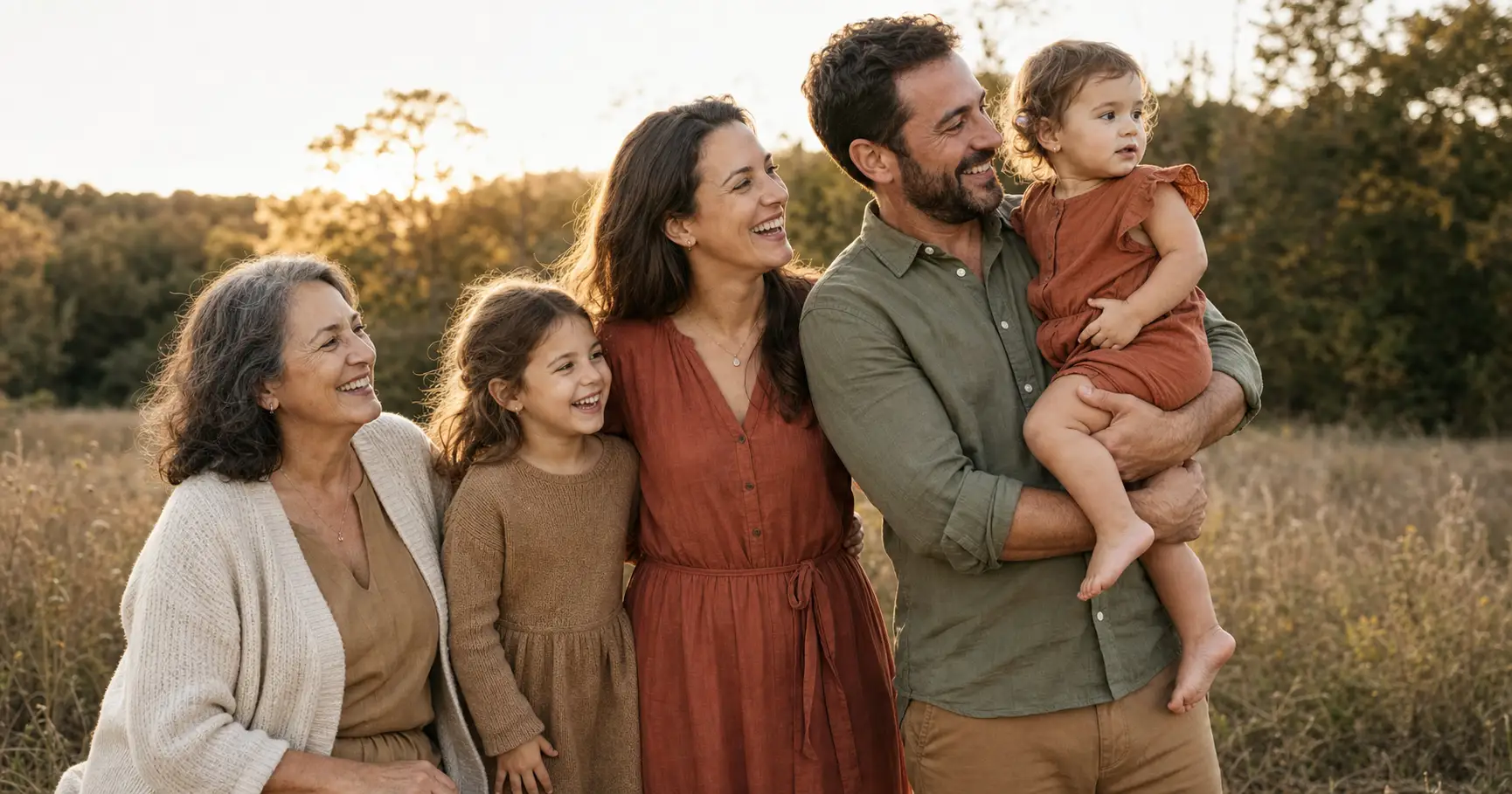
Dressing one person for a photo is easy. Dressing five people, from a toddler who will not keep socks on to a grandparent who hates fuss, so they look like one family and not a focus group, is the real problem. The trick is to stop dressing five people. Pick one anchor outfit, build a small palette out of it, then give every other person a different piece of that palette in something their age can actually wear.
Start With One Anchor Outfit
A whole family is too many decisions to make at once. So don’t. Make one decision, then let it make the rest.
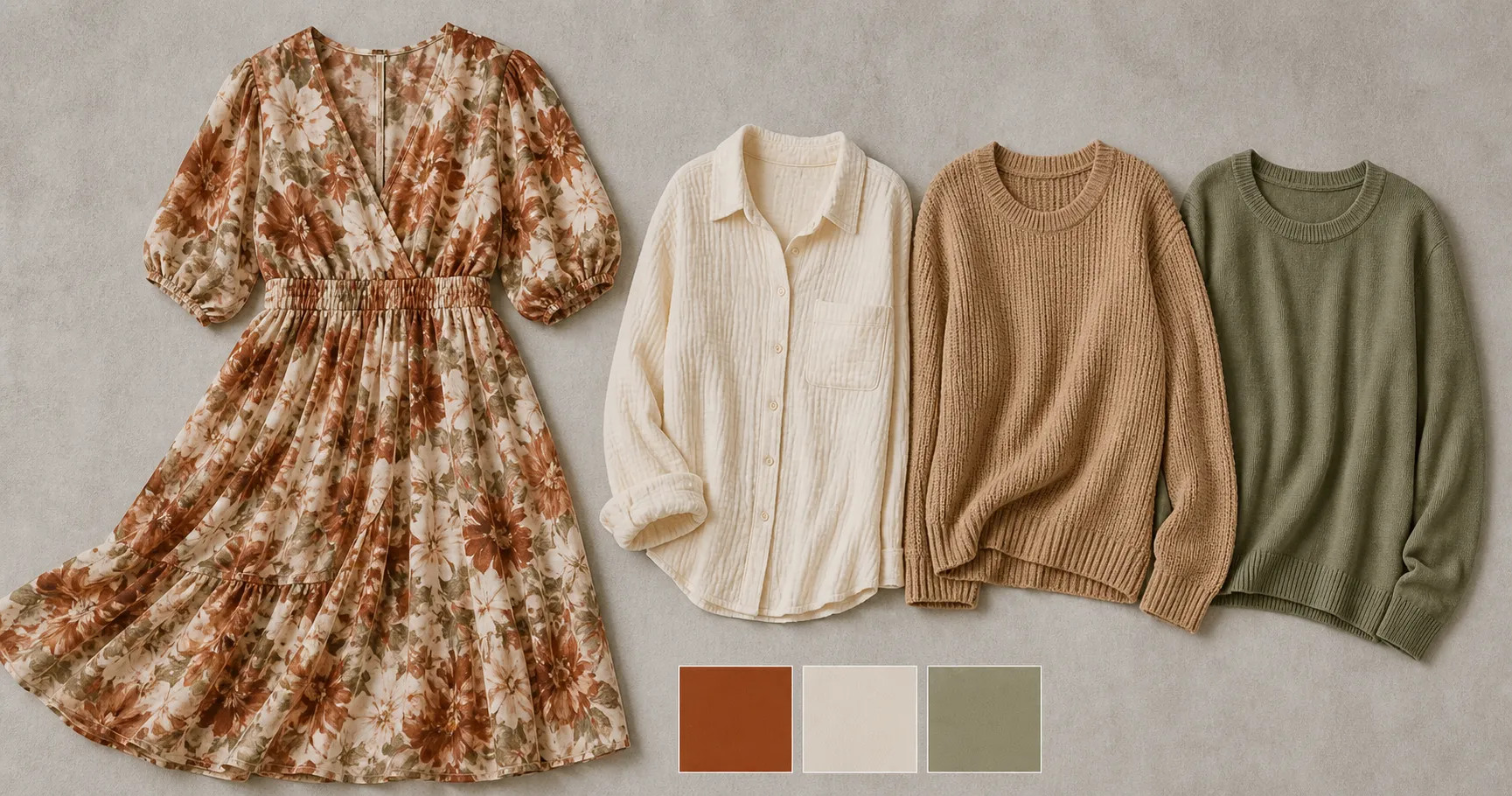
Pick the anchor first. There are two ways to choose it, and you only need one. Either pick the hardest person to dress, or pick one statement piece. The hardest person is whoever has the strongest constraint: the teen who refuses anything but black, the grandfather who owns one good shirt, the baby whose wardrobe is whatever fits this month. Dress that person first, because they have the fewest options. The statement piece works the other way: a patterned dress, a bold floral, a textured plaid jacket, anything with two or three colors already living in it. AK Studio and Design calls this the statement-and-anchor idea, and it scales straight from a couple to a crowd: one piece carries the pattern, everyone else pulls solid colors out of it.
Either way, the anchor is the source. Pull two or three colors out of it and that is your family palette, decided. The mother’s floral has rust, cream, and a soft sage in it, so the rest of the family lives in rust, cream, and sage. Nobody else has to invent anything. They just claim a color and wear it well.
This is the move that separates a photo you frame from one you delete. Photographers say it almost in unison: don’t match, coordinate. Shawn Spencer Photography puts the rule in its title, and Westport studio N. Lalor Photography frames it the same way. The same logic runs our guide on what to wear for engagement photos, where it is a couple’s problem. With a family it becomes a sourcing problem: one outfit feeds all the others. And these are not throwaway photos. Home-services marketplace Thumbtack puts a family portrait session at about $300 to $900 for roughly 30 edited images, the ones headed for the holiday card and a grandparent’s mantel.
Dressing Every Age
One palette, but not one rulebook. Each age has a different constraint, and the trick is to honor the constraint while staying inside the colors.
- Adults have the most freedom and the most responsibility. They carry structure: a tailored jacket, a button-down with the sleeves rolled, clean trousers, a wrap dress. They also set the formality ceiling, so nobody outdresses the rest. This is where you put the quieter palette colors and let the kids take the loud one.
- Teens care about one thing more than the photo: not looking like their parents dressed them. Give them the color, not the outfit. Hand a teen the sage and let them style it their way, fitted or layered, and they stay inside the palette without feeling costumed.
- Little kids are dressed for movement, not for standing still. Soft fabrics they can run in, nothing stiff, nothing that has to be tugged back into place every thirty seconds. Let them lead with the boldest palette color, because a small kid in a strong color is what the eye loves in a family frame.
- A baby is the easiest color slot and the hardest fabric call. Their wardrobe is small, so claim whatever palette color a clean onesie or romper already comes in. The real constraint is comfort and a high spit-up risk, so keep it soft, keep it simple, and assume you will change it once.
The point is that the palette is fixed and the form flexes. A grandparent in a cream cardigan and a toddler in a cream romper are wearing the same color in the only garment each of them would tolerate. That is what coordination across ages actually looks like.
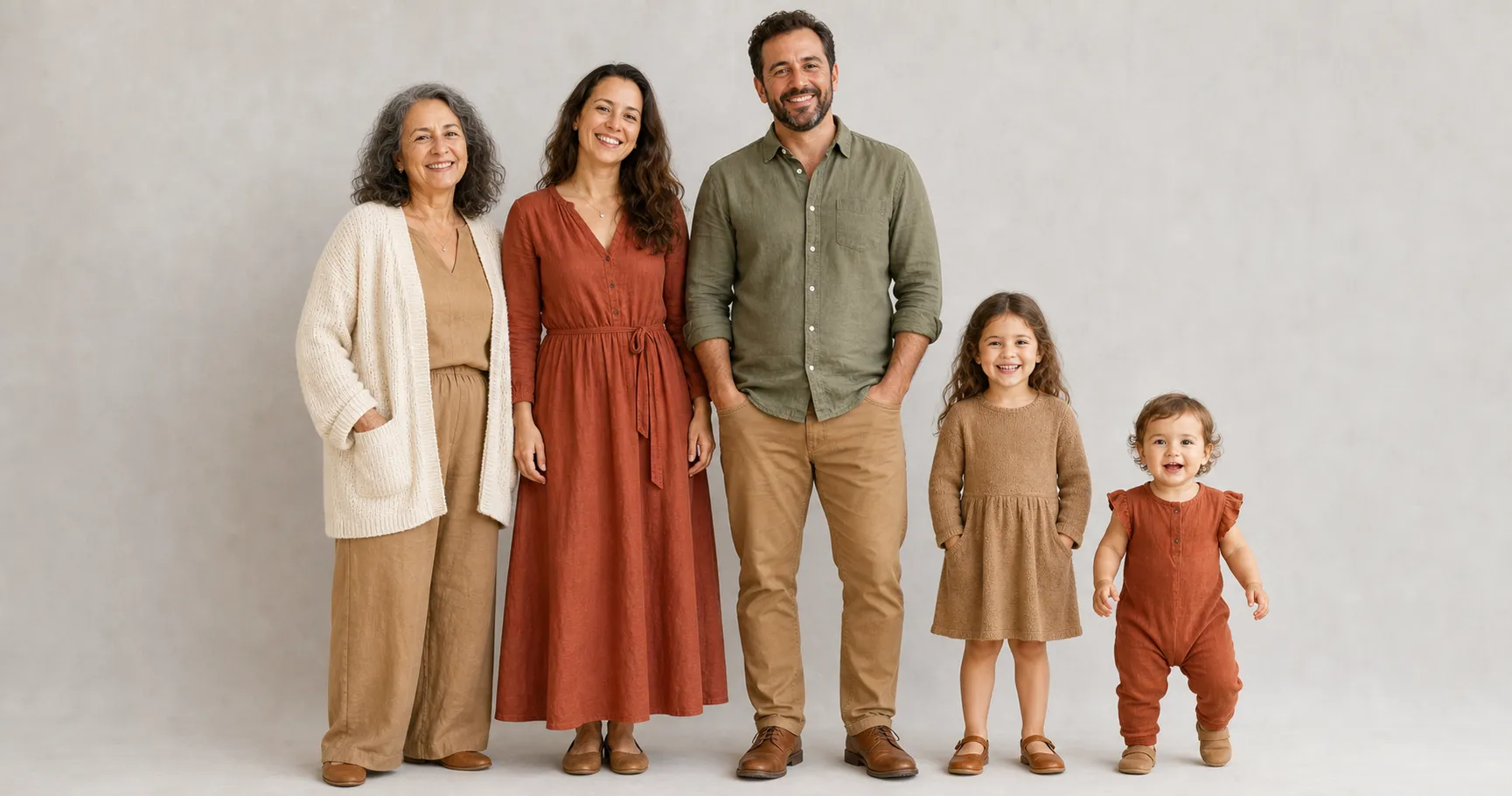
One palette, five ages, five different garments: structure for the adults, the bold color on the kids, the easy slot for the baby.
The Kid Rules
The adults will be fine. The session lives or dies on the kids, and the rules for them are not about color at all. They are about reality.
Comfort wins, every time. A scratchy collar, a stiff waistband, or a tag in the wrong place will end your session faster than bad light. A child who is uncomfortable is a child who is done, and no palette survives a meltdown. Choose the soft version of everything, and let the kid wear it around the house once before the day so the clothes are not a surprise.
No character tees, no loud logos. A four-year-old’s favorite cartoon shirt will win every glance in the frame, and PatPat’s photographer guide is blunt about why: large logos and characters pull the eye off faces and expressions, and they date the photo to one year. The shirt that is perfect on a Tuesday is the wrong call in a print you hang for a decade.
Dress stain-smart. Little kids find dirt, grass, and snack the way water finds a crack. Lean on the mid-depth, slightly muddy palette colors that forgive a smudge, and keep the pure pale shades for the people tall enough to stay out of the mud. Then pack a backup. A full second outfit in the same palette, folded in the bag, is the cheapest insurance in family photography. The spill is not a maybe; it is a when.
One paste-ready AI move a week, the kind you can use on a Tuesday or a Sunday. Subscribe to the newsletter and the Independent Brand Visual Kit, a set of copy-ready photo prompts, is yours free: join here.
How Many Colors for a Crowd
Two people can share two colors and call it a day. Five or six people need a plan, because the same small palette now has to stretch without going flat or, worse, without anyone accidentally matching.
Keep the palette small. Two or three colors is plenty, even for six people, the same range photographers use for a couple. The work is not adding colors; it is spreading the ones you have. Shawn Spencer Photography advises against putting any two family members in the same color or the same type of top, though the same color in a different garment is fine, like Dad in a sweater and a child in a polo. So you vary two things across the group: tone and texture. One person wears the deep version of rust, another the soft faded one. One wears it in linen, another in knit. Same family of color, no two people twinning.
The danger to plan against is the opposite of variety. Everyone in white and denim is the default a panicking family reaches for, and it is a trap: it reads as a team uniform, and different whites rarely match in tone on camera, so the look fractures instead of unifies. If you want the full rundown of which colors and patterns the camera punishes, that lives in our guides on what to wear for pictures and what colors to wear in photos. For a crowd, the one rule that matters is this: spread the palette, vary the tone, change the texture, and let no two people read as a pair.
| People in the group | Colors to use | How to spread them |
|---|---|---|
| 3 to 4 | 2 to 3 | One lead each; repeat a color only in a different garment and tone |
| 5 to 6 | 2 to 3 | Same colors, split by tone (deep vs soft) and texture (linen vs knit) |
| 7+ | 3 | Cluster by sub-family; vary tone so no two adjacent people twin |
Location and Season
The palette still has to answer the place. As Fstoppers notes, grass bounces a green cast up onto skin in midday sun, so green and turquoise outfits in a field make everyone look slightly ill and also vanish into the background. PatPat’s seasonal guide gives the same warning the other way: take cues from the setting, but make sure the family does not blend into it. A beach wants soft neutrals, a forest wants warmer or jewel tones, a studio wants one or two clean colors against the backdrop.
Season is a dial on the same palette, not a new one. Reach for warmer earth tones in fall and deeper jewel tones in winter, but keep the two-or-three-color logic intact. The palette does not change when you leave the closet. It only gets tuned to the place. Once the outfits are settled, the other half of a great session is what everyone does in front of the lens, which is where our family photo ideas and poses take over.
FAQ
Q: What is the best color to wear for family photos?
A: There is no single best color. The best one is a small palette of warm, muted, mid-depth tones built around your hardest-to-dress person, then shared so no two people lead with the same color. Earth tones, soft neutrals, and one gentle accent photograph reliably well across a range of ages and skin tones. The full logic by skin tone is in our guide on what colors to wear in photos.
Q: What colors don’t look good on camera?
A: Neon and hot-saturated colors are the main offenders. They bounce their own color onto skin, and because skin is translucent the cast reads unnatural, per Fstoppers. Pure bright white blows out and clips before anything else in the frame, and a wall of identical white-and-denim across a whole family reads as a uniform. The full avoid-list is in our guide on what to wear for pictures.
Q: Should I wear a dress or pants for family pictures?
A: Either works. The choice that matters more is texture and fit, not dress versus pants. A flowing dress adds movement, tailored trousers add structure, and a family reads best with a mix of both across its members. Pick whatever each person can sit, kneel, and chase a toddler in, keep it inside the shared palette, and make sure formality levels do not clash.
Q: What should toddlers and little kids wear for family pictures?
A: Comfort first, because an uncomfortable toddler ends the session. Soft, stretchy, tag-free fabrics in a palette color, nothing stiff or scratchy, and no character tees or loud logos that pull the eye off faces. Bring a full backup outfit in the same palette for the inevitable spill, and let the kids carry the boldest piece so they pop without anyone matching.
Q: Do we all have to wear white shirts and jeans for family pictures?
A: No, and it is one of the more common mistakes. Identical white shirts and jeans read as a team uniform, and different whites rarely match in tone on camera. Pick one anchor outfit instead, build a small palette out of it, and give each person a different piece of that palette. Denim can stay as one neutral among several if you vary the washes and tops.
Key Takeaways
- Stop dressing five people. Pick one anchor, the hardest person or one statement piece, and build everyone’s colors out of it.
- Keep one palette but flex the form by age: structure for adults, freedom of styling for teens, comfort for little kids, the easy slot for a baby.
- With kids, comfort beats everything. No character tees, dress stain-smart, and pack a full backup outfit in the same palette.
- For a crowd, keep two or three colors and spread them by tone and texture so no two people twin; avoid the everyone-in-white-and-denim default.
- The outfits are the one variable you fully control in a photo your family will see for years.
One Last Check Before the Shoot
Lay every outfit out side by side on the bed, the way photographers say is the single best move you can make. Find the anchor in the pile first. Does everything else pull its color from that one piece, or did three different plans sneak in? Can the smallest kid actually move in what they are wearing? Is the backup outfit packed? And is anyone wearing a cartoon tee or a wall of plain white?
If you want to see a coordinated, well-lit version of a look before the day, turn one selfie into an AI photoshoot and preview how it reads on camera, so the only surprise on shoot day is how good everyone looks together. And if you are still deciding on one person’s outfit, you can see it on them before you buy it.