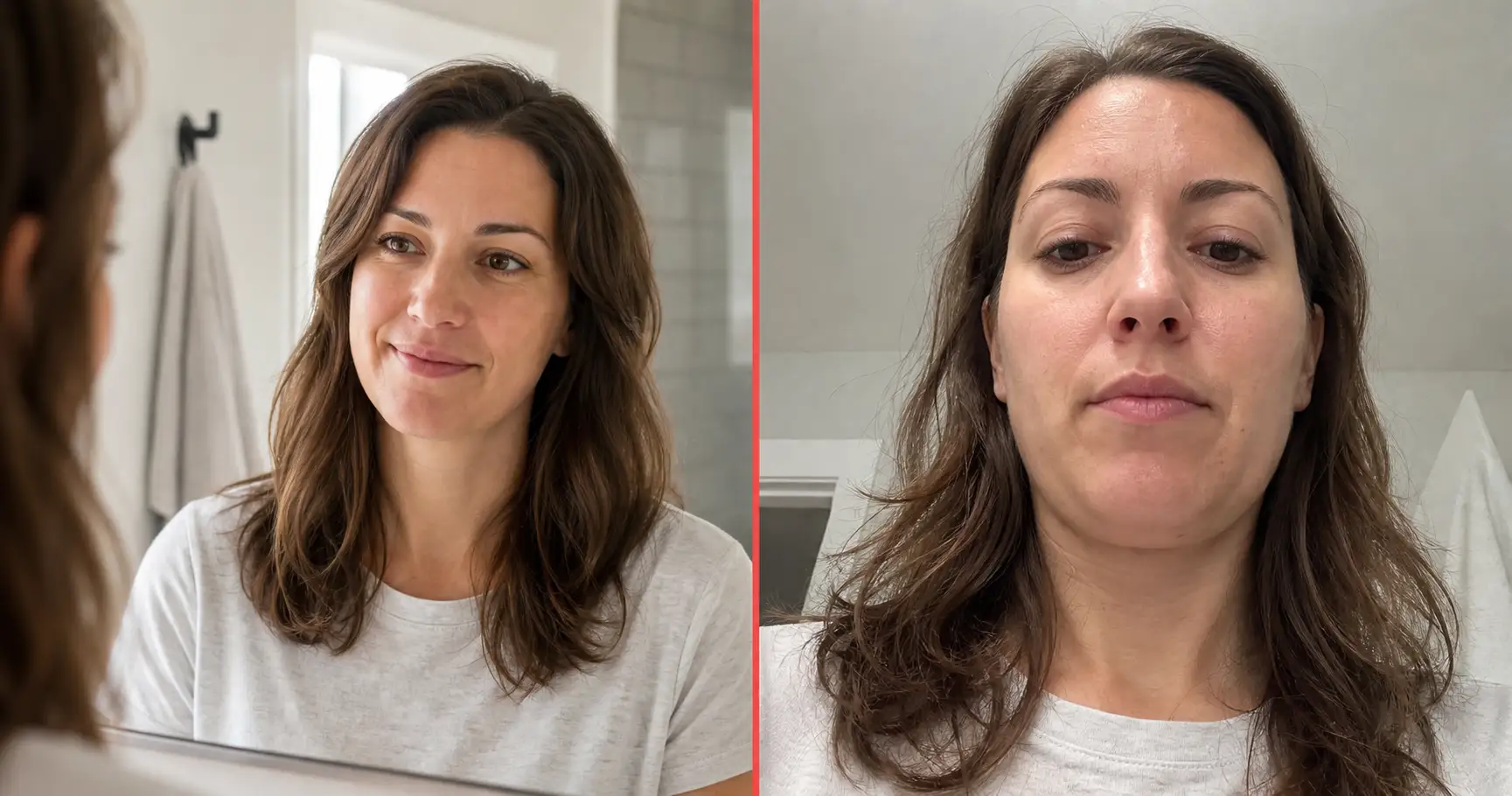
You catch yourself in the bathroom mirror, and you look fine. Then a friend posts a photo from the same night, and the person in it is puffy, off, almost a stranger. So you ask them to take it down and quietly file yourself under “not photogenic.” Here is the part that should change your evening: the mirror you and the photo you are the same person. Three specific, measured things happen in between, and not one of them is that you are ugly.
The mirror is the one view of yourself you trust, and the camera keeps contradicting it. So let’s take the gap apart. Here are the three reasons, one at a time, with what is actually going on under each.
Three things happen between the mirror and the camera. None of them is your face.
A phone held close stretches the nearest part of your face. A 2018 study measured a nose looking about 30% wider at selfie distance.
You have memorized your mirror face, which is reversed. A photo shows the un-flipped you, the version a stranger to your own eye.
A still freezes one microsecond your moving face never holds. People are rated more flattering in video than in stills of that same video.
Reason 1: The lens stretches the nearest thing to it
Hold a phone close to your face, the way every selfie happens, and the lens does not record you. It records a stretched version of whatever is closest, which is usually your nose and the center of your face.
This is measured, not a feeling. A 2018 study in JAMA Facial Plastic Surgery, led by Rutgers surgeon Boris Paskhover, found that a photo taken at about 12 inches makes the base of your nose look roughly 30% wider than the same face shot from five feet away. The mirror sits at a comfortable distance and never does this. The front camera, held at arm’s length or closer, does it every time.
So the first reason you look “off” is geometry. The camera was too close, and a close lens pushes the middle of your face forward and out. It is the same reason a fish-eye photo bends a doorway. Your face did not change between the mirror and the phone. The distance did.


That is reason one, and it is the camera’s fault, not yours.
Reason 2: You memorized the mirror, and the photo is flipped
This is the one that explains “good in the mirror, bad in photos” better than anything else, and almost nobody knows it.
You have looked at your mirror face thousands of times. Every morning, every time you wash your hands, every passing window. And there is a well-documented quirk of the mind here: the more you see something, the more you like it. Psychologist Robert Zajonc named it the mere-exposure effect in 1968, after showing that people grow to prefer faces, words, and shapes simply because they have seen them before. You have given your mirror face the most exposure of any face on earth. Of course you prefer it.
Here is the twist. The mirror flips you. The face you have learned to love is reversed left-to-right, and it is the only version of you that you ever practice liking. A photo shows the un-flipped you, the version everyone else sees, and to your own eye that version is subtly, unsettlingly wrong.
Researchers proved this in 1977. In a study by Mita, Dermer, and Knight, published in the Journal of Personality and Social Psychology, people reliably preferred the mirror-reversed image of their own face, while their close friends preferred the true, un-reversed one. Each group liked the version it had seen more often. You are not looking at a worse face in the photo. You are looking at the version you never trained yourself to like.
That is reason two, and it is the version your friends already think is you.
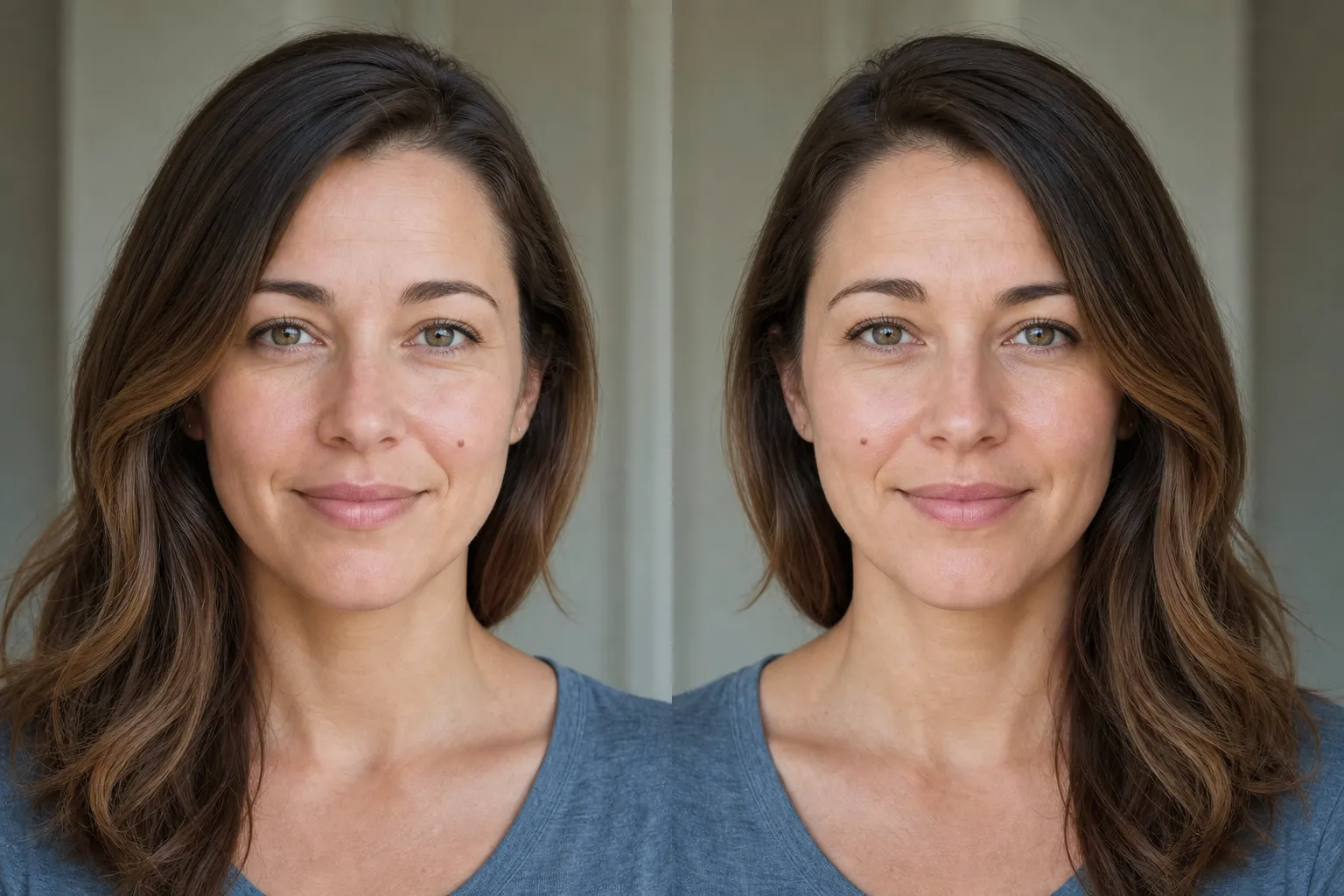
Reason 3: A photo freezes a microsecond your face never holds
Your face is never still. It is always mid-word, mid-laugh, mid-thought, a moving blend of small expressions. People see that moving face in person and in the mirror. A photo does something the eye never does: it stops you dead on a single frame.
And a single frame is often unlucky. Out of the thousands of micro-positions your face moves through, the shutter catches exactly one, and it might be the half-blink between two good ones. Researchers led by Robert Post described this as the “frozen face effect” in a 2012 paper in Frontiers in Psychology. Across six experiments, people were rated more flattering in short video clips than in the still frames pulled from those very same clips. Same person, same lighting, same outfit. The motion flattered them; the freeze did not.
This is why you can love a video of yourself and hate the screenshots from it. The video is the real, moving you. The screenshot is one frozen instant that your moving face passed through too fast for anyone, including you, to ever actually see.
That is reason three, and it is a frame that does not exist when you are in motion.

So are you actually uglier than you think?
No. And it is worth saying plainly, because this is the quiet fear under the whole question.
You are not uglier in person. You are not secretly ugly and only the camera tells the truth. The truth sits between your best mirror moment and your worst tagged photo, and it is much closer to the middle than to either one. The mirror flatters you with familiarity. A bad photo punishes you with a close lens and an unlucky frame. Reality is the calm average of the two, which is to say: you look like a normal person, which is to say, fine.
Being photogenic, it turns out, is a separate skill from how you look. A camera freezes one flat instant out of a moving face and often distorts it. People who photograph well have usually learned how to work around that, not won a better face. Which means the gap you have been blaming on your looks is mostly a fixable problem.
So how do you actually fix it?
Understanding why is the relief. Fixing it is the next move, and it is more controllable than you would guess. The same three reasons point straight at their own solutions: back the camera up to undo the lens, get a little height and turn toward soft light, and time the shot to a real expression instead of a frozen one.
That is the whole playbook, and it lives in one place. The full version is how to be photogenic, which walks through the three levers you control in the moment: angle, light, and expression. If your bad photos are mostly about a stiff smile, how to smile in photos goes deeper on that one.
One paste-ready AI move a week, the kind you can use on a Tuesday or a Sunday. Subscribe to the newsletter.
And if you want a guaranteed-good shot of the real you today, without waiting to practice any of it, an AI photoshoot builds one from a single selfie while keeping your real face. It applies the right distance, light, and expression for you, so the photo finally matches the person you see in the mirror.
FAQ
Q: Why do I look bad in pictures but good in the mirror?
A: Because the mirror and the camera show you two different things. The mirror shows a flipped face you have stared at your whole life and learned to like. A photo shows the un-flipped version, often through a close lens that widens your features and a shutter that freezes one instant your moving face never holds. The mirror you and the photo you are the same person, seen under different conditions.
Q: Am I uglier in person or on camera?
A: Neither, really. In person people see you moving, lit from all sides, at a normal distance, and that reads as more flattering than a single frozen frame shot up close. A 2012 study called this the frozen face effect: the same faces score higher in video than in the stills pulled from that video. You are not uglier on camera. The camera just stops on a frame that does not exist in motion.
Q: Can you be pretty but not photogenic?
A: Yes, and it is common. Being photogenic is a separate skill from how you look in person, because a camera freezes one flat instant out of a face that is always moving and often distorts it with a close lens. People who photograph well have usually learned the angle, light, and expression that work for them, not won a genetic lottery. It is learnable.
Q: Do I look worse in photos than in real life?
A: Most people look a little different, not worse. Real life shows you in motion and at a comfortable distance; a close, frozen photo exaggerates and stills what real life smooths over. The honest answer is that the truth sits between your favorite mirror moment and your worst tagged photo, and it is closer to the middle than to either extreme.
Q: Why do I look bad in the front camera but good in the mirror?
A: The front camera sits close to your face and uses a wide lens, which stretches whatever is nearest to it, usually your nose and the center of your face. Your mirror does not. Hold the phone farther away, or use the rear camera and a timer, and the front-camera distortion mostly disappears.
Key Takeaways
- The mirror you and the photo you are the same person. Three measured things happen in between, and none of them is that you are ugly.
- The lens: a close phone distorts you. A 2018 JAMA study measured a nose looking about 30% wider at selfie distance than at five feet. Back the camera up.
- The flip: you have memorized your reversed mirror face and learned to like it (the mere-exposure effect). A photo shows the un-flipped you that your friends already see as normal.
- The freeze: a still catches one microsecond your moving face never holds. The frozen face effect found people look more flattering in video than in stills from that same video.
- It is fixable, not fated. The angle, light, and expression that fix it are a learnable skill, and an AI photoshoot can hand you a guaranteed-good shot of the real you from one selfie.
- In practice, copy photo poses and ideas that flatter, or for the front camera specifically, selfie poses and ideas.
- And since most “bad” photos are selfies, the fixes for the front camera itself are in how to take a good selfie.
The mirror was never lying to you
The next time a photo makes you flinch, remember what it actually is: one frozen, flipped, lens-stretched instant of a person who is, in real life, moving and fine. It is not a more honest version of you. It is a less complete one.
So which of the three has been fooling you the most: the lens, the flip, or the freeze?