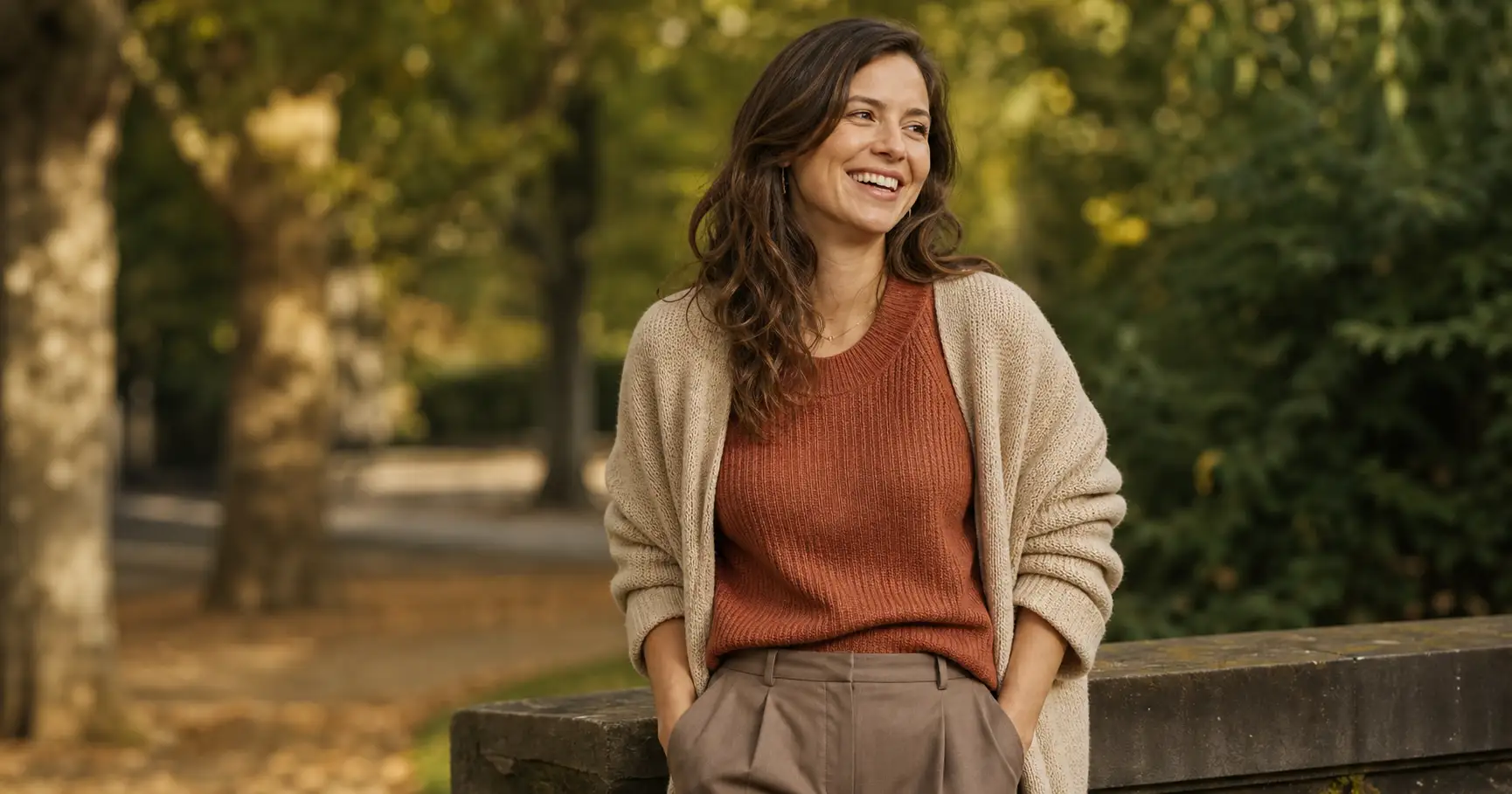
You have photos coming up and you do not even know the occasion yet, just that you want to look like yourself in them. Here is the answer that works before any of the details: wear something that fits, keep it a solid color, stay inside one small palette, and dress for the light and the place. Four rules, no shopping required. The occasion only changes the dial settings, never the rules.
The Four Rules That Always Apply
Most outfit panic is really decision panic. There are a hundred choices, so it feels like a hundred problems. It is four. Settle these four and the closet stops being a threat. They hold for a headshot, a family session, a maternity shoot, or a phone snap at a friend’s wedding, because they are about how fabric behaves in front of a lens, not about the event on the calendar.
Rule 1: Fit beats everything
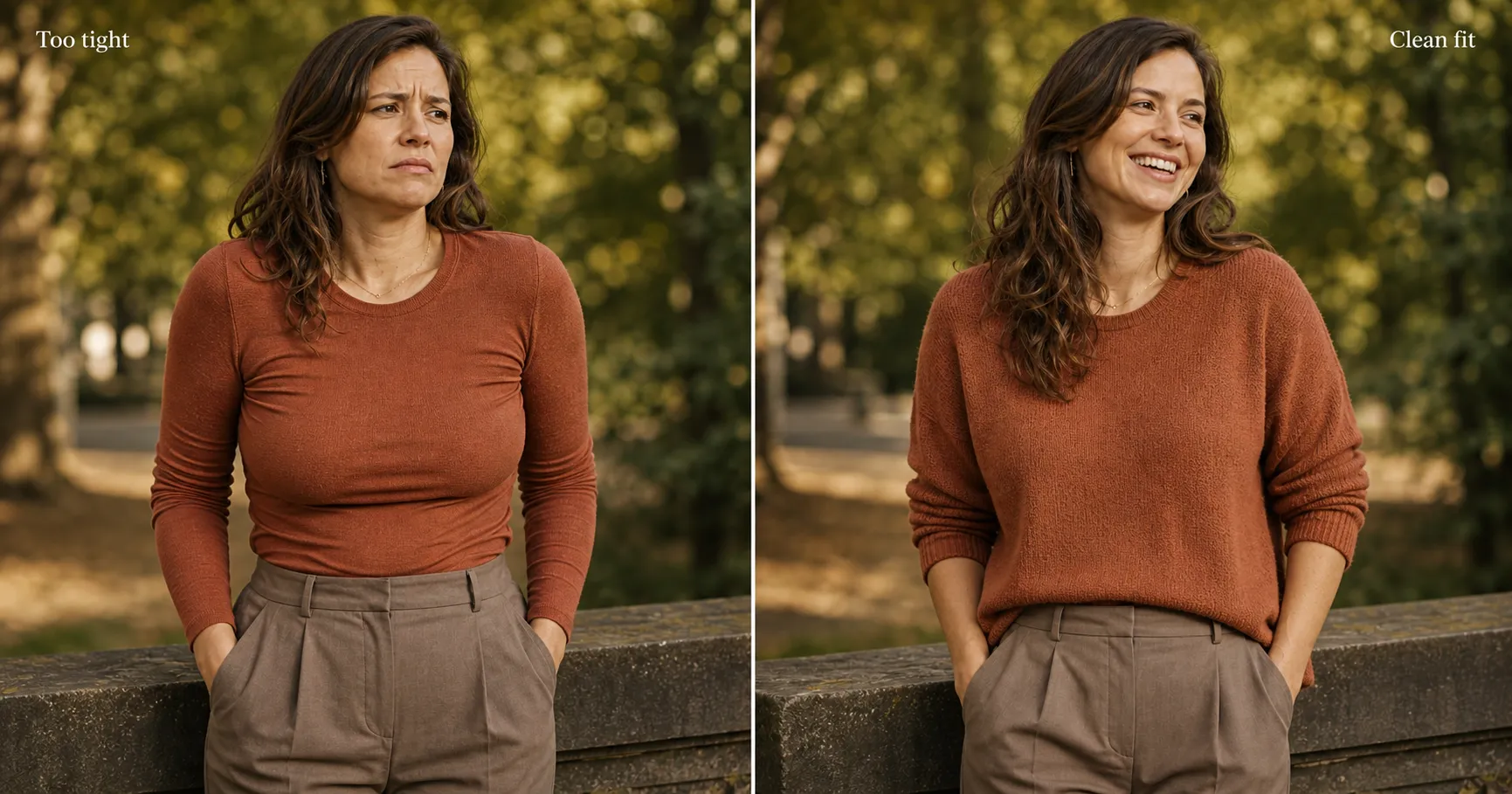
Color gets all the attention, but fit quietly does more work. A piece that fits you and lets you move will out-photograph the “perfect” color you cannot sit down in. Flytographer, a global photography service, puts it first: if you are not comfortable in what you are wearing, that discomfort shows in the frame, and if you feel good, that shows too. Their other quiet truth is that you probably already own the right thing, so try a few outfits on well before the day instead of panic-buying. Fit is the rule that costs nothing and changes the most.
Rule 2: Solids and texture over busy patterns
The subject of a photo is a face, and a busy pattern competes with it. Jeanne Sager, the photographer who ranks first for this exact search, reaches for solids for that reason: they minimize distraction and keep the focus on you. Solids can look thin on their own, so add texture, not pattern. Knit, linen, denim, suede, and corduroy give the eye depth without a print fighting your face. If you love a pattern, allow exactly one, large and loose, and let everything else stay solid.
Rule 3: One small palette, two to three colors
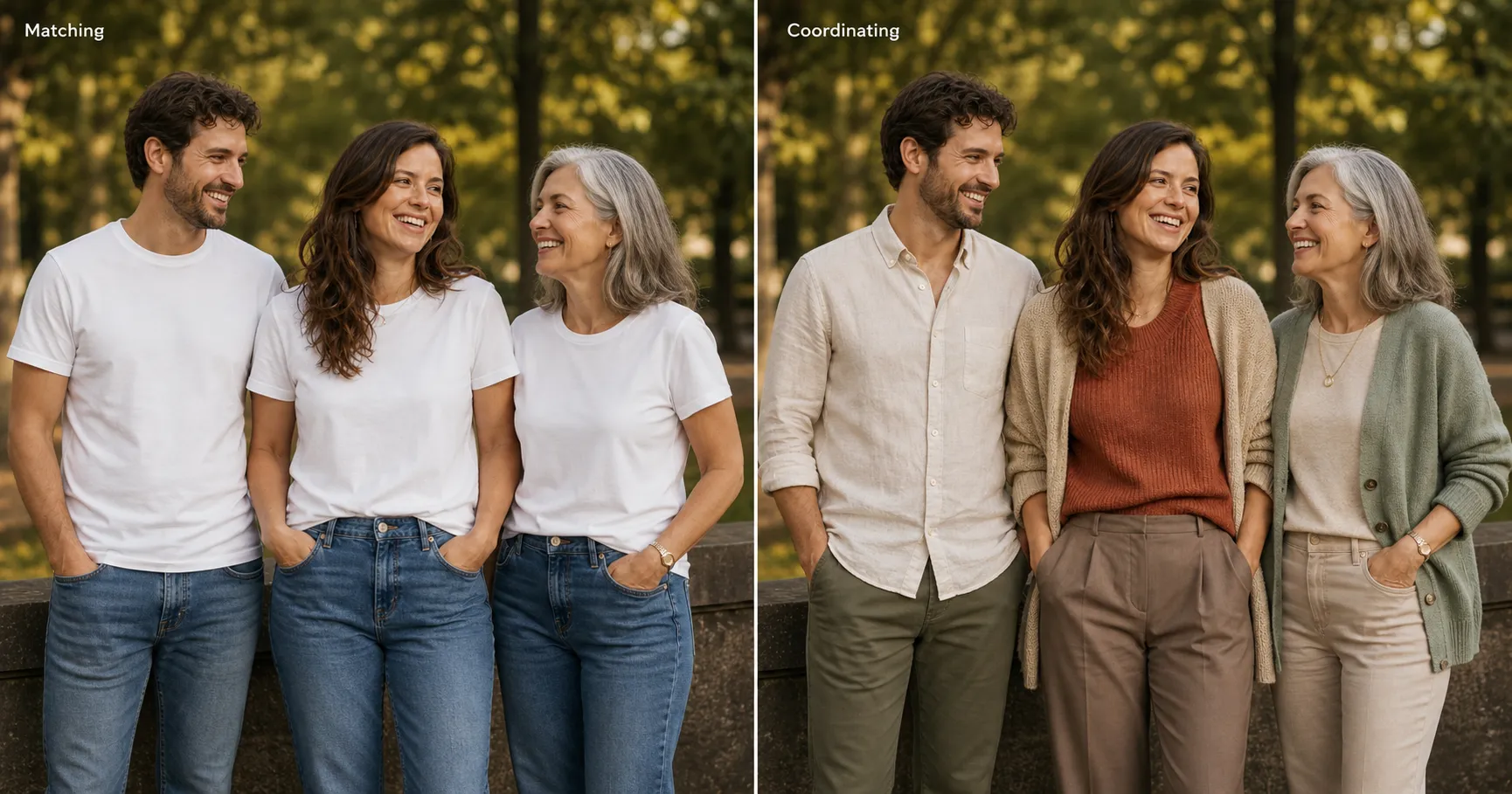
Pick two to three colors that live in one tone family, then build everything from that small set. N. Lalor Photography, a portrait studio that dresses clients for a living, frames the whole job as establishing one unified color theme and keeping everyone at a similar level of brightness. Warm earth tones are the easy default because they agree with each other. The palette is also what carries you when other people are in the frame: everyone shares it, but each person leads with a different color from it. That is the difference between coordinating and matching, and it is its own subject for couples and families, linked below.
Rule 4: Dress for the light and the place
The same outfit answers the room. Soft directional light is kind to almost everything; harsh midday sun is not, and a busy backdrop wants a calmer outfit so you do not disappear into it. Both Flytographer and Jeanne Sager warn against blending into the background or showing up dressed for the wrong setting, so think about your backdrop and your weather before anything clever. A field of green grass, a pale stone wall, and a dim living room each ask for a different answer from the same palette.
What the Camera Always Punishes
Some clothes look fine in the mirror and fall apart in the photo. The mirror shows you the color. The camera shows you the color, plus the light bouncing off it, plus the limits of the sensor. A few things lose that fight in every kind of photo, so clear them once and they are handled for every occasion.
The white one surprises people, so it is worth the detail. Canon’s own guide to dynamic range explains that a sensor can hold only so much range between bright and dark, and a blown-out highlight is gone for good, with no detail left to recover. Bright white reflects light straight back and clips first, which is why a crisp white shirt turns into a flat white shape. Cream and ivory give you the same light feel without the blowout.
The color-cast problem is just as real. As Fstoppers points out, a saturated top throws its own color onto your skin and leaves a cast on the face that reads unnatural and pulls focus off your expression. And tight repeating patterns shimmer: Photography Life explains that fine stripes and small checks interfere with the sensor’s pixel grid to create moiré, and it shows up more now that many cameras have dropped the filter that used to soften it.
One paste-ready AI move a week, the kind you can use on a Tuesday or a Sunday. Subscribe to the newsletter and the Independent Brand Visual Kit, a set of copy-ready photo prompts, is yours free: join here.
Then Adjust for the Occasion
The four rules do not change from one kind of photo to the next. The occasion only turns the dials: how many people share the palette, which cuts flatter, how dressy you go. That is the whole job of this page, to hand you the universal answer and then point you at the exact guide for your shoot.
| Occasion | What stays the same | What the occasion changes | Go deeper |
|---|---|---|---|
| Engagement or couples | Four rules, one palette | Coordinate, don’t match, since two people share every frame | What to wear for engagement photos |
| Family pictures | Four rules, one palette | More people, one tone-setter outfit everyone else builds around | What to wear for family pictures |
| Maternity photos | Four rules, one palette | Bump-flattering cuts and seasonal colors that suit you | What to wear for maternity photos |
| Senior pictures | Four rules, one palette | A few looks with room for personality, plus the framework people ask about by name | What to wear for senior pictures |
| Any occasion, by color | Four rules | Which exact colors suit your skin tone, and which to avoid | What colors to wear in photos |
The wardrobe is half of looking good in a photo. The other half is angle, light, and expression, covered in how to be photogenic, and what to do with your body once the camera is up, in photo poses and ideas.
And if those photos are happening at a wedding you are attending, dressing as a guest is a different question from what flatters the camera. It comes with its own etiquette, from decoding the dress code to the one color you never wear: see what to wear to a wedding as a guest.
FAQ
Q: What is the best color to wear for pictures?
A: There is no single best color. The best one suits your skin, suits your location, and sits in the same family as whoever you are standing next to. Soft, muted tones and warm neutrals photograph reliably well for most people. The full logic, including which colors suit which skin tone and which to avoid, is in our guide on what colors to wear in photos.
Q: What colors don’t look good on camera?
A: Three groups cause trouble. Pure bright white reflects light and blows out to a flat patch, and a clipped highlight can’t be recovered, per Canon’s dynamic-range guidance. Neon and hot-saturated colors bounce their color onto your skin and leave an unnatural cast, as Fstoppers shows. And greens can blend into grass or foliage in the background. Reach for the muted version of any color you love.
Q: What is the 3-3-3 rule for clothes?
A: It is not a fixed, standard photography rule, so be careful with it. People use it loosely to mean balancing your outfit in thirds or planning a small set of coordinated pieces. For the specific framework that gets attached to this question for younger subjects, see our guide on what to wear for senior pictures. The dependable version for any photo is simpler: make it fit, keep it solid, stay in one small palette, and dress for the light and the place.
Q: What clothes look best in photos?
A: Clothes that fit you cleanly, in solid colors or one loose pattern, pulled from a single palette of two to three colors. Flytographer’s stylists put fit and comfort first, because discomfort shows in the frame. Add texture like knit, linen, or denim so solids gain depth, and skip pure white, neon, tight fine patterns, and big logos.
Q: Do I have to coordinate with the other people in the photo?
A: If anyone is in the frame with you, yes, and the rule is coordinate, don’t match. Everyone shares one palette of two to three colors, but each person leads with a different color from it. Matching outfits read as a uniform, as photographer N. Lalor and Flytographer both point out. For family-specific coordination, see our guide on what to wear for family pictures.
Key Takeaways
- Four rules cover every photo: make it fit, keep it solid, stay in one small palette, and dress for the light and the place.
- Fit beats the “perfect” color. Wear what fits and lets you move, and you probably already own it.
- Skip what the camera punishes: pure white, neon, tight fine patterns, big logos, and head-to-toe black next to white.
- One palette of two to three colors carries the whole outfit, and lets a group coordinate instead of match.
- The rules never change by occasion. Only the dial settings do, which is why this page points you to the right specific guide.
One Last Check Before the Shoot
Lay the outfit on the bed and look at it the way the camera will, not the way the mirror does. Does it actually fit? Is it solid, or fighting your face with a busy print? Does it sit inside one small palette? And does it suit the light and the place you are headed?
If you want to see yourself camera-ready before the day, you can turn one selfie into an AI photoshoot and preview how a well-lit, well-dressed version of you comes together. And if you are torn between two outfits, see each one on you first, dressed for the occasion you are shooting for, so the wardrobe is settled before you arrive.
Which of these four rules is the one your outfit is currently breaking?